
Personalized Marketing: Use Relevant Facts, Not Confident Guesses
Personalized marketing adapts a message or experience to a known need. The most useful differences often come from a chosen topic, an existing product, a stated location or the task someone is trying to complete. Start with information you can explain and maintain, then decide whether changing the experience will help the reader.
This guide focuses on practical business marketing. Examples are illustrative, and linked documentation was reviewed on September 23, 2026.
Find the decision worth personalizing
Begin with the friction in the current experience. A customer may have to search through instructions for products they do not own. An event subscriber may see invitations in places they cannot attend. A prospect may receive an introductory explanation after already asking a detailed buying question. Those are concrete opportunities to make content more relevant.
Name the task before choosing the data. If the task is finding the right maintenance guide, the product model matters. A first name or inferred personality type probably does not. Collecting more fields can increase maintenance work without making the answer more useful.
Distinguish relevance from familiarity. Mentioning a person's hometown may feel personal while adding nothing to a business proposal. Explaining how a service applies to the work their company publicly describes gives them a reason to evaluate it. Use the detail because it changes the recommendation, not because it proves you found a profile.
For a small team, choose one place to start. A more useful welcome message or a topic-specific resource page may be easier to maintain than a complex website that changes for every visitor. Define the improvement in reader terms so you can later assess whether it happened.
Separate declared facts, observed events and inference
A selected preference is different from an observed click, and both are different from an inferred need. Keep those categories visible in your records. Someone choosing “commercial projects” has made a direct statement. Someone clicking one commercial-project example may simply be curious. Treating the two as equally certain can lead to awkward messages.
Record where important information came from and when it was checked. A business website can support an observation about advertised services. A contact's reply can support a statement about their role. An old directory label may need confirmation. The business database guide explains how to preserve provenance while maintaining useful account records.
Give uncertain information a safe use. An inferred topic might influence which optional resource you suggest, with a visible preference choice. It should not become a confident assertion that the person has a particular problem. Avoid wording such as “We know your team is struggling with scheduling” unless they actually told you that.
Use the minimum information needed for the task. Sensitive personal characteristics rarely belong in an ordinary B2B content decision. A reader should be able to ask why they received something and receive a clear answer based on the relationship and preferences they understand.
Design a small set of useful experiences
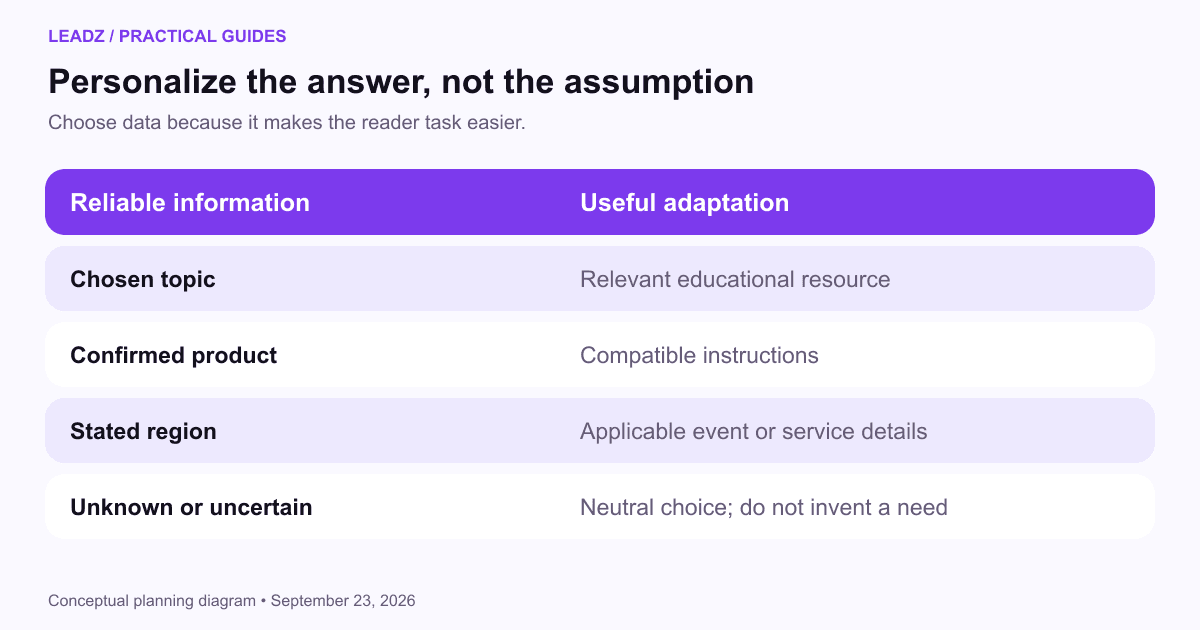
Consider a hypothetical equipment supplier. Customers who own a confirmed product can receive its maintenance guide. Subscribers who selected a trade can receive relevant application examples. Readers with no preference can choose a topic. Each variation has a reason and a fallback.
Known information | Useful adaptation | Avoid assuming |
|---|---|---|
Confirmed product owned | Compatible instructions and accessories | The customer wants an upgrade now |
Chosen content topic | A relevant article or workshop | Immediate buying intent |
Stated service region | Applicable event or coverage details | Home location or travel plans |
No reliable preference | Clear topic choices | A guessed personal need |
Keep the main offer understandable across variants. If every recipient sees different promises or exclusions, the sales team may struggle to explain what was communicated. For important changes, save the content version and rule so the team can reconstruct the message later.
Do not personalize away information people need to make a fair comparison. Relevant content can help someone navigate; it should not hide material conditions. The same principle applies to preference controls: every version needs an understandable route to change the relationship or stop promotional messages.
Apply personalization differently across channels
In email, a small conditional block can replace irrelevant material with a useful resource. Mailchimp's dynamic-content documentation describes audience conditions for showing or hiding blocks. The dynamic email guide covers rule priority, fallback content and previewing the complete rendered message.
On a website, preserve an easy way to change the selected context. If a visitor chooses commercial services, do not make residential information impossible to find later. Shared devices, changed needs and exploratory browsing mean a remembered choice should remain a convenience rather than a trap.
In direct business outreach, research should shape the reason for contact. A supplier approaching accounting firms, for example, should establish whether its offer serves the work those firms actually perform. A business category and a reported title do not prove a current need or purchasing authority.
For customer service, use known history to avoid making someone repeat information, but confirm details that may have changed. An old installation address or contact role can become wrong. A short confirmation is often more helpful than confidently acting on stale information.
Test the rules, language and missing-data cases
Create test records for each intended experience, including missing, conflicting and outdated values. Read every complete message. A correct content block can still sit beneath an unsuitable subject line or lead to the wrong destination. Check the whole task from selection through the next action.
Pay attention to language that exposes an inference as fact. “You selected updates about commercial installations” is appropriate when the preference record supports it. “Your company is expanding its installation team” needs separate evidence. A template can make an unsupported statement at scale if nobody reviews the underlying field meaning.
Check whether preference changes survive imports and integrations. If a subscriber deliberately chooses a new topic, a nightly synchronization should not overwrite it with an old inferred segment. Define which source wins and assign an owner for conflicts.
Inspect stale content as well as stale data. A tailored product recommendation can be wrong because the product is no longer available, even when the customer record is accurate. Keep availability and eligibility checks close to the sending process when they affect the offer.
Measure usefulness without confusing audience differences
Set an outcome connected to the adaptation. If the purpose is helping customers find instructions, measure successful access or a reduction in the relevant support question where you can do so responsibly. If the purpose is event relevance, look at suitable registrations and attendance. More clicks alone may not mean the experience improved.
Compare like with like. A customer group and a prospect group start with different relationships. Their response rates cannot establish which version of an email is better. A planned comparison within a comparable audience is more informative; see the A/B testing guide for design considerations.
Suppose an illustrative test assigns 400 comparable subscribers to a general guide and 400 to a topic-selected guide. If 24 and 32 people complete the intended resource action, the observed rates are 6% and 8%. That is a two-percentage-point difference. The counts still need uncertainty assessment before anyone calls the improvement dependable.
Review qualitative feedback and errors. A small number of recipients saying the information is wrong may expose a field-definition problem. Fixing that problem can matter more than a modest average response increase. Keep complaints, incorrect recommendations and preference failures in the evaluation.
Maintain a personalization policy the team can use
An illustrative rule register might contain three entries. Confirmed product ownership selects the maintenance instructions; the service team owns corrections. A subscriber-selected topic chooses the educational block; the subscriber can change it through preferences. A single page visit is used only as aggregate content feedback, not as a sentence asserting personal need. Those choices give the writer a clear boundary for what can appear in copy.
Include a removal path for data that no longer serves the task. An old event location may have been useful for attendance reminders and unnecessary afterward. Decide what should be retained for legitimate records and what should stop influencing marketing. Keeping every historical field active can make personalization less accurate even as the database becomes larger.
Document the fields you use, their sources, allowed purposes and fallback behavior. Keep the document practical: which data supports a topic choice, which requires confirmation and which should not be used in marketing. A short policy helps writers avoid turning every available field into a sentence.
Assign review responsibilities. Marketing owns the content rule, operations may own product eligibility and a systems colleague may own synchronization. Name who can pause a rule when data becomes unreliable. A neutral general version is useful when a personalized branch cannot be trusted.
Review active rules when products, services or audience promises change. Remove variations that no longer help. The cost of personalization includes writing, testing and maintaining the differences, so retire complexity that produces little reader value.
Choose your first improvement from a repeated customer question. Replace the unnecessary search, irrelevant example or repeated form field with a clear answer based on reliable information. Personalization works best when the reader experiences less effort and can still understand and control the relationship.