
Lead Qualification: Separate Account Fit, Contact Evidence and Intent
A suitable business is not automatically a sales opportunity. Qualification should show whether the account fits your offer, whether there is an appropriate contact route and whether someone has expressed a relevant need. Keep those judgments separate so a complete-looking record does not become an unsupported claim that a buyer is ready.
Use the qualification scorecard CSV as a starting record. Its examples are illustrative, and your team must define criteria for its own offer. Current documentation was reviewed on September 23, 2026.
Define the account before scoring the contact
Start with the business problem your offer solves. A project-photography agency might research architecture practices that publish completed commercial work within a workable travel area. That is a reason to investigate the account. It does not prove that the practice has a current project, a photography budget or a person ready to hire.
Write the minimum account criteria in observable terms. The business advertises a relevant service, operates in the territory and has work that matches your capabilities. Avoid criteria that depend on guessing revenue, staffing or internal priorities from a category label. If a criterion matters but is unknown, give it a research task.
Name disqualifiers explicitly. An existing exclusion, an incompatible territory or a service you cannot support may stop the process regardless of other attractive features. Keep those rules visible so a high total score cannot override a condition that makes the account unsuitable.
A directory of architecture businesses can supply research candidates. Inspect the practice's own work and contact instructions before deciding how to proceed. The business database guide explains how to keep the account record and evidence organized.
Treat contact availability as a separate question
An email field means an address is available in the record. A phone field means there is a number to investigate. Neither identifies the budget owner or establishes the recipient's interest in your offer. Keep availability separate from the quality and appropriateness of the route.
Review the business's stated contact process. A supplier enquiry may belong in a shared inbox, while a project discussion may have a named contact. A shared address is not automatically inferior to a named person. It may be the organization's intended route for that purpose.
Where exported person profiles are available, Leadz can include names, reported roles and LinkedIn profiles associated with individual email addresses. Keep those associations intact. The person information should remain tied to the address it describes and should not be copied across every email in the business row.
The email availability guide explains the distinction between businesses with email, distinct addresses and technical address checks. Qualification adds another question: is this a suitable route for the proposed conversation? A technically usable address can still be the wrong recipient.
Record role evidence without inventing authority
A job title provides context, but purchasing involvement depends on the decision. A marketing coordinator may organize a photography project while a partner approves the budget. An operations manager may handle a software review without signing the agreement. Map the roles relevant to your offer rather than searching for a universal “decision maker.”
Record the evidence and date. A website team page, a current professional profile and a direct reply are different sources with different limits. If someone confirms that they manage a supplier review, preserve that statement as a dated observation. Do not upgrade a reported title into confirmed authority without a conversation.
Use an unknown state. A blank role field should remain blank until research or the recipient provides information. Guessing from a name, email pattern or company size makes the record look more complete while making the next action less dependable.
Ask routing questions that the organization can answer. “Who coordinates photography for completed projects?” is more specific than “Who is the decision maker?” The answer may identify a process rather than a person. Record that process and follow it.
Build a scorecard with gates and separate evidence
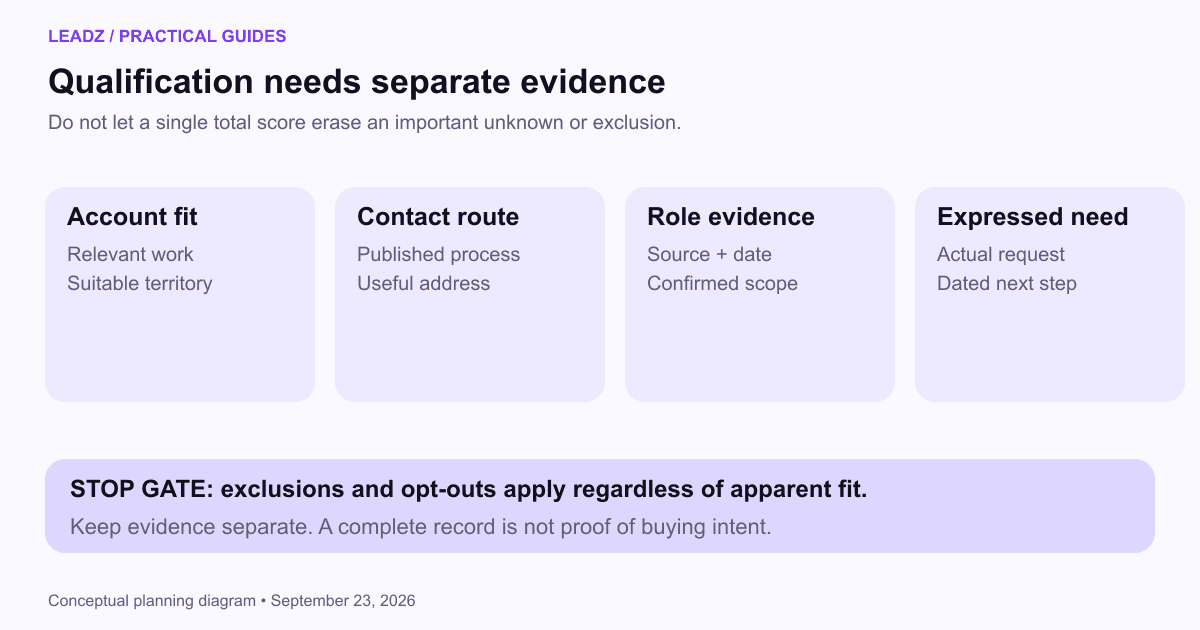
Use the scorecard to guide work, not to create an impressive number. Some conditions are gates: an opt-out or an incompatible territory stops outreach. Other fields identify research still needed. Expressed buying intent belongs in a dated note supported by an actual interaction.
Dimension | Example evidence | Appropriate outcome |
|---|---|---|
Account fit | Relevant projects and service territory | Approve for further research |
Contact route | Published project-enquiry process | Use or investigate that route |
Role evidence | Person confirms coordination responsibility | Record the scope of involvement |
Expressed need | Requests a discussion about a named project | Review as a potential opportunity |
Suppression | Prior stop request | Exclude from outreach |
The interactive qualification check can help review fit, route, role and suppression. It does not infer a budget or create buying intent. Use the result to decide the next task, then retain the underlying evidence in your working system.
If your team uses points, document what each point means and which gates override the total. Two researchers should reach similar decisions from the same record. When they disagree, improve the definitions instead of averaging scores that represent different judgments.
Work through a realistic account example
Consider a fictional architecture practice with a public portfolio of commercial projects. Its site lists a general project inbox, and a team page names a marketing coordinator. The practice is in the agency's travel area. Those facts support researching the account and its contact process; they do not establish a current photography requirement.
The agency sends an appropriate enquiry through the stated route, and the coordinator replies that a project will be completed later in the year. They ask for a portfolio relevant to occupied buildings and explain that a partner approves commissions. The record can now show a stated future need, the coordinator's role and a separate approval role.
If the coordinator agrees to a discussion after a completion date is confirmed, create that task with an owner. Do not count the account as a booked project or confirmed revenue. The timing and scope remain uncertain until the relevant steps occur.
Now imagine a second practice with a larger portfolio but no appropriate contact route and a prior request not to be approached. It should remain excluded despite apparent account fit. Qualification must preserve that decision when fresh data is imported, or the scorecard is not controlling the process it claims to support.
Connect qualification to sales stages
Define what qualifies an account for research, a contact for outreach and a conversation for opportunity review. These are different transitions. A person downloading a resource may become a subscriber while providing no evidence of an active project. A request for a scope discussion provides a stronger reason for sales involvement.
HubSpot's lifecycle-stage documentation describes a system for tracking relationship stages. Your business still needs written entry criteria and an owner for each change. A tool moving a contact automatically does not mean the account has passed a human fit review.
Agree the handoff information. Sales should receive the business context, relevant evidence, person's request, unresolved questions and next promised action. A score without those details forces the receiving colleague to repeat research or make assumptions.
Record why an opportunity is returned or declined. Wrong service, unsuitable timing, no confirmed need and missing information call for different actions. Keep “unknown” when the reason is not provided. A neat report built from invented rejection reasons will misdirect future targeting.
Check consistency and maintain the evidence
Use a short calibration exercise before assigning a large research batch. Give two reviewers the same five fictional or appropriately handled records: a clear fit, an unsuitable account, a strong account with an unknown role, a current customer and an excluded contact. Ask for the next action and supporting evidence, not just a score. Discuss why the decisions differ and revise the instructions where needed.
Pay special attention to records with mixed evidence. A suitable account with an unknown recipient should usually create a routing task, while an unsuitable account with a senior named contact should not pass merely because the contact looks valuable. Keeping those examples in the training notes makes the scorecard easier to apply when real records are less tidy than the template.
Keep corrections attached to the record that prompted them. If a reviewer discovers that a practice has moved outside your territory, update the account evidence and any queued outreach task together. A corrected worksheet is little help if a separate campaign still uses the earlier approval.
Track the workload created by the scorecard. A criterion that requires extensive research for every account should justify its value. You may decide to use an inexpensive first pass, then investigate a smaller group more deeply. The contact-sample review guide helps assess data before committing to a large batch.
Recheck evidence when circumstances change. A new campaign, changed territory, long delay or failed contact route may make an old decision unreliable. Preserve earlier findings and exclusions so a refreshed record does not erase useful history.
At the next campaign review, compare qualified accounts with the conversations they produced. Look for criteria that repeatedly admit unsuitable businesses or exclude appropriate ones. Adjust the definitions deliberately and document the change. Qualification is useful when it improves the next decision, not when it merely gives every row a score.