
Email A/B Testing: Ask One Question and Keep the Counts
An email A/B test compares two versions under sufficiently similar conditions to inform a decision. Write the question first, randomly assign comparable recipients, choose the outcome and observation window, then keep the underlying counts. A small lead in a dashboard is a result to assess, not automatic proof that one version is better.
This guide uses illustrative newsletter experiments. It covers practical test design rather than promising a universal sample size. Official product and privacy documentation was reviewed on September 23, 2026.
Turn a vague improvement goal into a testable question
“Improve engagement” can mean more opens, clicks, replies, registrations or sales. Those outcomes require different tests. Start with a decision the result could change: should a workshop invitation lead with the practical exercise or the speaker's background? The question names a meaningful difference and connects it to why someone would attend.
Choose one primary outcome. For the workshop, registration may be the best measure if enough registrations are expected to support learning. A click can provide earlier context, but it should not quietly replace the intended outcome after the results arrive. Write down the event definition, source system and reporting cutoff.
State the hypothesis in plain language. “Readers who understand the exercise may be more likely to register” is enough. Avoid inventing a precise improvement target without evidence. Decide what size of change would matter operationally, since a tiny numerical difference may not justify rebuilding a template or increasing maintenance work.
The campaign metrics guide helps define rates before testing them. Make sure the team agrees whether the denominator is assigned recipients, attempted messages or accepted messages. Each can answer a legitimate question, but switching between them changes the interpretation.
Change one meaningful element and hold the rest steady
If you test the main argument, keep the sender, audience rules, send timing and destination consistent where practical. Otherwise a difference in response could come from another change. You do not need every word to be identical; you do need the versions to express the planned contrast clearly.
For example, version A could introduce the workshop through a specific exercise, while version B introduces the speaker's relevant experience. Both should provide the same date, duration, registration process and event scope. If one version also offers a discount, the result no longer isolates the original question.
Mailchimp's A/B test documentation supports testing selected email variables and advises using clicks rather than opens when comparing body content. The body is encountered after opening. Check which options your platform actually supports, and do not assume an automatic winner setting matches your business objective.
Keep variants identifiable without revealing the hypothesis to recipients. Use internal campaign labels and preserve both final versions. A later reviewer should be able to see exactly what changed. A label such as “new copy” is less useful than a saved message and a short description of the intended contrast.
If the template contains conditional blocks, preview their possible versions before running the experiment. The dynamic-content testing workflow helps check missing values and rule priority, so an accidental personalization difference does not become an unplanned test variable.
Assign recipients without mixing audiences
Random assignment helps distribute ordinary differences between recipients across the versions. Do not give the new version to your most active subscribers and the old version to everyone else. That compares audiences as well as content. Likewise, sending one version on Monday and the other after a major announcement changes the conditions.
Choose the unit of assignment. If several contacts at one company may discuss the message, assigning at account level can avoid colleagues receiving conflicting versions. For a general subscriber newsletter, recipient-level assignment may be appropriate. Record the choice so later analysis counts the same unit.
Exclude people who should not receive the campaign before splitting the audience. Suppressions, internal tests and duplicate records should not be cleaned differently in each group. If a person can appear under several addresses, decide how that affects assignment and interpretation.
Check group sizes and basic characteristics before sending. You may see some imbalance by chance, particularly in small groups. Document substantial differences rather than quietly rearranging recipients until the groups look favorable. A planned stratified design is different from making ad hoc changes after seeing outcomes.
Plan the sample and stopping rule
There is no sample size that makes every email test reliable. The baseline event rate, minimum useful difference and desired uncertainty determine how much evidence is needed. Rare outcomes such as purchases generally require more observations than common actions. Ask someone with statistical expertise to review high-stakes experiments.
Small teams can still learn, but should name the limits. A pilot can reveal broken links, confusing copy or obvious audience mismatch before it can establish a modest lift. Qualitative replies can explain a problem even when a percentage comparison is inconclusive. Do not attach a certainty label that the design cannot support.
Choose the observation window before sending. A registration email may need several days because recipients consult calendars. A same-day cutoff can favor immediate reactions while missing later decisions. Keep the same window for both versions and record whether any messages were delayed or resent.
Avoid repeatedly checking the dashboard and stopping as soon as a preferred version leads. That practice changes the error behavior of an ordinary fixed-sample test. If ongoing monitoring and early stopping are necessary, use a method designed for that purpose and document it. Otherwise complete the planned window and evaluate once.
Read a worked comparison carefully
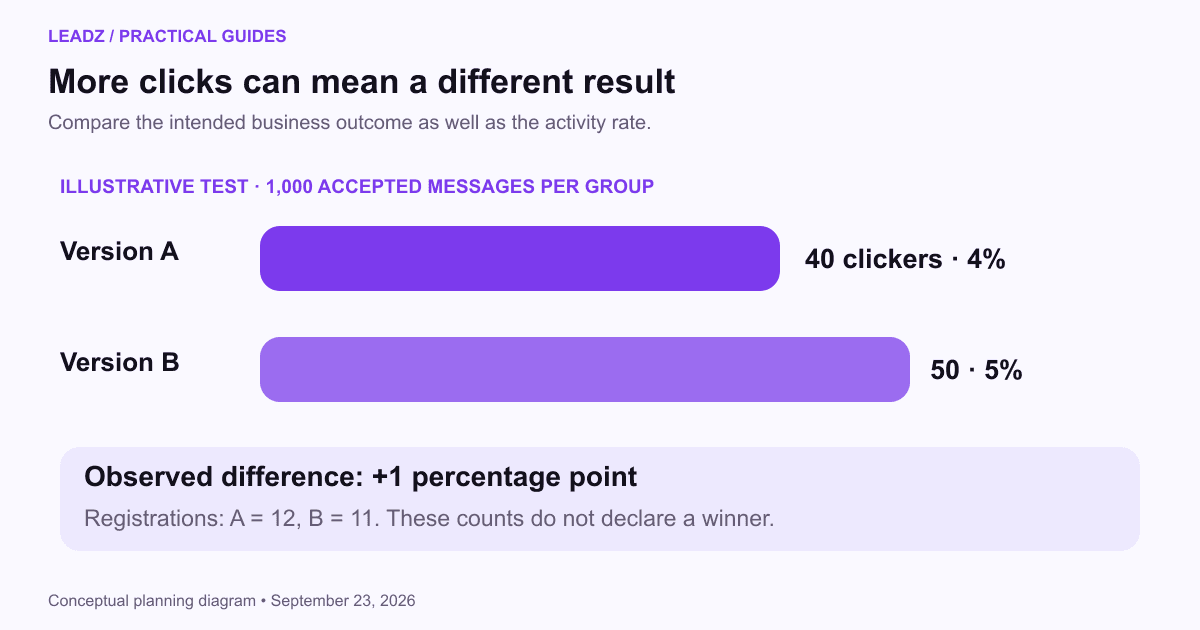
Suppose each version has 1,000 accepted messages. Version A records 40 distinct clickers and version B records 50. These hypothetical results yield 4% and 5% click rates. The absolute difference is one percentage point, and the relative difference is 25% because one divided by four is one quarter.
Measure | Version A | Version B |
|---|---|---|
Accepted messages | 1,000 | 1,000 |
Distinct clickers | 40 | 50 |
Click rate | 4% | 5% |
Completed registrations | 12 | 11 |
The click result and registration result point in different directions. If registration was the primary outcome, B cannot be declared the business winner merely because more people clicked. It may have attracted curiosity without helping the right readers decide to attend. It is also possible that the small registration difference reflects ordinary variation.
This table alone does not establish statistical significance or a dependable lift. Preserve the counts for an appropriate uncertainty analysis and inspect whether the tracking was complete. The example's purpose is to show why absolute change, relative change and downstream action need separate labels.
Record inconclusive results honestly. You can retain the simpler version, improve the event explanation or design another test addressing a specific question. “No decision from this test” is more useful than turning ten additional clicks into a universal copywriting rule.
Check measurement problems before interpreting behavior
Apple's Mail Privacy Protection guidance limits what senders can infer about opens. A subject-line test based entirely on open events therefore needs careful interpretation. Do not assume that every counted event represents a person choosing to read.
Automated security systems can also affect link activity. Use your platform's documented filtering consistently across variants and inspect unusual patterns before classifying clicks as interest. If tracking differs between versions, fix the reporting problem before drawing a content conclusion.
Verify landing-page attribution. Campaign parameters can identify visits, but a visitor may register later or on another device. Google's campaign URL guidance explains the link-labeling mechanism; it does not make every downstream outcome observable. Keep known attribution gaps in the interpretation.
Review unintended harms alongside the primary outcome. Complaints, unsubscribes and confusing replies may reveal that an attention-grabbing version created the wrong expectation. Do not optimize a click measure in isolation from the relationship the campaign is meant to maintain.
Keep a test record that changes future decisions
Write the decision separately from the result. For the example above, the result is that B produced ten more clickers and one fewer registration. A reasonable decision could be to retain the current invitation while investigating whether the new introduction attracted people who misunderstood the event. That decision uses the evidence without claiming the experiment proved the explanation.
Keep failed experiments in the same register. A test interrupted by a broken form can still teach the team which operational checks were missing, but it should not enter a library of winning copy. Label the failure and explain whether any portion of the data remains interpretable. This prevents an attractive partial result from resurfacing later without its context.
Save the question, versions, assignment method, audience rules, counts, window and decision in one place. Add operational exceptions such as a delayed send or unavailable landing page. Those notes determine whether another campaign can reasonably use the finding.
Repeat useful findings in another comparable campaign before treating them as a broad principle. The stronger invitation for one event may not be stronger for a product tutorial. The campaign-types guide shows why messages with different jobs need different measures and expectations.
Use a test to improve a specific part of the process. If the evidence suggests readers need the practical agenda sooner, adjust that element and retain the rest of the invitation. If the result is unclear, gather better evidence rather than making a large redesign merely to show activity.
Choose the next experiment from unanswered reader questions. Test an explanation, a useful action or a meaningful format. A long series of cosmetic tests can consume time while the offer remains unclear. The most valuable result is a decision your team can explain, reproduce and apply within the limits of the evidence.