
How to Market Services to Doctors and Medical Practices
Marketing a service to doctors begins with the medical practice's purchasing task, not with a guess about what every physician needs. Define the operational problem, identify the practice or organization that could buy the service and confirm the role responsible for evaluating it. A physician's name or an office email alone does not establish buying authority.
This guide is for vendors and agencies selling to medical practices. Patient acquisition, treatment advice and promotion of clinical products require their own appropriate review and are not interchangeable with this business prospecting workflow.
Define the service and its boundary
Describe the work in terms a practice can assess. “Improve efficiency” leaves too much unanswered. “Maintain approved location and appointment instructions across four practice pages” defines a more specific administrative task. The practice can then ask about staffing, approvals, access and cost.
Separate operational claims from clinical claims. If your service changes scheduling instructions, demonstrate the information workflow. Do not imply that it improves diagnoses or health outcomes. If your offer involves a health-related product, the FTC's health products guidance explains the need for appropriate support for health claims; obtain qualified review before making them.
Write down what the project excludes. A website maintenance service might exclude clinical content approval, payer contracting and handling patient records. These boundaries clarify responsibilities rather than weakening the offer. They also help the practice route the inquiry to the correct reviewer.
Choose a segment whose operating model fits the service. Independent practices, multi-location groups and hospital-owned offices may have different approval structures. Do not assume a physician listed at one office can authorize a supplier for the entire organization. The account definition should reflect the entity that can actually contract with you.
When the buyer is a hospital or health system, use the hospital supplier workflow to map the institutional review process. For a service aimed specifically at chiropractic offices, the chiropractic practice prospecting guide shows how to narrow the account definition and keep operational claims separate from clinical assertions.
Distinguish the practice, professional and buying role
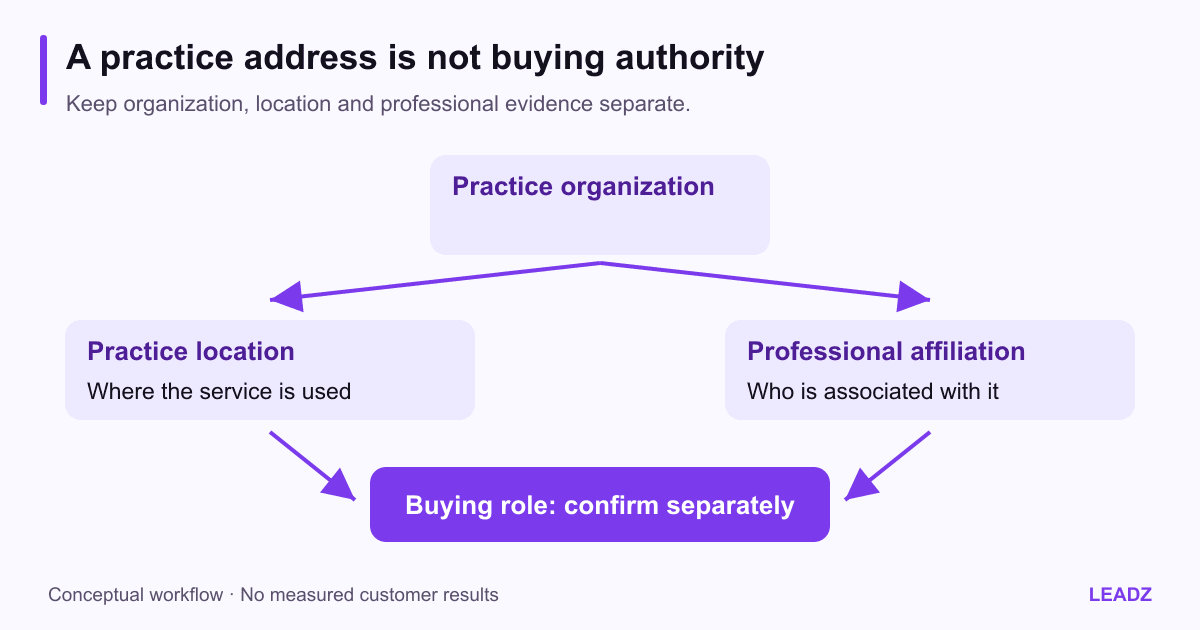
A practice location tells you where services are delivered or administration occurs. An organization can encompass several locations. A named professional may work across those locations. The buying role is the person or team responsible for your particular service. These identities can overlap, but your research should not force them into a single record.
Start with medical practice business records or a more relevant category, then review the practice's own website. Check locations, service descriptions and the published business-inquiry route. Use the category as a discovery aid, not as proof of an individual's current specialty, credentials or purchasing responsibility.
Leadz exports can include available names and roles associated with saved email profiles. That information can support research when present. It does not establish that a named professional works at every listed branch or receives every general-office message. The practice records versus physician contacts guide explains how to select the appropriate data unit.
Keep an evidence note for every relationship you rely on. “Website identifies this office as part of the group” is useful. “Likely owner because the name appears first” is a guess. A clean distinction between known and unknown information improves both the first message and the handoff to a salesperson.
Research the workflow without collecting patient information
Use public business information to identify a plausible operational fit. For a location-information service, inspect location pages and public instructions. For equipment maintenance, check the organization's stated supplier process and relevant service scope. Do not ask reception staff to disclose patient details as proof that a sales opportunity exists.
Prepare questions about the workflow: who maintains the information, how a change is approved, what systems are involved and what constraints a supplier must respect. These questions help determine fit without assuming that a visible inconvenience represents a major internal problem.
Keep patient information out of prospecting notes, sample demonstrations and ordinary marketing tools. HHS guidance on marketing and protected health information addresses permissions for uses and disclosures of PHI. A public business-contact source does not provide those permissions or turn a patient-data use into routine vendor prospecting.
If an eventual engagement requires sensitive information, let the practice's authorized reviewers define the access, contractual and security requirements before it begins. During sales, use fictional examples and a clear description of what the system would do. Do not describe a product as compliant or certified unless the claim has a sound, appropriately reviewed basis.
Make the first message easy to route
Ask about responsibility instead of trying to bypass administrative staff. An office manager may understand the process you want to improve and know who can assess it. Treat that person as a participant in the buying process, not an obstacle to reaching a physician.
A fictional introduction might say: “Your practice lists four locations with separate appointment instructions. We help groups maintain approved public information consistently. Who coordinates website updates for the organization?” This establishes relevance and asks one limited question. It does not claim that the practice is losing patients or that you have audited its internal systems.
Use the organization's published business-inquiry process. If supplier registration or a central procurement route is specified, follow it. Avoid presenting a sales message as a patient request, and do not send the same proposal to every professional whose name is visible online.
The B2B outreach guide provides a structure for follow-up. Adapt it to the practice's response and preferences. An introduction to another employee is not permission for an unlimited sequence across the organization, and an available contact field is not a guarantee that a particular channel is appropriate.
Give each reviewer the evidence they need
Different reviewers may need different information. The operational owner wants to understand the workflow. A technical reviewer may need system and access details. A financial approver needs costs and commitments. A professional reviewer may need to approve public claims. Present these as possible needs and confirm the actual process with the organization.
Create a compact evaluation package: scope, sample output, required practice input, implementation steps, support arrangements and known limitations. If you have relevant results you are authorized to share, describe how they were measured. If you do not, use a labeled demonstration instead of inventing a medical-practice case study.
For a service involving telehealth information, be precise about the communications work you provide. The telemedicine communication guide explains why eligibility, appointment preparation and help routes need clear presentation. A vendor should not make universal claims about which patients can receive remote care or what a payer will cover.
Document the approval path in the proposal. State which content the practice supplies, which claims it reviews and when publication can occur. This makes review effort visible in the schedule and prevents a sales commitment from becoming pressure to bypass a necessary check.
Test a bounded pilot and count real progression
Consider a hypothetical vendor researching 36 practices for a public-information maintenance service. Nine belong to organizations with a different purchasing route, seven fall outside the service scope and four require more identity research. Sixteen remain suitable for a first business inquiry. These are illustrative screening outcomes, not a typical database yield.
If the vendor spends six hours on research at an internal planning cost of $40 per hour, the research cost is $240, or $15 per suitable account. Data access, outreach preparation and meetings add further costs. The purpose of the calculation is to reveal the work behind a shortlist, not to predict a close rate.
For a pilot engagement, choose a limited deliverable and an agreed completion measure. Updating approved information across two locations can be assessed directly. Changes in patient volume or clinical outcomes cannot automatically be attributed to that work. Keep operational completion separate from wider business results.
Use the qualification framework to distinguish a relevant account, a confirmed role, an expressed need and an authorized purchase process. Reporting all four as “leads” hides the work remaining and makes the sales forecast less useful.
Maintain an account brief, not a collection of assumptions
Keep one current account brief with the organization, locations, appropriate contacts, supporting sources, research date, prior responses and next question. Preserve uncertain information as uncertain. When a contact changes roles, update the relationship without deleting the history that explains earlier conversations.
Reconcile the shortlist with existing customers, active opportunities and suppression records before each campaign. Group branches appropriately so multiple teammates do not contact one central office independently. The deduplication workflow offers a method for retaining locations while coordinating the account.
Review whether your original service definition remains useful. If conversations repeatedly reveal a different problem, do not simply rewrite the pitch to claim your product solves it. Assess whether you can deliver the required work, then adjust the segment or scope deliberately.
Begin with a small number of practices whose operating needs plausibly match your service. Confirm the buying route, show a bounded demonstration and let the organization evaluate the evidence. That is a sounder basis for selling to medical practices than stereotypes about doctors, exaggerated growth claims or a list presented as guaranteed access to decision-makers.