
How to Advertise Services to Chiropractic Practices
Selling to a chiropractic practice starts with a specific operational problem you can help solve: reception workload, equipment purchasing, website maintenance or another clearly defined task. Build your campaign around that problem, the practices you can serve and the person responsible for evaluating a supplier. A directory category alone does not establish any of those three things.
This guide is for businesses advertising to chiropractic practices. It does not offer treatment advice or suggest clinical claims for attracting patients.
Choose a practice problem you can actually demonstrate
Write your offer as a deliverable before you write an advertisement. “Improve your marketing” is too broad to evaluate. “Reorganize the appointment information on a three-location practice website” names a piece of work, a plausible buyer and a boundary. A prospective customer can understand what a conversation would cover without accepting an unsupported promise about patient growth.
Choose a problem your team can investigate using public business information. For a website service, that might be inconsistent opening hours, unclear location pages or an inquiry form that provides no explanation of what happens next. Describe the observation carefully. A missing instruction is visible; a claim that the practice loses ten patients every week is not.
If your offer concerns equipment, training or another health-related product, separate operational benefits from clinical assertions. The FTC's health products guidance explains that express and implied health claims require appropriate scientific support. A vendor should have its evidence reviewed before making such claims. A testimonial or an impressive demonstration cannot substitute for the required substantiation.
Prepare an offer sheet with the scope, inputs needed from the practice, implementation time, exclusions and evidence you can show. That document will do more useful work during a sales conversation than a long list of generic benefits. It also stops your advertising team from promising something your delivery team cannot provide.
Segment practices by buying situation
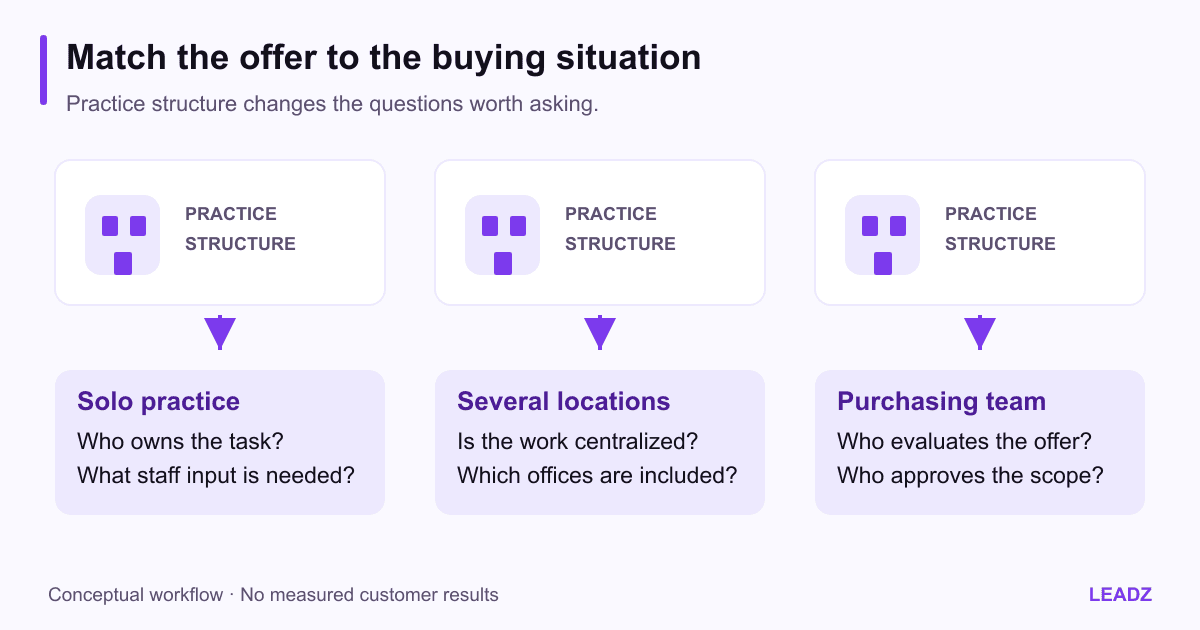
A solo office and a practice with several locations may buy the same service differently. The solo owner might assess both the practical fit and the budget. A larger organization might involve an office manager, an operations lead and a separate approver. Treat those as research hypotheses until the practice confirms its process.
Start with one segment that fits your delivery capacity. For example, an agency that photographs premises in person could choose practices within a workable travel area. A remote software service could instead prioritize a particular administrative workflow. In either case, write down your exclusions: locations outside coverage, existing customers, organizations with unresolved ownership, or practices that do not offer the relevant service.
Use chiropractic business records to find initial accounts, then check the practice website. Confirm its locations, services and public contact route. Record the date of the check and the page that supports the finding. A business category helps discovery; the practice's own information supports the account decision.
Do not rank businesses by a supposed willingness to buy inferred from their rating, website design or available email address. Those signals answer different questions. The lead qualification guide explains how to keep account fit separate from demonstrated interest and purchasing readiness.
Build a contact record that survives handoff
A useful prospect record should allow another teammate to understand why the practice is present. Include the business name, location, website, reason for fit, source URL, research date, contact route and next unresolved question. Keep the company record separate from any person associated with it.
An email might reach reception, a shared office inbox or a named professional. Label what you know. If a public team page identifies an office manager, record that evidence without assuming the person controls every purchase. If the role is unknown, ask who handles the relevant subject. A routing question is more credible than addressing a guessed decision-maker with manufactured familiarity.
Leadz exports can include available contact names and roles associated with email profiles. Availability varies by record and by the saved information accessible to your team. Those fields need interpretation: a name beside an email does not establish current buying authority or a relationship with every location. Use the CSV field guide when preparing the handoff.
Check for duplicate locations, existing account ownership and prior opt-outs before sending. If two offices use one central inbox, decide whether your service belongs at organization or location level. Keep both locations when they matter operationally, but assign one coordinated contact owner so the practice does not receive competing introductions from your team.
Match the channel to the evaluation task
Choose a channel because it helps the buyer assess your offer. A short email can introduce a tightly scoped service. A search landing page can explain a problem a practice is already researching. A professional event can support a detailed demonstration. None of these channels fixes a weak account definition.
For email, make the business relevance apparent immediately. Identify your organization, describe one supported observation, state what you offer and ask a small question. A hypothetical opening might say: “Your site lists three offices with separate appointment pages. We help practices make those location instructions consistent. Is website administration handled centrally?” This asks about responsibility without pretending the practice requested contact.
For paid advertising, send each offer to a matching page. A practice interested in appointment-page maintenance should see the deliverable, process and limitations, not a homepage promoting ten unrelated services. Define the conversion as a meaningful next step such as a scoped inquiry. A click alone says little about commercial fit.
For events or direct demonstrations, prepare questions that reveal the workflow: who maintains the information, what must remain under practice control, what systems are involved and how a change is approved. The B2B outreach sequence can help organize follow-up once the contact has context. Follow channel rules and applicable requirements for the particular campaign; public contact availability is not blanket permission.
Use a small pilot to test the offer, not just the subject line
Consider a hypothetical agency reviewing 40 practice records for a website-maintenance service. Eight are outside its service scope, five represent duplicate account relationships and seven need unresolved ownership research. That leaves 20 accounts ready for a considered introduction. These are illustrative screening decisions, not measured Leadz results.
If researching those records takes four hours, the team has spent twelve minutes per ready account: 240 minutes divided by 20. That cost matters even if the source rows were inexpensive. Record research effort separately from software charges and message preparation, then decide whether the possible contract value can support that work.
Split a pilot only when the groups can teach you something useful. Comparing a location-information offer with a broad “more patients” offer changes both scope and credibility; it is not merely a headline test. Keep the audience definition stable and change one important element at a time, such as the requested next step.
Review replies manually. Distinguish an appropriate referral to another employee, a request for details, a clear rejection and an irrelevant response. Each tells you something different about the segment. Do not celebrate a high reply count if most replies explain that you contacted the wrong organization or role.
Make the practice's review easier
A practice considering your service needs enough detail to assess disruption as well as benefit. Show a sample deliverable using fictional information, explain the staff time required and identify which approvals you need. If the project changes a website, specify who signs off on service descriptions and who maintains the result after launch.
Keep sales demonstrations free of patient information. If a later engagement requires access to sensitive information, address that through the practice's approved process before access begins. The HHS marketing guidance concerns uses and disclosures of protected health information; purchasing a business contact record is not a substitute for the permissions that a patient-data workflow may require.
Give the buyer a clear way to compare scope. A proposal might distinguish setup, ongoing maintenance, optional photography and items the practice retains responsibility for. Avoid combining everything into a single unexplained promise of growth. Defined responsibilities make implementation and later evaluation much more straightforward.
Finally, agree on an operational success measure you can actually observe. For a location-information project, that might be approved consistency across location pages and fewer staff corrections to published details. Patient acquisition, revenue and treatment outcomes involve additional factors. Do not claim that a small website task caused changes you did not measure.
Turn the first cycle into a reusable account brief
After the pilot, write a one-page account brief that a new teammate could follow. Include the eligible practice type, excluded businesses, research sources, role-routing question, accepted evidence and the stage at which the sales owner takes over. Attach one good fictional example and one rejected example with the reason for rejection.
Keep the brief specific enough to guide judgment. “Independent practices in our delivery area with multiple public location pages” is actionable. “Growing practices that need marketing” asks researchers to guess. Review borderline records together so the team develops consistent standards rather than quietly changing criteria from person to person.
Your next step is to select a small, relevant segment and complete the account briefs before launching advertising. The practical advantage comes from a clearer offer and better preparation. It does not depend on assumptions about chiropractic treatment, invented industry growth figures or a claim that every available business address belongs to a ready buyer.