
How to Market Products and Services to Hospitals
To market a product or service to a hospital, identify the organization responsible for buying it, the operational owner of the problem and the evidence required for evaluation. A hospital directory entry is a discovery record. It is not a verified list of executives, a purchasing authorization or a shortcut around the organization's supplier process.
Start with a narrow offer and a researched account brief. The scope of the purchase determines which clinical, operational, technical, financial or procurement reviewers may need to participate.
Define the hospital account and the service boundary
A hospital campus, a hospital organization and a wider health system are not necessarily the same buying unit. A local department may use the service while a central organization controls contracts. Confirm the relationship relevant to your offer before counting several facilities as independent opportunities.
Write a service statement with clear boundaries. A hypothetical signage vendor could offer maintenance of approved wayfinding signs at selected buildings. A software vendor might propose a defined administrative workflow. Neither should begin with a broad claim to improve healthcare outcomes unless it has the appropriate evidence and review for that claim.
List the conditions that make an account serviceable: geography, implementation capability, support coverage and any required organizational process. Separate those conditions from information you still need to discover. A facility's size or public profile does not establish that it has a current budget for your service.
Use hospital business records as one discovery input, then check the organization's own website and supplier information. The medical-practice data guide explains why locations, professionals and buying roles need separate evidence. The same discipline becomes particularly useful when several facilities belong to one system.
Research the organization with appropriately scoped sources
The CMS Provider Data Catalog describes official data used on Medicare comparison websites and directories. Such sources can help research facility identity and the context of publicly reported information. They do not identify every purchasing contact or establish that a particular organization wants your product.
When using a public dataset, read its definition, period and coverage. A quality measure, facility classification or ownership field answers a specific question. Do not turn a low score into a claim that the hospital needs your unrelated service, or imply that a comparison score is a direct measure of its willingness to buy.
Use the hospital's own procurement or supplier pages to find the appropriate business route. Record the source, access date, registration instructions and any stated restrictions. If the process is unclear, ask a routing question rather than guessing an executive's role from a directory title.
Keep research notes factual. “The organization publishes a central supplier registration process” is useful. “The chief executive will approve this quickly” is an unsupported forecast. A good brief should distinguish verified structure, possible stakeholders and unresolved questions so the next person knows what still needs confirmation.
Map the evaluation roles around the specific purchase
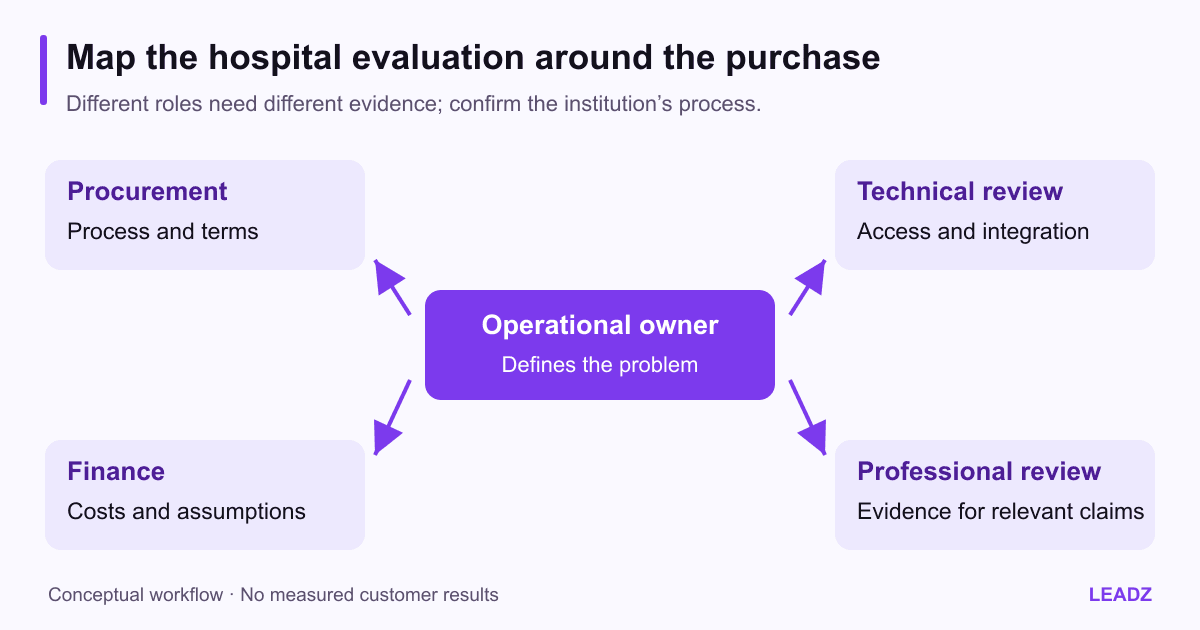
Think in functions rather than collecting impressive titles. The operational owner understands the problem. Procurement may manage the supplier process. A technical team may assess integration or access. Finance may review costs. Clinical or other professional reviewers may evaluate claims relevant to their responsibilities. The actual participants depend on the purchase.
Create a role map with three fields: what the reviewer needs to decide, what evidence supports that decision and who has confirmed the role. This prevents a list of names from masquerading as an understood buying process. It also helps you avoid sending everyone the same oversized presentation.
For a signage service, the operational owner may need a site plan and maintenance schedule, while procurement needs scope and commercial terms. For a system that handles information, access and security questions may become central. Do not assume a low-cost pilot removes those requirements.
Use the lead qualification framework to distinguish a relevant organization, an identified role, an expressed problem and an authorized evaluation. An employee's interest is useful evidence, but it does not automatically mean the institution has approved a trial or can sign a contract.
Prepare an evidence package that supports review
Build a concise package around the decision. Include the problem definition, proposed scope, implementation steps, required hospital input, support arrangements, costs and limitations. Use a clear table of responsibilities so reviewers can see what your team does and what the organization must provide.
Demonstrate with fictional or appropriately authorized information. Do not request patient data merely to make a sales demonstration more realistic. If a later engagement requires access to sensitive information or operational systems, address that through the organization's authorized review process before access begins.
Claims about clinical benefits, safety or regulated products require evidence suited to the claim. The FTC's health claims guidance emphasizes substantiation for health-related claims. A testimonial or a successful demonstration of an administrative feature should not be presented as proof of a clinical outcome.
If you have a relevant case study, explain the setting, what was measured and its limitations. If you do not, present an honest demonstration and a proposed evaluation method. Avoid fabricated hospital results, unnamed experts or an ROI percentage derived from assumptions that the buyer has not accepted.
Make the first contact a routing and relevance test
Use the published supplier route where one exists. Introduce your organization, state the specific service and ask how that category is evaluated. Do not present a sales inquiry as a patient matter, an urgent clinical concern or an existing vendor relationship.
A fictional example might say: “We maintain approved wayfinding signage for multi-building organizations in this region. Could you direct us to the team responsible for evaluating signage maintenance suppliers?” It is modest because the research supports a potential service fit, not a claim about a known internal failure.
If an appropriate employee agrees to discuss the subject, use that conversation to confirm the problem and process. Ask what evidence would be useful, which roles should participate and whether there is an established evaluation window. Listen for a reason to stop as well as a reason to proceed.
The medical-practice outreach guide covers similar role-routing principles at a different organizational scale. Hospital outreach should be adapted to the institution's own process, with contact preferences and prior responses preserved across your team.
Structure a pilot without assuming permission to operate
A pilot needs an agreed scope, authorized participants, access arrangements, measures, timeline and exit plan. Calling something a trial or offering it without charge does not establish permission to install equipment, access systems or involve staff. Confirm the required approvals for the actual activity.
Consider a hypothetical administrative service priced at $4,000 for a limited evaluation. Suppose the hospital also expects 20 staff hours of participation, valued for planning at $50 per hour. The total modeled evaluation cost is $5,000 before other expenses. These are illustrative figures, not hospital market prices.
If the supplier claims the service could save two staff hours per week, that assumption needs testing. At the same planning value, two hours represent $100 per week, but released time is not automatically a cash saving. The organization must decide how the time would be used and whether the benefit is relevant to the purchase.
Document a stop condition and a handoff plan. The hospital should know what happens to information, access, equipment and work in progress if the evaluation ends. That clarity makes the pilot easier to assess and reduces uncertainty for both parties.
Include the hospital's participation effort in the review meeting. A supplier may complete its tasks on time while the institution spends more staff time than expected preparing information, arranging access or resolving exceptions. Record that effort as part of the evaluation instead of treating it as a free input. Ask whether the workflow would remain manageable at the proposed scale, since a small demonstration can hide coordination work that becomes substantial across several departments or facilities.
Maintain the account through a realistic evaluation cycle
Keep a shared account record containing the organizational structure, role map, source dates, stated process, prior conversations and next agreed action. If responsibility changes, update the role evidence rather than continuing to use an old title as though it were current.
Measure stage progression that your team can substantiate: appropriate route confirmed, evaluation requested, scope reviewed, pilot authorized or contract agreed. Do not count a downloaded brochure or a general reply as evidence of procurement progress. Preserve the source of each stage change.
Coordinate messages across facilities that share a central process. The deduplication guide helps maintain parent and location relationships, while the B2B outreach guide can support a restrained follow-up plan. Avoid sending several versions of the same pitch to different departments without context.
Begin with a few institutions your team can serve and research them properly. A clear service boundary, an accurate role map and a reviewable evidence package are more valuable than a large hospital contact file presented as guaranteed access to decision-makers.