
Real Estate Lead Generation: Build Useful Conversations With Buyers and Sellers
Real estate lead generation works best when people can understand your service, find useful local information and choose a clear next conversation. Build separate paths for buyers, sellers and professional introductions. Then record the request, timing and follow-up agreement instead of treating every contact as a person ready to transact.
This guide is for real estate professionals seeking clients. A directory of real estate businesses supports B2B research; it is not a homeowner or buyer-intent list. Examples are illustrative and official sources were checked on September 23, 2026.
Separate buyer and seller questions
A prospective buyer may need help understanding the search process, representation and practical next steps. A seller may want to understand preparation, pricing discussions and the work involved in listing. The two audiences can share educational content, but their first requests often need different handling.
Write a clear service description for each. Explain the area you cover, the kind of assistance available and how the initial conversation works. Avoid guaranteeing a sale price, timing or investment return. Those outcomes depend on circumstances that a general marketing page cannot establish.
Ask what the person wants help with before assigning a stage. Someone downloading a moving checklist may be researching for a family member or planning far ahead. Someone asking about a particular listing may already have representation. Record what they actually say and follow your brokerage's process for the next step.
Keep property interest separate from personal assumptions. A question about a location does not establish a person's family situation, finances or preferred neighborhood characteristics. Use their stated needs and objective property information to guide the discussion. The qualification guide offers a general method for distinguishing evidence from inference.
Publish information that helps people prepare
Create resources around decisions clients regularly need to make: preparing documents for an initial consultation, understanding the listing process, organizing questions for a viewing or comparing the practical costs of a move. Explain the scope and encourage readers to confirm details that depend on their transaction.
Local content should provide objective, useful information. Transport options, municipal resources and the process for checking property records can help a reader investigate. Link to the relevant official source where details change. Avoid subjective descriptions that imply certain people belong in a neighborhood and others do not.
HUD's April 24, 2026 clarification says real estate professionals can share school-quality and crime information consistently without discriminatory intent. Use identifiable, objective sources and apply the same approach to people asking comparable questions. Review advertising choices against the current Fair Housing Act overview and your brokerage's requirements; a neighborhood resource should help people investigate their stated needs rather than decide who belongs there.
Keep listing information current and authorized. If a property is no longer available, update the destination and explain the next useful action rather than using stale availability to collect enquiries. A visitor who asks about one property should not discover that the advertisement was only a generic lead-capture device.
Create a consented follow-up path
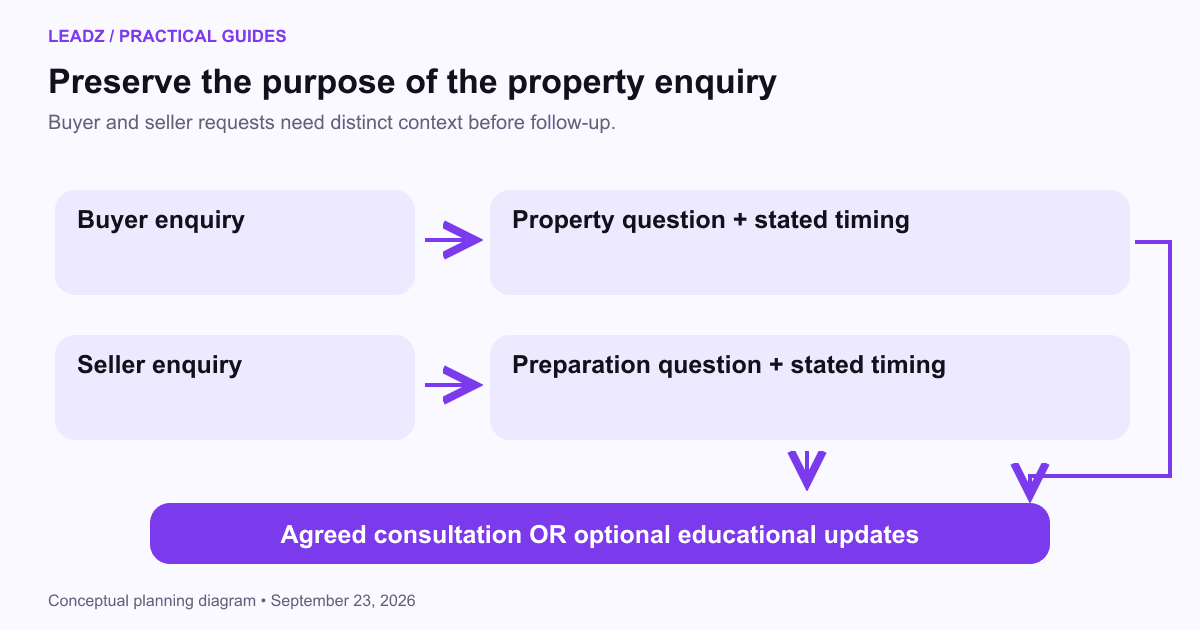
Make the form match the request. A viewing enquiry needs the property reference and a way to respond. A newsletter subscription needs a clear description of the updates. A valuation discussion may need different preparation. Combining every purpose into one vague form makes follow-up less relevant.
Tell the person what will happen after submission. Identify who will respond and whether the next step is a call, an appointment request or delivery of a resource. Only promise response timing your team can maintain. Ensure coverage when the agent is showing properties or unavailable.
Keep marketing preferences separate from the immediate enquiry. Asking about a listing does not necessarily mean wanting an indefinite newsletter. The opt-in email guide explains how to make the continuing relationship explicit and keep the record useful.
When timing is distant, ask what kind of follow-up would help. A person planning to sell next year may value preparation information at a chosen interval. Someone who has paused the search may prefer no further contact. Record the agreement and make it easy to change.
Build professional relationships around the client's choice
Clients may need inspectors, lenders, attorneys, contractors or other professionals, depending on the transaction. Maintain current information about relevant services and explain that clients can make their own choices. A relationship with another provider should not replace appropriate checks or a clear account of your role.
If you plan paid referrals, gifts or marketing arrangements, obtain a compliance review before launching them. The CFPB's RESPA Section 8 FAQs explain restrictions on things of value exchanged for certain settlement-service referrals and identify relevant exceptions. Coverage depends on the facts; an informal label such as “marketing partnership” does not settle the question.
A useful introduction begins with the client's agreement and a description of the help requested. Share only the information needed for that purpose. Confirm who will respond, and avoid distributing the person's details to several providers simply to increase the chance of a response.
For businesses selling services to real estate firms, a real estate agent directory can support account research. That is a separate campaign with different recipients and messages. Do not confuse professional contact records with consumer housing enquiries or permission to advertise listings to those contacts.
Use events and local discovery for a clear purpose
An open house, educational session or community event should have a stated purpose and a useful next step. Prepare materials that answer common questions and explain how attendees can request further help. An attendance sheet should not silently become a broad marketing subscription list.
Separate event administration from promotion. If someone registers for a buyer workshop, send the practical information needed to attend. Offer an optional continuing subscription with a clear topic. The email campaign-types guide helps distinguish those messages and their intended outcomes.
Keep local business profiles and contact information accurate where the business is eligible. Google's local-ranking guidance describes relevance, distance and prominence; it does not promise that a profile change will produce clients. Focus on information that helps people identify and contact the actual business.
When using paid housing advertising, review the platform's current housing-ad restrictions and applicable rules before selecting targeting. Preserve the campaign settings and approval record. A platform allowing an option does not by itself establish that the resulting campaign meets all obligations.
Track conversations through a realistic decision cycle
Create records for the request, source, date, assigned agent, stated timing and next agreed action. Keep notes factual. “Wants to discuss preparing a home for sale in spring” is useful. A subjective judgment about motivation or finances, without evidence, is not a dependable basis for follow-up.
Use stages tied to events: enquiry received, consultation requested, consultation held, representation process underway and transaction milestone reached, as appropriate to your brokerage. Do not label every subscriber a sales opportunity. A long decision cycle needs clear pending states as well as completed outcomes.
For an illustrative workshop, suppose 50 people register, 32 attend and eight request a consultation. Attendance is 64% of registrations, while consultation requests are 25% of attendees. If six consultations are held by the reporting cutoff, report six held and two pending or canceled according to what happened.
Those counts do not establish future transactions or commission revenue. Review the cohort later and preserve its original source. The campaign measurement guide explains why counts, time windows and distinct people need consistent definitions across stages.
Review the quality of the experience before buying more leads
Keep a clear process for duplicate enquiries. Someone may contact the brokerage through a listing portal, an event and the website. Those are several interactions with one person, not necessarily three new prospects. Check assignment before several agents independently respond, and retain the source history without making the client repeat the same question to each person.
Record when a request belongs with another existing relationship. A person may already be working with an agent or may contact you about information outside your role. Follow the brokerage's procedures, clarify the service you can provide and avoid turning a routing issue into an aggressive acquisition attempt. A useful outcome can be an accurate answer or an appropriate handoff, even when it does not create a new client.
Finally, protect the original request in the record. If a buyer asks about accessibility features, retain the objective feature question rather than guessing a health condition. That distinction helps the team provide relevant property information while keeping unnecessary sensitive assumptions out of marketing and follow-up.
Trace a few enquiries from the first advertisement or page through the latest conversation. Check whether the person received what was promised, whether preferences were respected and whether the assigned agent had the necessary context. A broken handoff can make a suitable enquiry appear unresponsive.
Review sources by the usefulness of the conversations they create. A small educational event may produce fewer contacts but clearer questions. A broad campaign may generate many requests outside the service area or intended scope. Record those differences rather than ranking channels only by cost per name.
Keep content and workflows current with brokerage requirements. Changes to forms, agreements, disclosures or service scope should trigger a review of the relevant marketing journey. A saved automation can continue sending outdated instructions long after the website has changed.
Choose one practical improvement for the next period: a clearer seller-preparation page, a better viewing-request form or a reliable consultation reminder. Real estate lead generation becomes more useful when it helps people understand their next decision and gives the professional team enough context to respond well.