
Local Lead Generation: Connect Nearby Demand to a Useful Next Step
Local lead generation starts with a clear service area, an offer people can recognize and a dependable way to enquire. Make the business easy to understand where local customers search, then build relationships and campaigns that fit the territory you can serve. Measure suitable enquiries and completed work, not just visibility.
This guide covers a local business seeking customers. A business directory serves a separate research purpose; it does not contain a ready-made queue of residents asking for quotes. Examples are illustrative, with official guidance reviewed on September 23, 2026.
Define the territory from delivery reality
A service area should reflect where the business can work profitably and reliably. Travel time, parking, access, crew availability and the kind of job all matter. A map radius may be convenient for planning, but it can conceal a river crossing or traffic route that makes two nearby locations very different to serve.
List the places you normally cover and any exceptions. A small urgent repair may have a tighter boundary than a large planned project. Explain those differences on the service page instead of advertising a large region and rejecting most requests later. Where the work requires licensing or permits, account for the relevant jurisdiction.
For a storefront, think about why someone would travel to you. A routine purchase and a specialist service draw from different practical areas. Customer records can help you understand observed demand, provided the analysis respects privacy and does not turn a few examples into a universal boundary.
If the business is new, use a test territory. Review response and delivery effort before expanding. Record the assumptions: typical travel, job duration and capacity. The service-business guide connects those operating constraints to the kind of enquiries worth pursuing.
Make your local information accurate and consistent
Check the business name, contact details, hours and service description on the website and major profiles. Changes to opening hours or phone routing affect real visitors, not just search engines. Assign someone to update information when operations changes rather than leaving marketing to discover outdated details later.
Google's local-ranking guidance identifies relevance, distance and prominence. Accurate information helps describe the business; it cannot remove the distance between you and a searcher or guarantee a ranking. Focus on details a customer needs rather than trying to force every keyword into the business name.
For service-area businesses, follow Google's service-area instructions, including how to represent a business that does not receive customers at its address. Do not create a customer-facing location merely to appear closer to a neighborhood you serve.
Check how calls and forms are handled. If a published number reaches voicemail, the greeting should explain the business and a realistic next step. If the business has several locations, make the destination clear. A correct profile is only helpful when the person contacting it reaches the right team.
Review photos and service descriptions for accuracy. Use current images of work or premises you can legitimately show. Explain the service in ordinary terms and keep temporary offers up to date. Customers should encounter the same business described online when they arrive or speak to the team.
Build pages around real local buying questions
For a business with several branches, decide what belongs on the central service page and what genuinely differs by location. Opening hours, access instructions, available services and the local contact route can justify a separate page. Keep shared promises consistent, but give each location enough accurate detail that a visitor can complete a practical task.
Do not advertise a temporary arrangement as a permanent location. A business using a shared venue for an occasional event should explain that event clearly rather than imply daily customer access. Check the eligibility and representation rules of each platform before creating a listing. Customers rely on the distinction when deciding where to travel or whom to call.
Write service pages that explain the work, the territory and how to request it. A page for commercial cleaning should address access, scheduling and scope, while a repair page may need to explain urgent-call availability. The reader's task should determine the information order.
Use local detail where it changes the answer. Building types, access constraints, seasonal demand or area-specific procedures may be relevant if you can explain them accurately. Replacing city names in otherwise identical paragraphs adds little. A location page should help a person in that location decide what to do.
Show evidence of relevant work with permission. Describe the project type, challenge and approach without exposing private customer details. If you cannot publish a real example, explain the work process or use a labeled hypothetical scenario. Avoid implying that generic stock imagery documents a local project.
Keep the request step appropriate to the service. A quote form may ask for location and a short scope description. A booking page may need availability and preparation instructions. Explain what happens after submission, especially when the request requires review rather than instant confirmation.
The Google Maps research guide covers using local business information for B2B account research. Keep that activity distinct from creating useful pages for residents or organizations seeking your own service.
Combine discovery with relationships in the area
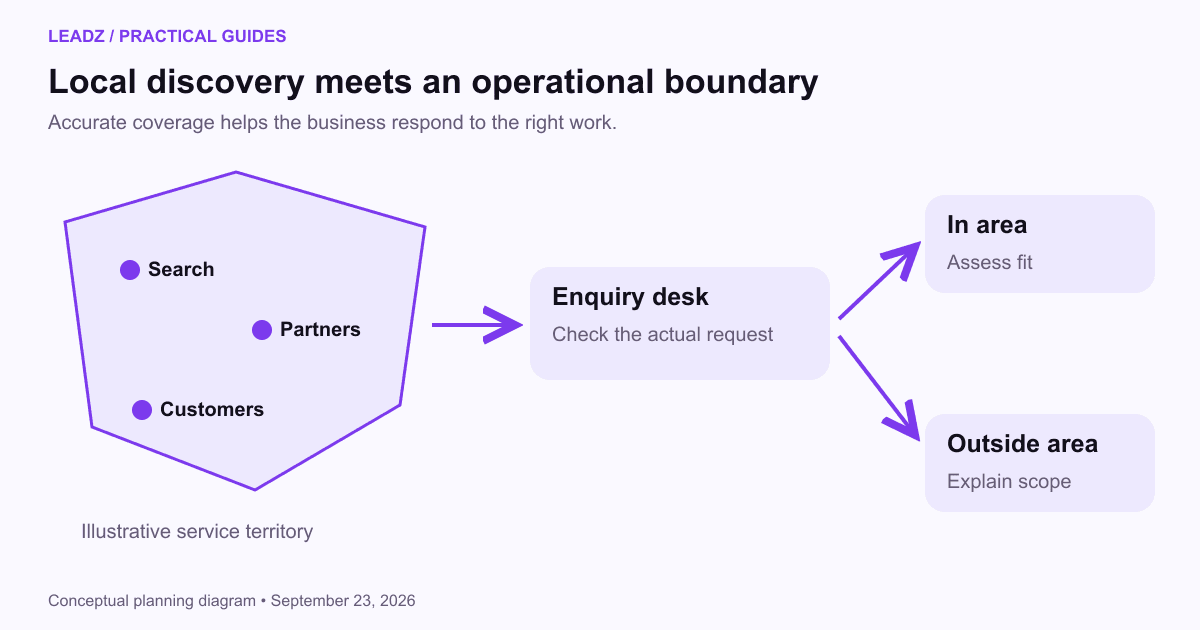
Local demand can reach the business through several routes. Someone may search after a recommendation, see a project sign and later visit the website, or meet a partner who explains your service. Make those routes consistent so the person can recognize the business and find a useful next step.
Identify complementary organizations that encounter your customer's problem. A commercial property manager may need reliable trades. A designer may need specialist installers. Discuss what a suitable introduction looks like and how the customer will agree to it. A shared postcode alone does not make a partnership useful.
Participate in local events only when the audience and activity fit. A practical demonstration or a short educational session can help people understand the work. Prepare the follow-up process before collecting details. Attending an event does not mean every attendee subscribed to your marketing.
When researching B2B partners, a category such as construction companies can identify organizations to investigate. Review their services, projects and territory before approaching them. A directory record establishes neither a partnership interest nor an immediate buying need.
Keep a record of introductions and responses. Notice which relationships lead to appropriate requests and where expectations differ. A short conversation clarifying scope can improve a partnership more than sending a generic reminder to refer business.
Real estate businesses need an additional distinction between local professional relationships and housing-related client acquisition. If that is your market, the real estate lead generation guide covers separate buyer and seller requests, objective information and referral considerations. A generic local advertising plan should not be copied into a regulated housing campaign without reviewing those differences.
Ask for honest feedback and make it useful
Create a consistent opportunity for customers to share their experience after work is complete. Explain how to leave feedback without dictating the rating or wording. Google's review guidance provides ways to share a review link and respond to customers.
Follow the platform's rules and avoid selectively requesting only positive public feedback. The FTC's review guidance addresses misleading review practices. Treat feedback as information about the service, not an inventory of favorable quotes to manufacture.
Respond in a way that respects the customer's privacy. Acknowledge the issue or appreciation without exposing private job details. Where resolution needs a conversation, provide a suitable route. A public reply should not turn into an argument about information other readers cannot evaluate.
Bring recurring feedback into operations. Confusing arrival windows, unclear estimates or cleanup concerns may reveal specific improvements. Correcting the service can make future recommendations more dependable. Asking for more reviews while ignoring the underlying issue only expands the record of the same problem.
Test paid activity with a narrow promise
Choose one service and a territory that operations can cover. Match the ad, destination and intake questions. If the campaign promotes scheduled commercial maintenance, the page should not primarily advertise emergency residential work. A consistent promise helps visitors decide whether to enquire.
Set a budget you can evaluate and a period that fits the service's decision cycle. Record the campaign settings and changes. If the territory, offer and landing page all change at once, later results cannot isolate which change mattered. Start with a manageable test rather than treating spending as a commitment to continue indefinitely.
Track enquiry suitability, not only cost per form submission. Requests outside the area, unrelated services and duplicate messages create work without adding sales opportunity. Preserve the rejection reason so the campaign can be improved. A low form cost can conceal a high cost per suitable request.
For trackable links, use consistent campaign labels. Google's custom URL guidance explains how referred visits can be identified. Keep a separate enquiry record for phone calls and other routes, and acknowledge the gaps rather than forcing every customer into a known digital source.
Use a local enquiry example to choose the next change
Suppose a fictional maintenance business receives 60 enquiries in a month. Forty-two are in its territory and fit the advertised service. Of those, 28 receive an assessment and 10 become booked jobs. Suitability is 42 divided by 60, or 70%. Booked jobs represent about 16.7% of all enquiries.
Now inspect the 18 unsuitable requests. If 12 are outside the territory, the campaign may need clearer geographic targeting or wording. If most concern a service you do not offer, review the promise and category selection. The total rejection percentage alone cannot tell you which change would help.
Suppose the business spent $900 in media and allocated $600 of staff time to the campaign. Total modeled acquisition cost is $1,500, or $150 per booked job. The cash-only media figure is $90 per job. Keep both definitions clear and compare them with the value and effort of the work actually delivered.
Do not evaluate a long-cycle service solely on immediate bookings. Some assessments may still be awaiting a decision. Record pending cases and review them later, using the original cohort. The lead generation budget guide explains how time and follow-up affect the working cost.
Maintain a small local marketing routine
Keep a short source log for enquiries whose digital path is unclear. Ask how the person heard about the business when it fits naturally into the conversation, and record their answer as self-reported information. “A neighbor recommended you, then I searched your name” contains two useful contributions. Do not erase the recommendation simply because the final website visit came through search.
Review missed calls and incomplete forms as operational evidence. A phone log may show attempts without explaining whether the caller was a suitable customer, so avoid counting every missed call as lost revenue. Still, recurring unanswered calls during advertised hours deserve investigation. The practical fix may be better coverage, clearer hours or a callback process rather than more traffic.
For a new territory, compare the first completed jobs with your planning assumptions. Record actual travel, preparation and return visits. If the work takes longer than expected, adjust scheduling and campaign coverage before the business commits to more of the same. A local marketing report should help operations make that decision, not merely celebrate a larger map of enquiries.
Set aside regular time to check new enquiries, update availability and review the reasons people chose or rejected the business. Assign profile changes to someone with access and keep a record of important edits. Routine maintenance prevents marketing from advertising a version of the business that operations no longer runs.
Review a few complete customer journeys. How did the person hear about you, what did they expect, what happened when they contacted you and what work followed? These conversations can reveal confusing instructions or missing information that analytics alone will not show.
Choose a limited set of improvements for the next cycle. Clarifying the service area, improving one buying page or arranging a relevant partner introduction may do more than opening another social account. Connect each activity to a specific question about discovery, suitability or follow-through.
Expand the territory only when the current process can support it. Check travel, staffing, response coverage and project quality as well as enquiry volume. Local growth is more useful when new customers receive the same dependable experience that made the original area work.