
How to Market Your Services to Law Firms
To sell a service to a law firm, show that you understand the firm's work, the role responsible for the problem and the review process your proposal will need. Lead with a concrete deliverable and credible evidence. Generic promises about more clients give a firm little basis for deciding whether your agency or supplier belongs on its shortlist.
This guide concerns marketing to law firms. It does not teach lawyers how to solicit clients or provide legal advice about a particular campaign.
Segment firms by the work your offer supports
A small estate-planning practice, a regional litigation firm and a business-law boutique can have different operational requirements. Choose a segment because your service fits its work, not because a profession appears on a large contact list. A document-management provider and a photography agency should not use the same account definition.
Write down the practice area, geographic reach, delivery constraints and relevant business structure. Separate mandatory conditions from preferences. If your service needs on-site delivery, the travel area matters. If it can be delivered remotely, responsibility for purchasing and implementation may be more important than office proximity.
Use the firm's own website to confirm how it describes its services. Avoid assigning a specialty from one article or one employee biography. A firm may publish about a topic it rarely handles, and individual lawyers may have different practices. Record the source page and research date beside the account note.
The guide to different types of lawyers can help organize an initial vocabulary, but the firm's published description and direct confirmation should guide the actual segment. Keep unknowns visible. A practice area tells you something about the work; it does not reveal budget, urgency or willingness to change suppliers.
Map the evaluation team before writing the pitch
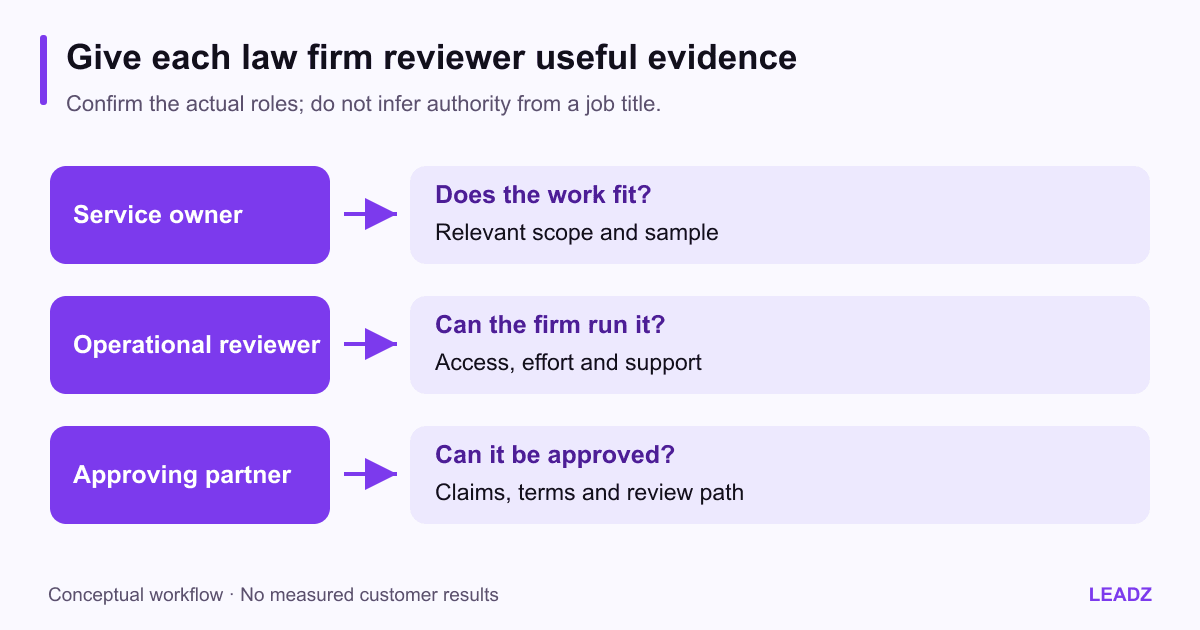
Identify the function your offer affects. Website work may involve marketing staff and a responsible lawyer. Billing software may involve operations, finance and technology reviewers. A small firm may combine several responsibilities in one person. Treat these as possible roles, then confirm the firm's actual process.
Begin with law firm business records for discovery, then review the firm's team and business-inquiry pages. A directory email can be a general office route. Even when a saved contact profile supplies a name or role, verify that it is appropriate to the subject rather than assuming it belongs to the purchasing decision-maker.
Use a routing question when necessary: “Who coordinates supplier reviews for the firm's website?” This is more useful than sending a detailed proposal to every partner. It also gives the firm a simple way to direct you without asking someone to evaluate a service outside their responsibilities.
Preserve account ownership internally. If your team contacts several offices, coordinate the approach under one firm account where appropriate. The deduplication workflow helps distinguish legitimate locations from repeated records, preventing several salespeople from presenting the same central service as unrelated local offers.
Demonstrate the problem without inventing a diagnosis
Choose an observable issue that your service addresses. A website agency might notice inconsistent office details or a confusing route from a service page to an inquiry form. Describe what you can see. Do not claim that the issue costs a firm a specific amount of revenue unless you have evidence the firm has authorized you to use.
Prepare a small, relevant demonstration. For a content workflow, show how a draft moves through legal review, revisions and approval. For a software service, use fictional matters and contacts. For an office service, show the schedule, access requirements and service standard. Make it easy to assess the work without exposing client information.
A useful proof package includes scope, sample output, implementation steps, responsibilities and limitations. Distinguish examples from results. If a case study is fictional, label it clearly. If it is real, obtain appropriate permission and explain the circumstances without suggesting the same result is guaranteed for another firm.
This preparation supports a better first question: “Would a short review of this workflow be useful?” The lead qualification framework helps separate interest in that review from a funded opportunity. A polite reply or an introduction to another employee is progress, but it is not a signed project.
Design review and confidentiality into the offer
If your service creates public-facing legal marketing, build the firm's approval process into the scope. The ABA's Model Rule 7.1 addresses false or misleading communications about legal services. It is a model rule; the firm must assess the rules applicable in its jurisdictions. Your proposal should identify who reviews and approves claims before publication.
Do not sell a guaranteed number of clients, a guaranteed case outcome or an unsupported superiority claim as if a disclaimer resolves the issue. Offer deliverables and a measurement plan within your control. The firm can then assess both the commercial value and the professional obligations involved.
Confidentiality also affects demonstrations, onboarding and support. ABA Model Rule 1.6 addresses lawyers' duties regarding information related to representation. For a supplier, the practical starting point is to avoid requesting real client materials during prospecting and let the firm define authorized access if an engagement proceeds.
Document what your team needs, where information will go, who can access it and how the firm can stop access. Use the firm's review process for contractual, security and professional-responsibility questions. A confident sales answer should not substitute for a requirement your organization has not actually met.
Write an introduction that earns a relevant reply
Use the first message to establish business relevance and ask one clear question. A fictional example for a website agency might read: “Your firm lists offices in two cities, with separate contact instructions on several service pages. We help professional firms maintain consistent location and inquiry information. Is that work managed by your marketing team or an external supplier?”
This message states a visible observation, identifies the service and asks about responsibility. It does not claim that the firm is struggling, imply prior contact or pretend to know confidential business results. Adapt it to the evidence you actually have rather than inserting a firm name into a fixed compliment.
For content or events, offer something the relevant role can use: an approval checklist, an example project scope or a demonstration of a specific workflow. Avoid sending a long general marketing presentation before the recipient has established interest. The personalization guide explains how research can improve relevance without becoming intrusive.
Follow the firm's stated business-inquiry route and applicable channel requirements. Do not approach a prospective supplier relationship as though you were a potential legal client. That wastes staff time and creates a misleading context. A clear subject and an honest description of your business are basic parts of a professional introduction.
Price the pilot around the work and approval effort
A pilot should test a bounded piece of work, not disguise an open-ended retainer. Define the deliverable, the number of review rounds, the firm's required input, the completion criteria and what happens after acceptance. This is especially useful when several people need to approve public-facing material.
Consider a hypothetical agency pilot covering three office-information pages. The agency plans six production hours and two review-management hours. At an internal planning cost of $50 per hour, labor cost is $400 before other expenses. If the agreed pilot fee is $700, the remaining $300 must cover overhead, risk and contribution. These are illustrative assumptions, not market prices.
If review expands to eight extra hours, labor becomes $800 and exceeds the fee. The lesson is to define scope and approvals, not to pressure the firm into skipping review. Agree how new requirements or additional rounds will be handled before starting.
Track whether the pilot delivers the agreed work and whether the collaboration process functions. Traffic, inquiries and retained clients may require a longer observation period and additional context. Use the campaign metrics guide to keep activity and business outcomes distinct when reporting the relationship's progress.
Include a named approval owner in the schedule. If reviewers disagree, the agency needs an agreed escalation route and a record of the final decision, rather than guessing which comment should govern publication.
Keep the relationship useful after the sale
At handoff, document the firm's service owner, approvers, communication preferences and recurring responsibilities. Keep a record of accepted deliverables and unresolved decisions. A new colleague should be able to understand the engagement without relying on the original salesperson's memory.
Schedule reviews around meaningful work: a completed phase, changed office information, a renewal or a new requirement. Sending frequent generic updates is not the same as maintaining a useful relationship. Explain what changed, why it matters and what decision, if any, the firm needs to make.
If a satisfied customer is willing to introduce you to another firm, keep the request straightforward and voluntary. Do not casually propose payments linked to legal referrals or representation. Different arrangements raise different professional and legal questions; qualified review should precede any incentive scheme rather than follow it.
Start with a small set of firms whose work matches your offer. Prepare the evidence, confirm the responsible role and propose a scope the firm can evaluate. That approach makes the sales conversation concrete while respecting the review standards that will matter throughout the engagement.