
Types of Lawyers a Business May Need: A Selection Guide
Choose a lawyer by the legal issue, jurisdiction and urgency, rather than by a broad directory category alone. A business may need different counsel for an employment dispute, a tax matter, a property transaction or financial distress. Start by describing what happened and what decision is needed, then confirm that the lawyer handles that kind of work.
The categories below help organize the search. They do not determine your legal rights or the deadline for acting on a particular matter.
Identify the issue and the first deadline
Write a factual summary with the parties involved, relevant location, key dates and documents received. Separate what you know from what someone has alleged. If a notice, claim or proposed agreement contains a deadline, tell the lawyer immediately rather than trying to interpret it from a general article.
Ask the firm how to provide the names needed for a conflict check before sending a large confidential file. Explain whether you are seeking an initial consultation, representation in a dispute or continuing advice. That helps the firm decide whether it can consider the engagement.
The North Carolina State Bar's questions before hiring a lawyer are a useful starting point for discussing experience and the working relationship. Verify licensing and status with the relevant jurisdiction's authority as part of the selection process.
A practice-area label is not necessarily a specialist certification. Ask what the lawyer's actual experience covers and whether a claimed certification has a recognized issuing body. The ABA specialization resources identify programs and further information; confirm any individual claim with its issuing authority. Do not assume that “business lawyer” means the person routinely handles every employment, tax and litigation issue your company might encounter.
Injury and liability matters
An injury involving a customer, visitor or other person can require counsel experienced in the relevant liability issue. The appropriate role may differ depending on whether the business is defending a claim, pursuing recovery or coordinating with an insurer. Explain the relationship between the parties and any notice already received.
Preserve existing records and ask counsel or the insurer how to handle the matter. Avoid changing documents or creating a retrospective account that blends observation with speculation. Give the adviser the original information and identify who has direct knowledge of the event.
Ask about experience with similar circumstances and how the engagement interacts with insurance. If an insurer is involved, confirm who appoints counsel, who receives updates and which questions require separate advice. Do not assume that every issue arising from the event falls within the same coverage or representation.
The first meeting should establish the immediate actions, information needed and communication route. A good selection discussion does not require a promise about the outcome. It requires a lawyer who can explain the proposed process and the questions that must be resolved before offering an assessment.
Workers' compensation and workplace injury
A work-related injury may involve a specialized workers' compensation process as well as other employment or insurance questions. Rules and procedures vary by jurisdiction. Tell the adviser where the employee works, what has been reported and which notices or insurer communications the business has received.
Seek counsel with relevant employer-side or worker-side experience, depending on whom the lawyer would represent. A lawyer assisting the company is not automatically acting for the injured employee. Clarify the client relationship so everyone understands whose interests the appointment covers.
Ask which records are needed and how they should be transmitted. Personnel, incident and medical information can require careful handling. Follow the advice of the relevant professionals rather than circulating a broad file to everyone who might be involved operationally.
For the business owner, the practical hiring questions include familiarity with the applicable process, coordination with the insurer and responsiveness to time-sensitive requests. Ask who will handle routine correspondence and who will attend any formal proceeding. Keep the agreed responsibilities visible so a notice is not left unanswered because two parties assumed the other was dealing with it.
Employment and labor advice
Employment counsel can help a business assess matters involving hiring, workplace policies, pay, discipline, termination or disputes. Labor work may involve collective employment relationships and related processes. Describe the actual situation rather than assuming a general template or another employer's approach will fit.
Choose counsel with experience in the jurisdictions where your staff work. A remote team can create questions beyond the location of the company's main office. Explain the employment arrangement and the decision you are considering before taking an irreversible step.
Ask whether the proposed service is a document review, a policy project, advice on a particular event or representation. The output and fee basis will differ. For a policy project, define which documents are included, who supplies business information and how changes will be explained to managers.
A useful first brief might say: “We employ staff in two locations and need advice on updating our handbook and manager process.” It should identify current documents, known concerns and the intended rollout. It should not ask the lawyer merely to approve a predetermined outcome without examining the facts.
Tax counsel and accounting support
Tax lawyers and accounting professionals can have overlapping knowledge but different roles. A business may need legal advice about a disputed tax matter, transaction structure or a particular obligation, while its accountant prepares records and returns. Ask the advisers how their work should be coordinated.
The guide to types of accountants explains how to define bookkeeping, tax preparation and financial-reporting assignments. When legal representation or interpretation is needed, identify that separately rather than assuming the existing accounting engagement includes it.
Prepare the notices, returns, transaction documents and correspondence relevant to the issue. Keep originals and dates intact. Ask counsel which information is required initially and how to transfer it securely. A concise chronology can help the first discussion, provided it distinguishes facts from your interpretation.
Confirm who communicates with authorities and who approves submissions. If several advisers are involved, establish one coordination point and a shared understanding of deadlines. The selection goal is a team that can address the actual matter without duplicating work or leaving an important responsibility between engagements.
Immigration matters affecting the business
A business may need immigration counsel when hiring, transferring or continuing to employ a person whose situation raises immigration questions. The appropriate advice depends on the person, role, employer and jurisdiction. Avoid promising a start date or outcome before the relevant professional has assessed the facts.
Ask candidates about experience with the type of employer and matter involved. Explain the proposed work location, timing and any existing status or application information through the firm's designated process. The lawyer should identify what it needs before advising on possible routes.
Clarify whom the lawyer represents. An employer and an individual may have related but distinct interests. Ask how communications, fees and responsibilities will be handled, and whether separate advice is needed for any party.
Keep the engagement focused on documented next steps. Who gathers employer information? Who reviews the individual's documents? Who tracks filings and communications? A process with named owners is more useful than a broad assurance that the firm “handles visas.” The business should also know whom to notify if the proposed role, location or timing changes.
Financial distress and transaction counsel
If the business is struggling to meet obligations, seek appropriate advice early enough to understand the options. Insolvency or bankruptcy counsel addresses a specialized area; a general commercial appointment may not cover it. Explain the position accurately and avoid relying on a generic online sequence of actions.
For property, financing or commercial agreements, look for counsel experienced in the relevant transaction. The mortgage-broker selection guide explains why a financing intermediary does not replace legal review of loan and security documents. Similarly, an accountant's forecast does not interpret every contractual obligation.
Ask the lawyer to define the scope: reviewing specified documents, negotiating terms, coordinating completion or advising on a particular risk. Identify which parties the firm represents and which documents remain outside the engagement.
For an illustrative transaction, the owner might need a lease review, a related guarantee review and advice on a construction agreement. Those are three connected work items, not necessarily one undifferentiated “contract check.” The construction appointment guide can help you gather the scope, proposal and change records for counsel; the lawyer assesses their legal implications. A written engagement scope helps the adviser price the work and explains what decision each review supports.
Compare the appointment, not just the hourly rate
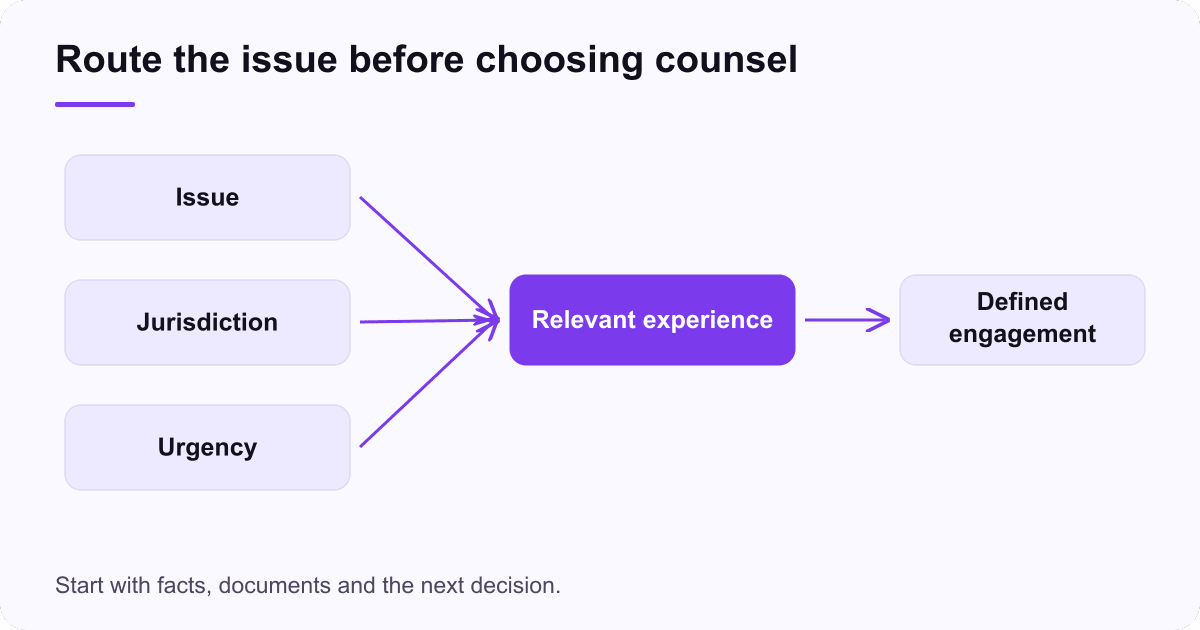
Use a law-firm directory or a recognized referral route to identify candidates, then verify fit and regulatory status. Organize your selection questions around the legal matter, its jurisdiction and urgency, and the precise scope of representation you need.
Compare the proposed work, assigned lawyer, communication process and fee basis. Ask about estimates, retainers, expenses, billing intervals and what triggers additional work. A lower hourly rate does not establish a lower total cost if the scope and staffing differ.
For a hypothetical initial review, one proposal might estimate six hours at $300 and another four hours at $450. Both equal $1,800 before any other stated charges. These invented figures demonstrate why hours and scope belong beside the rate; they are not legal-fee benchmarks.
Before proceeding, obtain the engagement terms and confirm the immediate next action. Supply the information requested, preserve relevant records and make sure the business contact can answer questions. The aim is to appoint suitable counsel for a defined issue, with enough clarity to act promptly and understand the advice received.