
How to Test a Business Contact Sample Before Setting a Budget
Test a business-contact sample against the job you intend to perform, using criteria written before you inspect the rows. Record how the sample was selected, review account fit and contact evidence separately, and include the labor required to make the data usable. A polished file demonstrates presentation; it does not establish the quality of the full inventory.
The sample evaluation CSV and editable sample calculator support a structured review. Their example values are illustrative, not measured results from your eventual segment.
Write the acceptance rule before requesting the sample
Describe the intended buyer, geography, required fields and next action. A supplier seeking businesses for a routing inquiry may accept a general office contact. A campaign requiring a named finance leader needs person-level identity and role evidence. Those tasks should not use the same definition of a usable record.
Separate mandatory criteria from research that can happen later. Trade and delivery territory may be mandatory. A purchasing role may remain unresolved if the next step is an appropriate routing question. Write down the remaining work so “accepted” does not quietly become “ready for any campaign.”
Set rejection and pause conditions. Examples include a recurring category mismatch, unexplained branch duplication, contact fields that cannot be interpreted or a claim of verification with no stated meaning. These conditions should arise from your workflow, not from an invented universal quality threshold.
Use the lead qualification guide to distinguish account fit, contact route and demonstrated interest. A sample review can assess some of those things; it cannot establish demand simply because a business appears relevant. Keep the buying decision about data separate from the later decision about a sales opportunity.
Find out how the sample was selected
Ask whether the sample is random, consecutive, filtered for certain fields or manually chosen. Record the category, geography, source date and any selection rules. A provider's handpicked examples can explain the schema, but they should not be presented as a representative estimate of the segment you intend to buy.
A sample containing only records with email cannot estimate email availability in the unfiltered category. A national sample may also differ from a particular city's businesses. Match the evaluation cohort as closely as possible to the purchase decision, and state the limitations that remain.
If you choose records yourself, document the method before reviewing them. For example, you might take a defined consecutive set from a specified search and note its ordering. That remains a convenience sample unless a defensible probability-sampling method was used. Do not attach confidence claims or a margin of error to a method that does not support them.
Start by browsing relevant business categories, then inspect the actual fields in the CSV guide. Check the current plan and credit requirements before any export. A free public preview or fictional download should not be confused with unrestricted access to a paid production segment.
Review rows with separate evidence columns
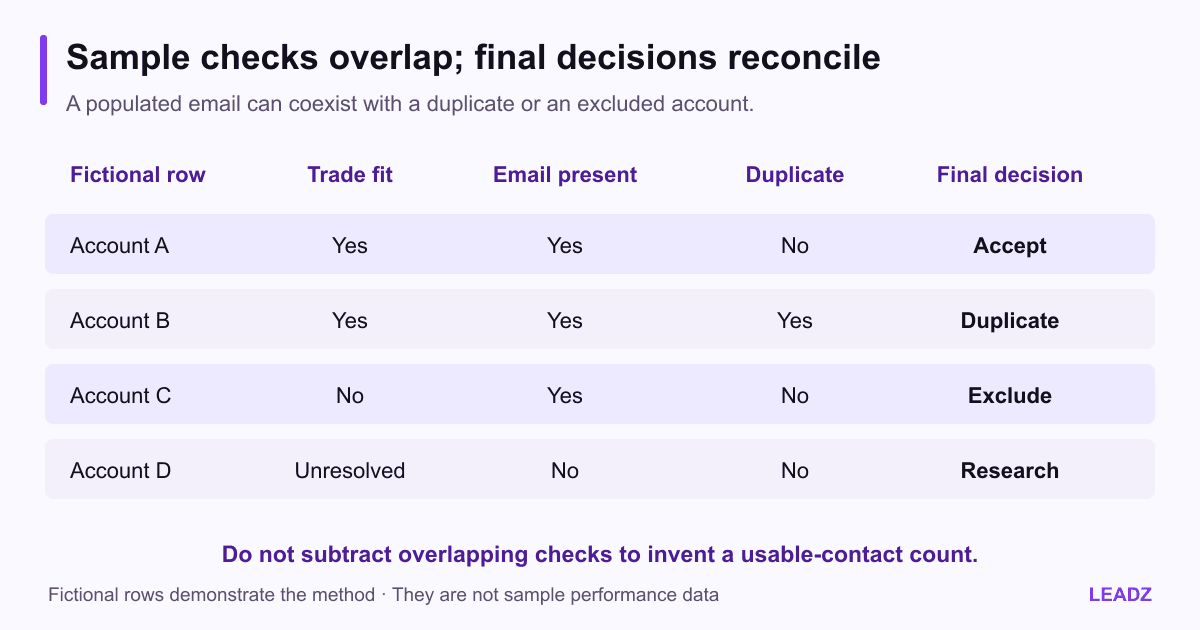
For each row, record the business identity, location, trade fit, possible account relationship, contact fields and evidence source. Use explicit values such as yes, no and unresolved where appropriate. A blank cell should not silently mean both “not checked” and “failed.”
Check the business website where available. Does it describe the service or business model required by your offer? Does the location fit the territory? Are several rows branches of one account? Is the contact route suitable for the next step? These questions are more useful than a single impression that the row looks complete.
Keep email availability separate from current deliverability and role suitability. A cell containing an address is an availability observation. It does not prove that the mailbox belongs to a named decision-maker or that the recipient welcomes the proposed use. The availability versus verification guide explains the distinction.
If several people review the sample, begin with a small shared set and compare decisions. Discuss disagreements, clarify the rule and revisit affected rows. An elaborate scoring system is not useful if one reviewer counts branches as duplicates while another counts them as separate companies.
Record the time spent on each type of uncertainty during this calibration. A recurring need to identify parent companies calls for a different improvement from a recurring need to check service areas, even if both produce the same unresolved label.
Keep overlapping checks out of a misleading funnel
The worksheet's illustrative 20-row example contains 18 category matches, two duplicate rows and seven rows with primary email. Using all reviewed rows as the denominator gives 90% category fit, 10% duplication and 35% email availability. These are separate observations about the same 20 rows.
The groups can overlap. A duplicate row might match the category and contain an email. Another email-available row might fail the trade criteria. Therefore, subtracting two duplicates from seven email rows does not establish five unique relevant contacts. You need the row-level intersections to answer that question.
For an acceptance funnel, assign one final disposition per row. A hypothetical reconciliation could be eleven accepted, two excluded for duplication, three excluded for fit and four unresolved. The total is 20. Keep additional issue flags, but do not count a row twice when reporting the primary outcomes.
Always name the denominator. Seven email-available rows out of 20 reviewed is 35%. If six of eleven accepted rows have email, that different question produces approximately 54.5%. Neither percentage should be substituted for the other. If no rows were reviewed, the rate is unavailable rather than zero percent.
Test whether the file can survive your import workflow
Data quality includes usability in the destination system. Inspect how multiple emails, phones and people are represented. Leadz exports can include available contact names and roles associated with saved email profiles; preserve those associations rather than treating every name as a new business or every role as belonging to all addresses.
Review the destination's current documentation. HubSpot's import guidance explains that files need property headers and appropriate identifiers for updates. Its particular rules should not be assumed to apply to every CRM. Confirm the behavior of the system you actually use.
Run a small controlled import with cases that exercise the important mappings: one new company, one existing account, a legitimate second location and a record with multiple contact values. Check ownership, relationships, missing-field behavior and rejected rows. Keep the original sample untouched so the import result can be traced back to the source.
The deduplication and suppression workflow covers the preparation in more detail. Reconcile existing accounts and contact restrictions before any campaign enrollment. An import that technically succeeds can still be unsuitable if it creates confusing relationships or bypasses established preferences.
Calculate working cost and test the uncertain assumptions
Use cost per account meeting your written rule, not just price per downloaded row. Include attributable data charges, review labor, cleanup and role research. Keep software fees separate from hypothetical internal hourly values so readers can see which amounts are actual and which are planning assumptions.
Suppose a fictional evaluation allocates $80 of data cost and three hours of work at $40 per hour. Total working cost is $200. If eleven accounts meet the acceptance rule, the cost is approximately $18.18 per accepted account. These figures are illustrative and are not current Leadz prices or an expected sample yield.
Test a less favorable case. If further review reduces the usable group to eight accounts and requires another hour, total cost becomes $240, or $30 per account. That change may still be acceptable for a valuable service, but the decision should be made with the extra work visible.
The small-business budget guide connects this calculation to contribution and capacity. Do not invent a close rate to make the purchase look affordable. Use ranges, state what is untested and choose a limited next step when the economics depend heavily on optimistic assumptions.
Make a decision the next reviewer can understand
Write a short review note containing the segment, sample-selection method, reviewed count, acceptance rule, findings, working cost and remaining uncertainty. Include examples of an accepted, rejected and unresolved record using fictionalized or appropriately handled information. The point is to make the reasoning inspectable, not to expose unnecessary contact details.
Choose among proceeding with a limited segment, refining the selection or declining the source for this use. A sample can fail because the target definition was too broad rather than because every record is poor. If so, change the segment and repeat the relevant checks. If the required people evidence is absent, budget research or choose a better-suited source.
Keep campaign outcomes separate from the sample report. Delivery outcomes, relevant replies, meetings and sales emerge later from actual use. They should be measured against the reviewed cohort and the communication process, not promised by a field-completeness score.
Retain the review as a baseline for the next purchase. If a later batch differs, compare selection rules, dates, fields and cleanup effort before drawing conclusions. A consistent evaluation process gives your team a practical way to improve data buying without relying on vague labels such as premium, accurate or verified.