
How to Sell Services to Restaurant Owners
Sell services to restaurant owners by connecting a specific deliverable to an operating decision they can evaluate. Define which restaurants fit, confirm who handles the subject and show the cost, staff effort and practical effect of your proposal. A broad promise to increase sales gives an operator little information about whether your service belongs in the business.
This guide is for suppliers and agencies approaching restaurants. It keeps that business-to-business task separate from marketing a restaurant to diners.
Choose a restaurant format and an operating problem
A café, a multi-location quick-service group and a hotel restaurant may need very different versions of the same service. Segment by the factors that affect delivery: ordering model, location structure, service hours, purchasing responsibility and the systems your offer must work with. Cuisine alone rarely provides enough information.
Write a practical account definition. A hypothetical photography service might target independent restaurants within its travel area that need a planned menu shoot. A maintenance supplier might instead require particular equipment and a viable service route. Both should identify exclusions before building a list.
Use current industry context to ask better questions, not to diagnose an individual restaurant. The National Restaurant Association's 2026 industry outlook describes cost pressure and interest in technology that improves operations. That does not establish that every owner wants another software subscription. Confirm the actual workflow and constraint.
The current restaurant trends guide can help organize those questions. Pick one problem your service can address and one outcome you can reasonably evaluate. “Make menu updates easier to maintain across locations” is more concrete than “transform your digital presence.”
Research the business before contacting the owner
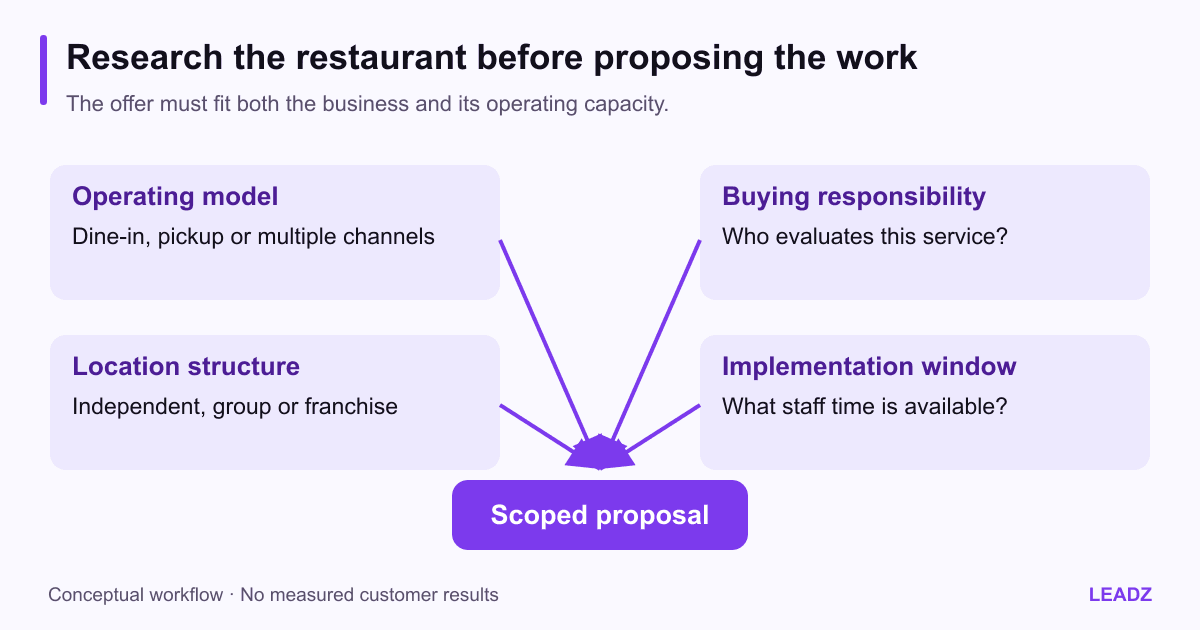
Start with the restaurant's own website and public business information. Check locations, ordering options, opening hours and the contact route for business inquiries. Record specific observations and their sources. Do not infer financial distress from a quiet social feed or a particular review score.
Use restaurant business records as an initial discovery source, then verify fit. A listed location may be part of a group with centralized purchasing, a franchise with constrained supplier choices or an independent operation. That relationship determines whether a local manager can assess your proposal or needs to route it elsewhere.
Keep the business record distinct from any person associated with it. An available email may reach reservations, customer service or a general office. Leadz exports can include available names and roles associated with saved email profiles, but those fields do not guarantee ownership or purchasing authority. The CSV field guide explains the relationship between business and person fields.
Build a short note for each account: why the offer might fit, what evidence supports that view and what remains unknown. This gives the salesperson a useful starting point and prevents a list of restaurant names from being mistaken for a list of interested buyers.
Make contact at the right operational level
Ask who handles the relevant subject instead of insisting on speaking to the owner. The manager responsible for menu updates may be the right initial contact for a content service. Equipment purchasing could follow another process. A head chef's expertise does not automatically make them the budget approver for your offer.
Use the restaurant's stated business-inquiry route. Do not disguise a sales approach as a reservation, catering order or customer complaint. If a call or visit is appropriate, respect the establishment's operational needs and arrange a suitable conversation rather than interrupting service with an unannounced demonstration.
A concise fictional introduction might say: “Your two locations publish separate menus online. We help small restaurant groups manage approved menu updates consistently. Who coordinates those changes for the business?” The observation should be true, and the question should match the service you actually provide.
Coordinate outreach across locations. A central contact should not receive the same proposal from three members of your team. The deduplication guide explains how to group related accounts while retaining useful branch information. Record the internal account owner and previous responses before each new contact.
Present the economics in the operator's terms
Explain what the restaurant pays, what staff must do and what changes operationally. For an ordering tool, discuss setup, menu maintenance, fees and support. For photography, discuss preparation, shoot duration, image rights and how the images will be delivered. A promise of revenue growth should not replace this basic scope.
Distinguish revenue from contribution. A new order has ingredients, packaging, payment costs and potentially additional labor attached to it. The amount available to cover a service fee depends on those costs. Let the operator supply actual figures rather than presenting a universal restaurant margin.
Consider a hypothetical service costing $240 per month. If the operator estimates $8 of contribution per additional order after the relevant variable costs, the service would need 30 incremental orders to cover that fee: $240 divided by $8. That calculation excludes setup and staff time and does not show that the service will generate those orders.
If contribution is only $4, the requirement becomes 60 orders. If the restaurant is already at capacity during the promoted period, more demand may not be useful. A sound proposal identifies these conditions before launching a campaign. The small-business budget guide develops this kind of capacity-aware planning.
Design a pilot that staff can actually run
Choose a limited scope and a clear review period. A menu-information project could cover one location and a defined set of pages. A photography pilot could focus on a small group of dishes. A workflow trial could involve one team before extending to every location. The pilot should reveal implementation effort as well as commercial potential.
Write down responsibilities. Who supplies approved prices and descriptions? Who checks allergens or other regulated information where relevant? Who authorizes publication? Who handles corrections? Your team should not assume responsibility it is unqualified to take, and the restaurant should not discover an unplanned workload halfway through the project.
Use appropriate test information for demonstrations and obtain the required access through the business's normal process. Explain how the restaurant can retain its accounts, assets and approved content if the service ends. Clear handoff arrangements reduce uncertainty during evaluation.
Choose a stop or revise condition in advance. If staff cannot maintain the information, fix that problem before expanding. A pilot that identifies a poor fit early can save money even when it does not lead to a full contract.
Ask the operator to nominate someone who can report practical problems during the test. A weekly summary from the person doing the work can reveal missing instructions or duplicated effort before those issues become part of the permanent process.
Match proof to the claim being made
Show evidence relevant to the promised deliverable. A portfolio can demonstrate photography style. A documented workflow can demonstrate how approvals are handled. A customer result can be informative when its conditions and permissions are clear. None should be presented as a guarantee that a different restaurant will achieve the same commercial outcome.
If your offer includes local business profile work, use the platform's actual guidance. Google's Business Profile overview explains the basic service and eligibility. Do not imply that paying your agency is a fee required to create a profile, or that adding structured data guarantees a particular search appearance.
Keep reporting tied to the agreed scope. For an inquiry campaign, distinguish visits, inquiries, suitable opportunities and completed sales. For an operational project, show completion and usage before claiming commercial effects. The campaign metrics guide helps define denominators and avoid treating activity as revenue.
When the evidence is incomplete, say what is known and what needs more time. For example, the new pages may be live and accurate while the effect on inquiries remains uncertain. That is a more useful report than assigning a precise return to a short period with no credible comparison.
Build a repeatable supplier relationship
After the first project, document the accepted deliverables, responsible people, update schedule and unresolved decisions. Give the restaurant a clear route for corrections and support. If your service requires recurring input, explain the expected effort and timing before renewal.
Review whether the original account definition was useful. Did the restaurant format fit? Was purchasing centralized? Did staff have the capacity to support the work? Use these findings to improve the next shortlist. Avoid expanding to every restaurant category merely because one project went well.
Keep follow-up relevant to an actual need. A planned menu change, a new location or a contract review may justify a discussion when you have appropriate context. Repeated generic messages about growing sales rarely add value. Respect a rejection and preserve the contact preferences your team has received.
Begin with a few restaurants whose operating model fits your offer. Prepare one clear scope, one honest demonstration and one practical question for each. The aim is to make the owner's decision easier: what will change, what will it require and how will both sides know whether the work was worthwhile?