
Restaurant Industry Trends for 2026: What to Test in Your Business
The restaurant trends worth acting on in 2026 are the ones that improve a specific operating decision: how to offer value, manage work, serve off-premises orders and maintain a useful customer relationship. Evaluate each change against contribution, staff capacity and the guest experience before buying technology or launching a promotion.
This article was substantially updated on September 23, 2026. Its original URL retains “2023,” but the guidance below concerns the current 2026 operating environment. Forecasts and historical comparisons keep their actual dates.
Read the 2026 outlook without turning it into a promise
The National Restaurant Association's February 2026 outlook projected $1.55 trillion in restaurant and foodservice sales for the year, with real growth of 1.3%. These are national forecasts, not completed 2026 results or a prediction for an individual restaurant. The 2026 report summary is the source for those figures.
Recent employment data also need their own label. In its September 4, 2026 analysis, the Association reported that eating and drinking places added 59,200 jobs in August, using preliminary seasonally adjusted BLS data. A single month's change can be revised and does not describe every restaurant format or local labor market. See the dated employment analysis.
For an operator, these reports provide context for questions about demand and staffing. They do not establish that your restaurant should add hours, raise prices or invest in a new ordering system. Those decisions need your own order mix, costs, capacity and guest feedback.
Compare like periods in your business records. A busy holiday week should not be compared casually with an ordinary week, and revenue growth should be separated from price changes. Write down the decision you need to make before selecting the industry statistic that might inform it.
Offer value while protecting contribution
Value can mean a clear price, a dependable portion, a convenient bundle or an experience the guest considers worthwhile. It does not always require a discount. Start by identifying the occasion you want to serve: a quick lunch, a family pickup order or a quieter midweek visit.
Calculate the contribution from a proposed offer using your actual costs. Consider a hypothetical $18 bundle with $7 in food and packaging costs and $2 in other incremental costs. It leaves $9 before fixed costs and any additional labor or promotion costs not included in the example. A $3 discount reduces that amount to $6; it does not merely reduce revenue by a harmless-looking percentage.
If the bundle uses capacity that would otherwise be idle, the economics may differ from a promotion during an already full service. Check whether discounted orders replace full-price orders or create additional demand. Without that distinction, a campaign can report more redemptions while leaving less contribution.
Use the small-business budget guide to plan a bounded test. Set a maximum spend, a review date and a contribution-based stop condition. The example figures are planning arithmetic, not typical restaurant costs or a recommended price.
Automate a bottleneck you can name
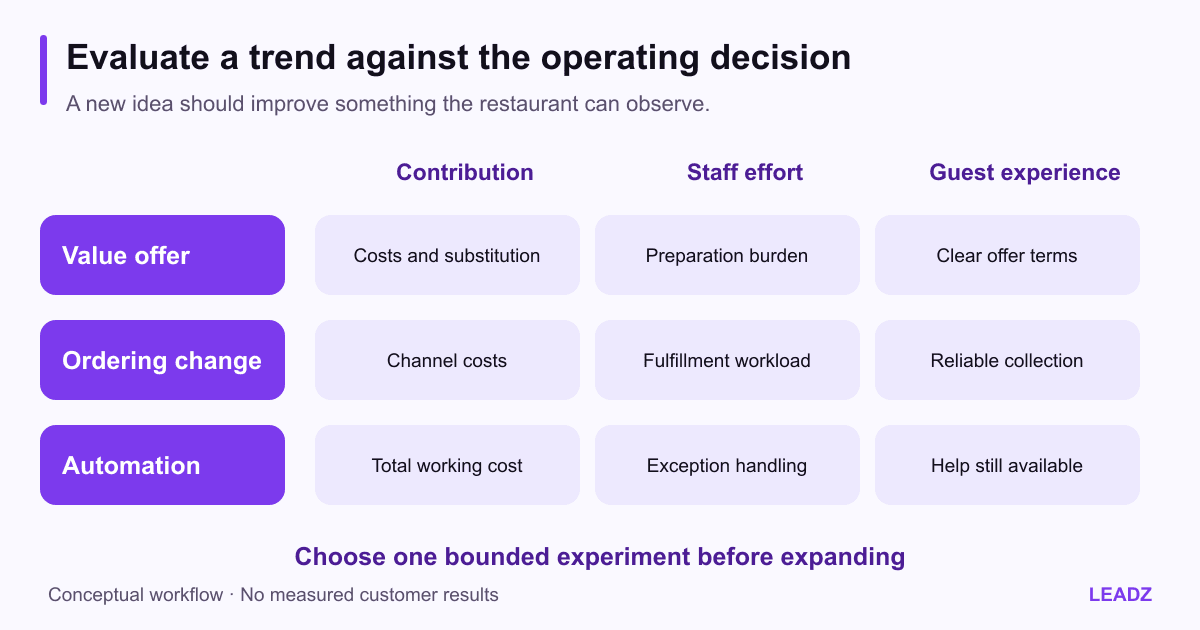
Start with an observed task that repeatedly creates delay or errors. It might be entering the same menu change in several places, transferring order details or reconciling information after service. Map the current process before evaluating a tool. Otherwise, automation can preserve the confusion while adding another system to maintain.
Ask what information enters the workflow, who approves it, where it goes and what happens when something fails. A menu tool needs a clear source for prices and availability. An ordering system needs a route for exceptions. A kiosk needs an alternative for a guest who cannot or does not want to use it.
Evaluate the full working cost: setup, integration, training, recurring fees, support and staff time. Do not assume that a technology purchase automatically reduces labor needs. It may shift work from one task to another or require ongoing supervision. Test that effect in the actual operating environment.
A useful pilot compares a defined task before and after the change, using a consistent method. For example, record how long an approved menu update takes and how many corrections are required. Keep that operational result separate from a claim about sales growth. Ask the staff who perform the task to review the result before deciding whether the change should expand.
Treat off-premises ordering as its own service model
Pickup and delivery orders have different packaging, timing and support requirements from a meal served at a table. Review whether the menu travels well, whether collection instructions are clear and how the kitchen handles demand arriving through several channels. Adding a channel without planning the workload can create a poor experience for both off-premises and dine-in guests.
Calculate channel contribution separately. A hypothetical $30 order may produce different results depending on packaging, payment costs, delivery arrangements and platform charges. Use the actual agreement and order costs; do not assume every platform has the same fee structure or that a higher order total means higher profit.
Keep availability and menu information consistent. If an item is unavailable, staff need a reliable way to update the relevant channels and handle existing orders. Confirm who owns that task during a busy service. A technology feature is only useful when the team knows how and when to use it.
Before expanding hours or delivery coverage, test a manageable window. Record fulfillment time, corrections, support contacts and contribution. Ask whether the change creates additional business or moves existing customers to a more expensive channel. The answer can vary by restaurant and by occasion.
Include the kitchen and front-of-house team in the review. A channel can look successful in an order dashboard while creating collection congestion or delays for seated guests. Record those effects alongside the sales figures.
Build a customer relationship with a clear purpose
A useful customer communication program answers a reason to subscribe: menu news, event announcements, availability or relevant offers. Explain what people will receive and honor their preferences. A purchased business list of restaurant owners is not a diner audience and should not be used as though it were a restaurant's customer list.
Segment messages only when the information supports a meaningful difference. Someone who asked about private events may need different updates from a regular lunch guest. Avoid collecting more personal information than the program needs or making assumptions about customers from a single order.
Make each message easy to act on. State the offer or update, relevant dates, terms and the next step. If an event has limited capacity, keep booking information current. Do not create false urgency or imply that a routine promotion is personally selected for every recipient.
The email campaign metrics guide explains why opens alone are an incomplete outcome. For a restaurant, examine the action relevant to the message, such as an appropriate booking or redeemed offer, then consider contribution and capacity. A busy inbox report cannot tell you whether the program was commercially useful.
Make the restaurant's story specific and supportable
Guests can learn about the people, ingredients and choices behind a restaurant when the story is concrete. Explain a supplier relationship, a recipe's history or a service decision using facts you can support. Avoid broad claims that a generation of diners universally prefers one mission or format.
If you describe local sourcing, identify what is actually sourced locally and the period or conditions involved. A seasonal ingredient does not make every menu item local. Environmental or health-related claims need appropriate evidence and review; a moving brand story does not remove that responsibility.
Community participation can also be described precisely. Name an event, partnership or contribution with permission where needed. The local restaurant economy guide explains why local impact should be tied to specific jobs, purchases and places rather than a generic multiplier applied to every business.
Use photographs and customer content only with appropriate rights and permissions. A tag or public post should not be treated as unlimited permission for advertising reuse. Plan a repeatable approval process so the team can share useful material without improvising ownership decisions during a campaign.
Choose one experiment for the next operating cycle
Create a short experiment sheet with the problem, proposed change, owner, cost, required staff effort and success measure. Keep the scope small enough that the team can observe what happened. Testing a new bundle, ordering system and loyalty program at once makes it difficult to identify which change caused which result.
For a fictional café, an experiment might offer a clearly priced afternoon bundle during an underused hour for two weeks. The team records orders, ingredient and packaging costs, additional staff work and whether regular full-price orders were displaced. The test ends on the planned date, even if the promotional report looks impressive.
For a different restaurant, the first experiment might simply fix inconsistent pickup instructions. Success could mean fewer clarification calls and fewer collection errors. That is a worthwhile operational outcome without attaching an invented revenue increase to it.
If an outside supplier is involved, agree on scope and responsibilities before starting. Ask for evidence relevant to your problem and a clear handoff plan. The best 2026 decision is the one your team can explain, afford and run reliably, with results measured against the purpose you set at the start.