
Generating Construction Leads: From Enquiry to Bid Decision
Generate construction leads by making the right project owner aware of your relevant work, then making it easy to submit a usable brief. Before increasing enquiries, define the projects you can deliver and the information needed for a bid decision. A large pipeline is not valuable if it consumes estimating time on work outside your scope, territory or capacity.
This guide is for a construction company seeking projects. Suppliers and agencies selling to contractors are working with a different audience.
Define the project you want to win
Describe the work in terms a colleague can apply: project type, location, approximate scope, operating constraints and preferred starting stage. A firm experienced in occupied-office refurbishment should make that capability visible rather than presenting itself as the answer to every construction need.
Include exclusions. If you do not handle a particular trade, project size or delivery arrangement, establish how enquiries will be screened or referred. Clear boundaries save time for the prospect and estimator. They also make your examples more persuasive to the audience you actually serve.
Review capacity with operations. Consider the availability of the project lead, crew, specialist trades and estimating staff. Marketing may create interest months before delivery, but the team still needs a realistic view of what it can assess and commit to.
Write an illustrative fit statement such as: “Commercial interior alterations in our service area, with an owner contact and enough information to assess the next phase.” Replace it with your actual criteria. Do not use a generic budget threshold copied from another business if your own costs and capabilities differ.
The contractor lead-generation workflow can help turn that definition into a repeatable process. Keep the qualification rule available to everyone who answers calls or reviews forms.
Make the website answer the first buying questions
A prospective owner needs to know what you build, where you work and whether you have handled similar constraints. Put that information ahead of broad claims about quality. Use project examples that identify the company's role and the scope delivered.
A useful project page explains the client's requirement, the important constraint, your work and the way the project was managed. Use photographs and names with appropriate permission. Avoid unsupported statements about cost savings or completion speed, especially when you cannot show the baseline.
Explain the enquiry process. Tell owners what information helps, what happens after submission and who will contact them. If an initial assessment has a fee or a defined scope, make that clear. Do not let a form suggest a guaranteed quotation when the project first needs design or investigation.
Keep forms proportional to the stage. An early enquiry may need location, project type, a short description and contact details. Ask for drawings through an appropriate route when they exist, but allow the owner to say that the scope is still being developed.
Use the construction-company hiring guide to understand the buyer's questions. Your website should make those questions easier to discuss, not try to bypass them with a vague promise that everything is included.
Choose channels according to the buyer and project stage
Referrals work best when contacts know the situations you can help with. Give architects, designers, property professionals and past clients a concise description of your fit. Ask for an appropriate introduction rather than a list of private details about people who have not joined the conversation.
Local search can help suitable owners discover the business. For eligible businesses, Google Business Profile's official guidance explains the profile's role and eligibility. Keep service information accurate and distinguish the profile from paid advertising or a guarantee of enquiries.
Project-focused content can answer preparation questions and demonstrate relevant experience. Choose subjects from actual enquiry conversations: working in an occupied property, preparing a scope or understanding the first assessment. Publish only explanations your team can stand behind.
Public-sector opportunities require their own process. The SBA identifies SAM.gov as a route to federal contracting opportunities. Registration, eligibility, solicitation requirements and bid preparation need separate attention. A public notice is an opportunity to evaluate, not proof that your business can or should bid.
A construction-business directory can support partner or subcontractor research. It does not identify property owners with live projects. Use each data source for the population it actually describes.
Qualify the enquiry before investing in a bid
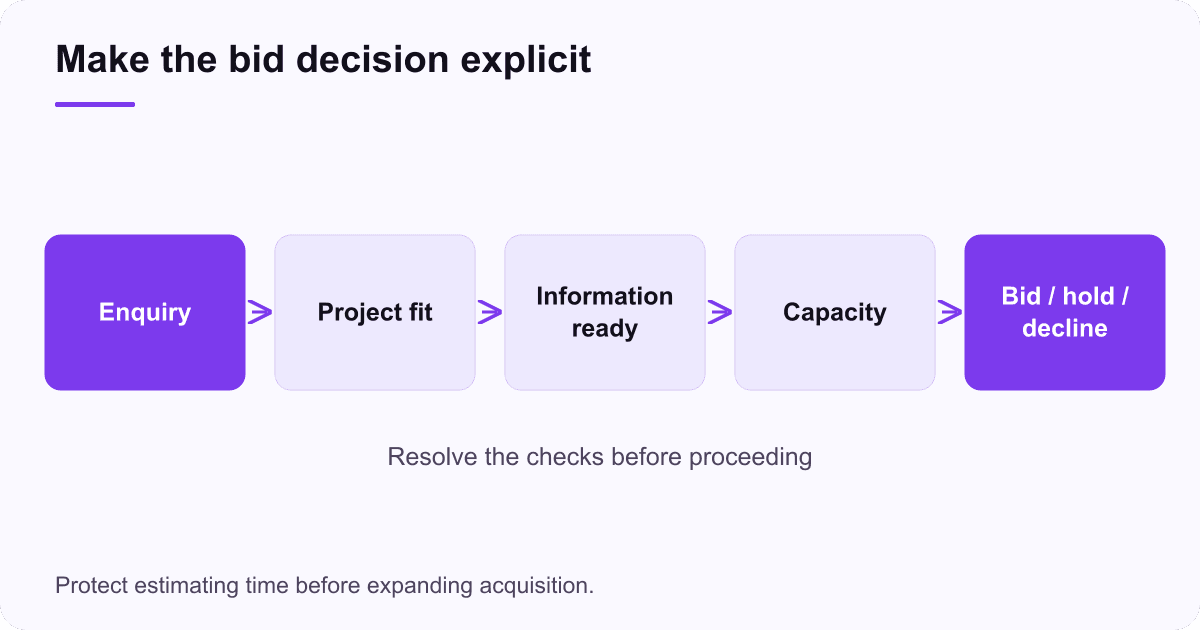
Give every enquiry an owner and an initial status. Review whether it matches the service and territory, whether the requester can help clarify the project and whether enough information exists for the next discussion. Keep “needs information” separate from “unsuitable.”
Ask questions that change the decision. What is the intended use? Who controls the property? What has already been designed? Which date matters and why? Who is making the appointment? The goal is a useful next step, not an interrogation that demands a complete tender package immediately.
Question | Why it matters |
|---|---|
Does the scope fit our capability? | Avoids bidding work the team cannot deliver |
Is the location serviceable? | Connects the project to access and supervision |
What information exists? | Determines assessment or estimating readiness |
Who makes the decision? | Establishes a route for scope and commercial questions |
What timing is required? | Tests capacity and key dependencies |
What remains uncertain? | Creates a specific follow-up task |
The lead qualification guide provides a general framework. Adapt it to construction rather than treating a contact name and phone number as a fully qualified project.
Record a bid, hold or decline decision with a reason. A hold should identify the missing information and review date. Otherwise it becomes an unowned list of projects that never move.
Protect estimating capacity with a simple model
Estimating consumes skilled time before a contract is won. Track that work so a rise in enquiries does not hide a fall in useful output. Include site visits, clarification, take-offs, pricing and proposal preparation in the effort you review.
Consider a hypothetical month with 30 enquiries. Twelve fit the initial criteria, eight provide enough information for a bid decision and six are selected for proposals. If each proposal uses ten staff hours, the proposal workload is 60 hours. The six proposals are not six contracts.
Suppose two proposals are accepted within the stated period. The proposal win rate is 2/6, about 33.3%, while the enquiry-to-award share is 2/30, about 6.7%. These invented figures describe different denominators. They should not be presented as industry performance targets.
If the team only has 40 estimating hours available, the plan needs a change before more leads arrive. You might improve the bid selection, simplify an appropriate preliminary stage or allocate additional capacity. Sending more prospects to an already overloaded estimator is unlikely to improve their experience.
Use the small-business budgeting guide to connect cash spending with staff effort. A channel that produces cheap enquiries can still be expensive if most require substantial work before being rejected.
Follow up with a question that advances the project
A follow-up should refer to the actual status. If the owner is waiting for drawings, ask when those are expected and whether the bid timeline remains realistic. If a proposal has been issued, ask whether a scope clarification would help the decision. Avoid a sequence of identical requests for an update.
Agree the next contact during the conversation where possible. Record the action, owner and date. If the prospect says the project is postponed, update the record and decide whether a later check-in is appropriate. Do not continue an active-bid sequence as though the information had never arrived.
Email can support this process with project explanations and preparation content. The construction email guide separates newsletters, active enquiries and past-client communication. Use the format that fits the relationship.
Keep commercial commitments controlled. A salesperson should not promise a start date or scope that operations has not confirmed. If the customer's requirement changes, return the project to the relevant review rather than allowing an old proposal to stand for a new assignment.
When a project is lost, record the reason if known. Distinguish price, scope mismatch, timing, no decision and lack of information. “Lost” alone provides little guidance for the next campaign.
Review the pipeline from the first constraint
Once a month, compare enquiries, suitable projects, bid-ready projects, proposals and awards for a defined period. Include pending opportunities separately. Long construction cycles can make a calendar-month report misleading if new enquiries are compared with awards originating much earlier.
Look at the earliest stage that is not working. If enquiries are mostly outside your territory, revise channel targeting and service-area wording. If they fit but lack information, improve the preparation process. If proposals repeatedly stall, examine the offer, decision process and follow-up.
Read examples, not just totals. Review a few accepted, declined and pending projects with estimating and operations. The reason behind one awkward enquiry can reveal a wording problem that a percentage will not show.
Start the next improvement with one change you can observe. Publish a clearer project page, adjust the form or introduce a bid decision meeting. Keep the qualification definitions stable enough to evaluate the result. A useful construction pipeline is a set of projects the team understands and can act on, not merely a growing collection of names.