
How to Choose a Construction Company for Your Business
Choose a construction company by testing whether it can deliver your particular project under your operating constraints. Start with a shared brief, verify the relevant credentials and compare the same scope across proposals. The lowest initial figure is useful only when you understand what it includes, what remains uncertain and who will manage the work.
For an owner renovating a shop, office or other business property, a clear selection process can prevent misunderstandings before they become site problems.
Define the project before asking for a quotation
Write a short owner brief describing the property, proposed use, work areas and business reason for the project. Explain whether the business will remain open, whether neighboring tenants are affected and which dates are fixed. An opening target tied to a lease is different from a preferred completion date that can move.
Collect the information candidates need: available drawings, surveys, landlord requirements, equipment plans and known constraints. Identify missing information rather than letting every bidder make a different assumption. If you do not yet know what can be built, commission the appropriate feasibility or design work before requesting a firm construction price.
Decide which delivery arrangement you are considering. You might appoint designers separately and ask contractors to price a developed scope, or seek a package that includes defined design responsibilities. Ask your professional advisers to explain the implications for approvals, coordination and changes. A label such as “turnkey” still needs a detailed description.
The architect appointment guide can help when the business requirement has not yet become a coordinated design. For a project focused on the interior, the interior-designer hiring guide explains another part of the team.
Give every shortlisted company the same current documents and a route for clarification. Share material answers with the other bidders so you can compare their final responses on a common basis.
Shortlist for comparable work and an available team
Look for projects that resemble your constraints, not just your desired appearance. Working in an occupied building, coordinating restricted deliveries or completing phased handovers may be more relevant than a photograph of a larger project. Ask what the firm actually delivered and which members of that team would work on yours.
Meet the proposed project manager or site lead before appointment where practical. Ask how many other commitments they will carry, who covers an absence and who can make day-to-day decisions. A company's capacity matters at the time you need the work, not only in its historical portfolio.
Use a construction-company directory, professional referrals and local research to find candidates. Verify that each business handles your project type and territory. A broad category can include firms with very different capabilities, from small alterations to specialized construction.
Ask for a concise response to the brief before requiring a full proposal. It should identify relevant experience, likely timing, the proposed team and important information gaps. This lets both sides decide whether a detailed tender is worthwhile.
Avoid a shortlist so large that no candidate receives adequate information. Three well-matched responses can be more useful than ten hurried prices. That is a practical purchasing choice, not a prescribed number for every project.
Verify the business and investigate references
Check the contracting entity, applicable license or registration and the scope of work it is authorized to undertake. Requirements vary by location and project. Use the relevant regulator and building authority rather than assuming that a trade association membership answers the licensing question.
For a California project, the Contractors State License Board's hiring resources provide official routes to license checks and consumer guidance. Their rules are jurisdiction-specific; do not apply a California home-improvement requirement automatically to a commercial contract elsewhere.
Request insurance and any required bonding information for review by your adviser. Ask who carries responsibility for subcontractors and site activities. These arrangements need to fit the contract and property, so a reassuring phrase such as “fully insured” should lead to verification rather than end the discussion.
Call references with targeted questions. Did the firm communicate changes before proceeding? How did it handle access and disruption? Were completion records provided? What issue required the most owner attention? A reference who can describe the process gives you more useful evidence than a general statement of satisfaction.
Check whether the firm has worked with the proposed specialist trades before, but do not treat familiarity as the only selection criterion. The electrical-contractor guide shows the questions that arise when one specialist package has important operational consequences.
Normalize the bids before comparing totals
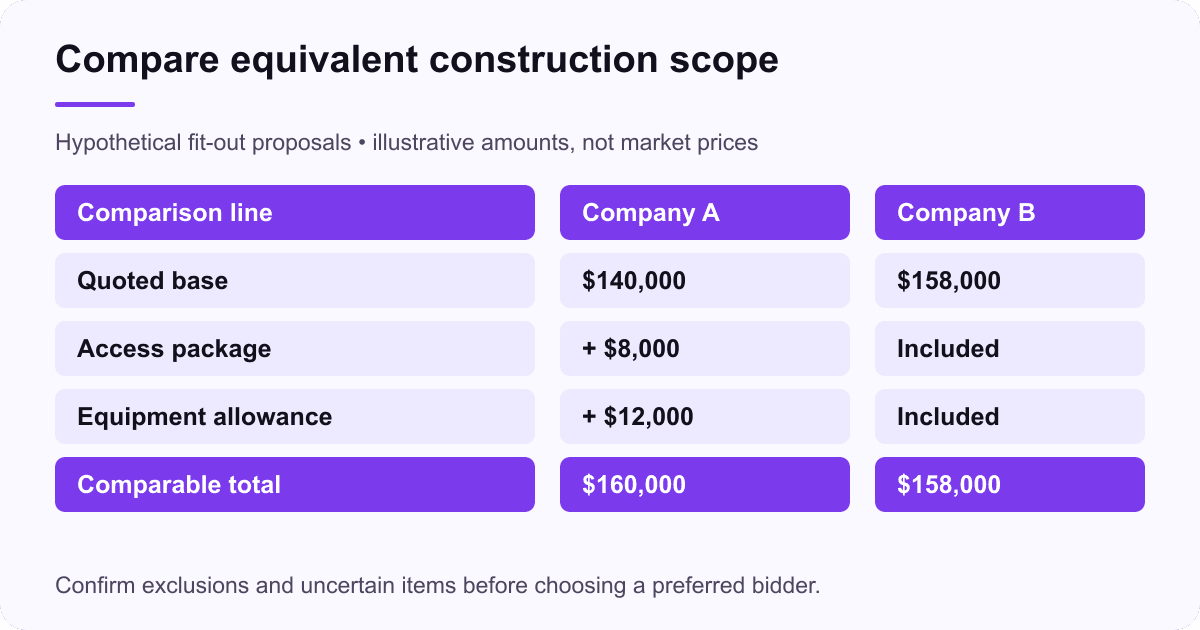
Create a comparison table that distinguishes fixed work, allowances, exclusions and owner-supplied items. Record assumptions about access, working hours, permits, disposal and making good. An allowance is a placeholder for defined uncertainty; it should not disappear inside a headline price.
Consider two hypothetical fit-out proposals. Company A offers $140,000, excluding an $8,000 access package and a $12,000 equipment-installation allowance. Company B offers $158,000 including those items. On the stated assumptions, A's comparable total is $160,000. This does not make B the automatic winner, but it changes the price question.
Comparison line | Company A | Company B |
|---|---|---|
Quoted base | $140,000 | $158,000 |
Stated access exclusion | $8,000 | Included |
Equipment-installation allowance | $12,000 | Included |
Comparable planned total | $160,000 | $158,000 |
These figures illustrate a method and are not market costs. Ask both firms to confirm how the uncertain items will be priced and approved. If an item cannot yet be defined, show a range or unresolved question rather than inventing precision.
Review quality and timing alongside the normalized total. A proposal may depend on an unavailable material, an unconfirmed subcontractor or owner decisions that have not been scheduled. Make those dependencies part of the evaluation before choosing a preferred bidder.
Test whether the schedule can survive ordinary changes
Ask for a schedule showing the main stages, long-lead purchases, owner decisions, inspections and handover. A start and finish date alone cannot explain what happens if one dependency slips. Identify the activities that control access to the next stage.
For an occupied property, request a phasing plan. Decide which areas remain operational, how deliveries enter, where materials are stored and who communicates changes to staff. The contractor should explain its proposed site arrangements; the owner should explain business constraints that the contractor cannot infer.
Agree a procedure for unforeseen conditions. Who records the issue, develops options, prices the change and authorizes the decision? Give the owner a response expectation that is realistic. A contractor cannot maintain a tight schedule if essential instructions remain unanswered for a week.
Separate changes you request from conditions discovered during work. Both can affect cost and time, but their causes and approval records differ. Keep a change register with a description, price status, schedule effect and decision owner.
Discuss what happens if a completion date moves. The contract and professional advice should address the actual project risks. Avoid relying on a verbal promise that the business can definitely reopen on a particular day regardless of approvals, deliveries or hidden conditions.
Make the contract and handover specific
The agreement should identify the parties, scope, documents, price basis, payment process, change method and completion obligations. Ask an appropriate adviser to review terms that affect significant risk. Standard forms still require project-specific entries and a shared understanding of responsibilities.
Tie progress reporting to useful evidence. A short weekly update can show completed work, next activities, outstanding decisions, changes and forecast dates. Photographs can support the report, but they do not replace an explanation of what the team needs from the owner.
Plan the handover package early. It may include relevant approvals, operating instructions, warranties, drawings, training and an outstanding-items list. Name the party assembling each part. For building services, identify the person who receives the records and learns how to request support.
Agree how completion and any remaining work will be recorded. A room that looks finished may still have an unresolved commissioning or documentation item. Conversely, a later owner preference should not silently become an unfinished original obligation.
Keep records in a durable shared location. When the property manager changes or a system needs maintenance, the next person should be able to identify what was installed, who supplied it and where the relevant information is stored.
Make a documented appointment decision
Bring the comparison together in a short decision note. State why the preferred firm fits the scope, which clarifications are resolved, what uncertainty remains and who will manage the appointment. Preserve the other proposals and the reasons they were not selected.
For example: “Preferred firm has completed comparable occupied-office work, provides the named site lead during our window and has clarified the access package. Final appointment depends on the landlord's access approval and the agreed services drawings.” That is more useful than “best quote” when someone later asks why the decision was made.
Confirm that the final contract incorporates the clarifications that mattered. Check the entity name, document revisions and scope against the selection note. A negotiated promise that never reaches the agreement can be difficult to rely on during delivery.
Your first action should be to assemble the brief and identify the missing decisions. Once the same information reaches suitable candidates, the selection becomes a comparison of how they will deliver the project. That process gives you a stronger basis for appointment than a low figure, a persuasive presentation or a large portfolio alone.