
Email Marketing for Construction Companies: A Practical Plan
Email can help a construction company explain its work, prepare prospective clients for a conversation and stay relevant to past clients or referral partners. Its value depends on the audience and the next decision. A message about a completed project should help a reader assess fit, while a follow-up to an active enquiry should resolve a specific question.
Build the program around those uses rather than a promised return for every dollar spent. Construction projects differ too much in scope and timing for an unrelated email benchmark to predict your results.
Choose the audience and the kind of project you want
Start with the work the company can profitably deliver and the territory it can serve. A firm focused on occupied commercial renovations needs a different audience from a residential builder or a specialist subcontractor. That distinction should shape the examples, language and action in the email.
Separate subscribers, past clients, professional referrers and active enquiries. They have different reasons to hear from the company. Record the source of the relationship and any communication preference so a team member can explain why a person receives a message.
A directory of construction businesses is not a list of property owners who want to hire your company. It may help a supplier research contractors or a subcontractor investigate potential business partners, but that is a different campaign. Do not mistake industry contact volume for customer demand.
For public newsletters, explain the content and expected frequency at signup. Give readers a clear way to leave the list. Keep project-specific communication in the agreed client workflow rather than relying on a marketing subscription to deliver essential project instructions.
The construction lead-generation guide helps define the wider acquisition process. Email should support a clear project niche and response system, not be added before the company knows which enquiries it can accept.
Use a project story to show how you handle constraints
A useful construction story explains the client's requirement, the constraint and the company's role. A photograph alone does not tell a prospective owner how the firm managed an occupied site, coordinated access or dealt with a limited work window.
Choose one point the audience will recognize. For an illustrative office-renovation story, the focus might be maintaining access to an occupied floor while another area was refurbished. Explain the planning approach in plain language, using only details you are authorized to publish.
Identify the actual scope delivered and credit other project participants appropriately. Do not claim responsibility for design, engineering or specialist work performed by others. Confirm permission for client names, photographs and commercially sensitive details before publishing.
Link to a page that provides enough context for a buyer to judge relevance: project type, location at an appropriate level, scope and the company's involvement. Avoid invented cost savings or claims that every similar project can follow the same schedule.
The guide to choosing a construction company is a useful resource for prospects. It helps them ask better questions about scope, team and handover, which can improve the quality of the conversation your email starts.
Send preparation content that improves the enquiry
Many enquiries arrive without the information needed to assess the project. An email can help an interested owner prepare a brief, gather available drawings or understand the first meeting. This benefits the owner and reduces repeated questions for the estimator.
Describe the information in terms of its purpose. The location establishes the service area; the intended use helps identify relevant experience; available drawings show what has already been developed; the target date reveals a planning constraint. Do not demand a complete technical package from someone who is still exploring feasibility.
An illustrative message might say: “Before we discuss your office alteration, it helps to have the property address, a short description of the work and any plans you already hold. If the scope is still uncertain, tell us what decision you are trying to make.” Use your actual enquiry process and service boundaries.
Keep the main action clear. A link labeled “Prepare your project brief” should lead to the checklist, not a generic home page. If the next step is a paid assessment or consultation, explain that accurately before the person books.
The contractor acquisition workflow can help connect this content to qualification and estimating. A useful email should make the next stage easier to perform, not merely increase the number of form submissions.
Match messages to the relationship stage
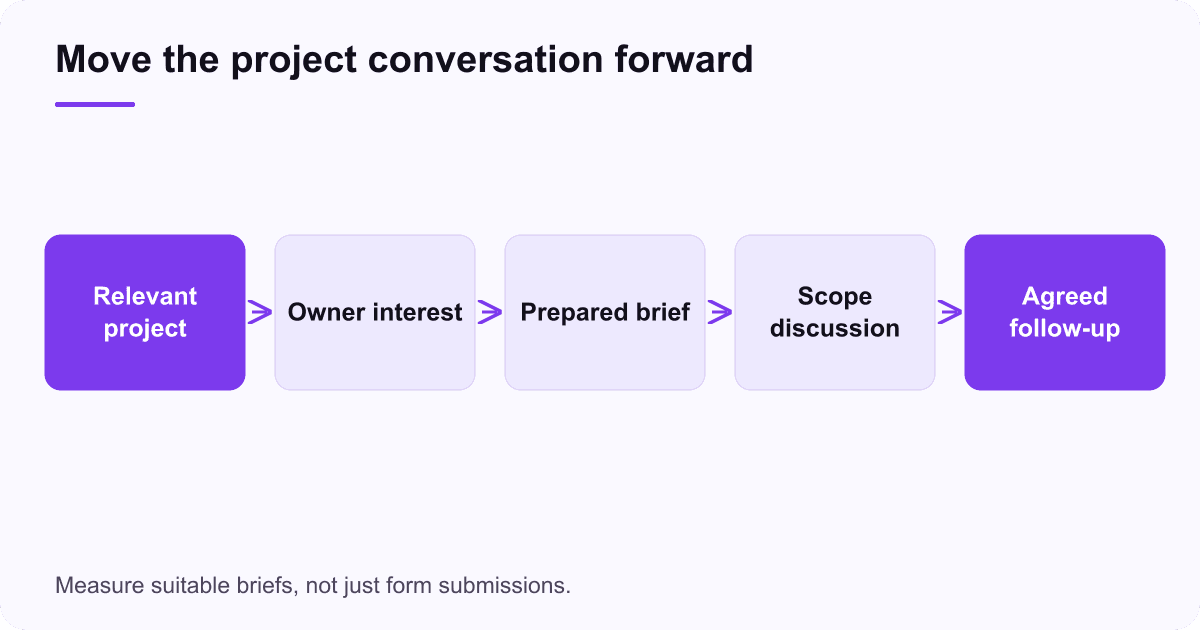
A general subscriber may need evidence of the company's approach. An active prospect may need a question answered before providing a brief. A past client may have a future phase or know someone with a suitable project. These are separate reasons to communicate.
Stage | Useful content | Next action |
|---|---|---|
Learning about the company | A relevant project and its constraints | Read the project explanation |
Preparing an enquiry | Scope checklist and first-meeting process | Submit a workable brief |
Active discussion | Clarification of an unresolved question | Supply information or agree a meeting |
Past client or referrer | A relevant service update or fit description | Make an appropriate introduction |
For an active prospect, reference the real issue. “You said the landlord's approval was still pending; would you like us to revisit the scope when that is clearer?” respects the conversation better than an automated demand to book immediately.
Keep a record of the response. If the project is delayed, closed or unsuitable, update its status. A marketing sequence should not continue as though nothing happened after the owner explains that the work has been cancelled.
Create a schedule your team can support
Start with a small content plan. One project explanation, one preparation guide and one relevant service update may provide enough material for an initial period. Choose timing around actual information and available review capacity rather than filling a weekly calendar with generic tips.
Assign an owner for facts, photographs, approvals and replies. Estimating staff should know what the campaign promises before it goes out. If the email invites site visits, confirm that someone can arrange and attend them within the stated process.
Check availability language carefully. A claim that the company can start next month may become false if another project is awarded. Use a current, qualified description of the enquiry process rather than a permanent promise embedded in an automated template.
Test the message on a phone. Essential information should be readable without loading a large image, and the main link should lead to the correct page. Inspect the form and confirmation as well as the email itself.
For U.S. commercial email, the FTC business guide covers sender identity and opt-out obligations. Follow the platform's audience rules and any other requirements applicable to the campaign. A public business address alone does not define the relationship.
Measure suitable enquiries and estimating effort
Define what counts as a suitable enquiry before reporting results. It might require a project type the firm handles, a serviceable location and enough information for a next discussion. Record incomplete enquiries separately so the team can see whether the preparation content is helping.
Suppose an illustrative campaign reaches 500 subscribers, receives 15 project enquiries and produces six suitable briefs. The enquiry rate is 15/500, or 3%. Suitable briefs represent 6/500, or 1.2%. If three progress to estimating, report that as a further stage rather than calling all 15 opportunities.
Add effort to the review. If preparing the campaign and handling enquiries takes ten hours valued at an assumed $40 per hour, the modeled labor is $400. With six suitable briefs, that is about $66.67 of modeled labor per suitable brief before other costs. These inputs are hypothetical, not construction-industry benchmarks.
A tender invitation is not a contract award, and an award is not the same as collected revenue. Track the later stages with dates and a stated attribution approach. Long project cycles make this particularly important: the first email may be one of several contacts before a commission.
The email metrics guide explains the denominators. Review the substance of enquiries alongside the numbers to identify whether the constraint is audience fit, scope clarity, pricing or capacity.
Improve the handoff before sending more
After the first campaign, ask the team what happened between the email and the next conversation. Were enquiries routed to the right person? Did prospects have the information requested? Were responses timely? Did the destination page explain the actual service?
If many enquiries are outside the territory, make the service area clearer. If people expect a different type of work, revise the project examples and scope description. If suitable prospects wait without an answer, fix ownership and capacity before increasing reach.
Use replies to develop the next useful topic. Repeated questions about working in occupied spaces may justify a focused explanation of how the company plans access and communication. Questions about early budgets may call for a guide to the information needed for a preliminary assessment, without promising a price before the scope is understood.
Keep a record of the approved message, audience rule, result and change made afterward. That makes the program cumulative rather than a series of unrelated sends. Email becomes valuable when it helps the right owner understand the company and take a well-prepared next step.