
Finding New Interior Design Clients: A Practical Pipeline
Find new interior-design clients by making the practice's fit easy to understand and the first step easy to take. Show the kind of problem you solve, explain the service and respond consistently to suitable enquiries. Then develop the channels that produce those conversations without consuming more time than the practice can deliver.
The seven approaches below work as parts of one pipeline. They are planning methods, not promises that a particular channel will produce a fixed number of clients.
1. Make the service recognizable to a specific client
Describe the project types and situations the practice handles. “Beautiful spaces for everyone” does not help a prospect decide whether to enquire. A more useful statement explains the environment, scope and starting point, such as a defined consultation for owners planning a small commercial interior.
Separate services that require different commitments. Advice on a room, a design package, procurement support and a full project appointment should not be presented as one vague offer. Explain what the first phase includes and how further work is proposed.
Choose a practical territory and project range based on the way you operate. Travel, site involvement and supplier coordination can affect what is realistic. If remote services are available, state their actual scope and what still requires local measurement or professional involvement.
Ask recent enquirers what they thought the service included. Their answers can reveal a mismatch between the website and your intended appointment. Correct that explanation before spending more money bringing people to the same page.
The client's guide to hiring an interior designer is a useful mirror for your offer. Prospects need to understand deliverables, purchasing arrangements and their own decisions before they can evaluate fit.
2. Turn the portfolio into evidence of how you work
Select projects that match the clients you want to attract. Explain the brief, the constraint, your role and a few decisions. A visitor should be able to tell whether you planned the interior, supplied selected products, coordinated procurement or contributed another defined service.
Use approved photographs and project details. Credit collaborators where appropriate and distinguish completed work from concepts. Do not borrow an image's visual authority to imply experience the practice does not have. A clearly labeled concept can still explain an approach honestly.
A strong project explanation connects appearance to use. For an illustrative reception redesign, describe how storage, circulation and seating were considered. Avoid unsupported claims about increased sales or employee performance simply because the finished image looks attractive.
Give each project page a relevant next step. A prospect interested in a similar scope should find the service description and enquiry route without guessing. If your availability or service has changed since the project, keep the current offer clear.
The email ideas for interior designers show how to reuse a project decision in a newsletter. The same underlying explanation can support the website, a referral conversation and a focused email without becoming a different claim on each channel.
3. Build referral relationships around a clear fit
Professional contacts can introduce suitable clients when they understand your work. Architects, contractors, property professionals and complementary suppliers may encounter relevant projects. Choose relationships based on actual overlap rather than compiling a large list of businesses with no reason to collaborate.
Give a potential referrer a concise description of the situations you help with. Explain the territory, service and appropriate first contact. Ask about their own work so an introduction can be useful to both sides rather than a one-directional request for leads.
A practical conversation might explore how an architect and designer divide responsibilities on a particular type of project. The architect appointment guide helps identify questions about scope and specialist coordination. Keep any collaboration consistent with each professional's authority and agreement.
Do not assume that a referral partner may share private client details freely. Prefer an introduction that lets the prospective client join the conversation. Make any referral arrangement transparent and check applicable professional requirements rather than inventing a standard commission practice.
An architecture-firm directory can support research into potential professional partners. It is not a list of owners actively seeking interior design. Confirm the practice's work and relevance before approaching it, and keep the message specific to a possible professional fit.
4. Create a useful first appointment
A first meeting should help both parties decide what comes next. Explain its purpose, preparation, duration and output. If it is a paid consultation, describe the fee and terms through your actual booking process. If it is an introductory call, avoid implying that it includes a complete design solution.
Ask for enough information to assess relevance: project location, intended use, broad scope, timing and the decision the client needs to make. Let the person identify uncertainty. Someone exploring a property may not yet know every detail that a full project brief would require.
Use a short qualification record. Note what fits, what remains unknown and whether the practice has capacity. Keep “needs clarification” separate from “not suitable.” A thoughtful follow-up can turn an incomplete enquiry into a useful brief.
For an illustrative prospect, the main question might be whether a reception-area refresh requires a focused consultation or a larger appointment. The meeting can establish the space, operational needs and available information, then propose the appropriate next phase. That is a concrete outcome even before any design begins.
The service-business acquisition guide provides a broader framework for moving from enquiry to appointment. Use it to make the handoff dependable rather than adding more fields to every form.
5. Reconnect with past clients through real context
A past client may have another phase, a new property or a suitable referral, but do not assume that every completed project creates an immediate upsell. Contact them with a relevant reason and respect their preferences.
Use what was actually discussed. If a client mentioned reviewing a shared area after several months of use, ask whether that is now a priority. If the practice has introduced a service relevant to their situation, explain it plainly. Avoid implying that the previous design is suddenly inadequate just to create demand.
A general past-client newsletter can share a project explanation or useful process guide, provided the subscription relationship is clear. Personal project follow-up and promotional newsletters should remain distinct. The opt-in email guide helps establish that boundary.
Record replies and preferences in the system used by the practice. If the principal learns that a client has moved or paused plans, the next automated message should not ignore that information. Consistency matters more than elaborate personalization based on guesses.
For U.S. commercial email, FTC guidance addresses identification and opt-out requirements. Apply relevant rules and the sending platform's audience policy to the communication you actually intend to send.
6. Test one channel against available capacity
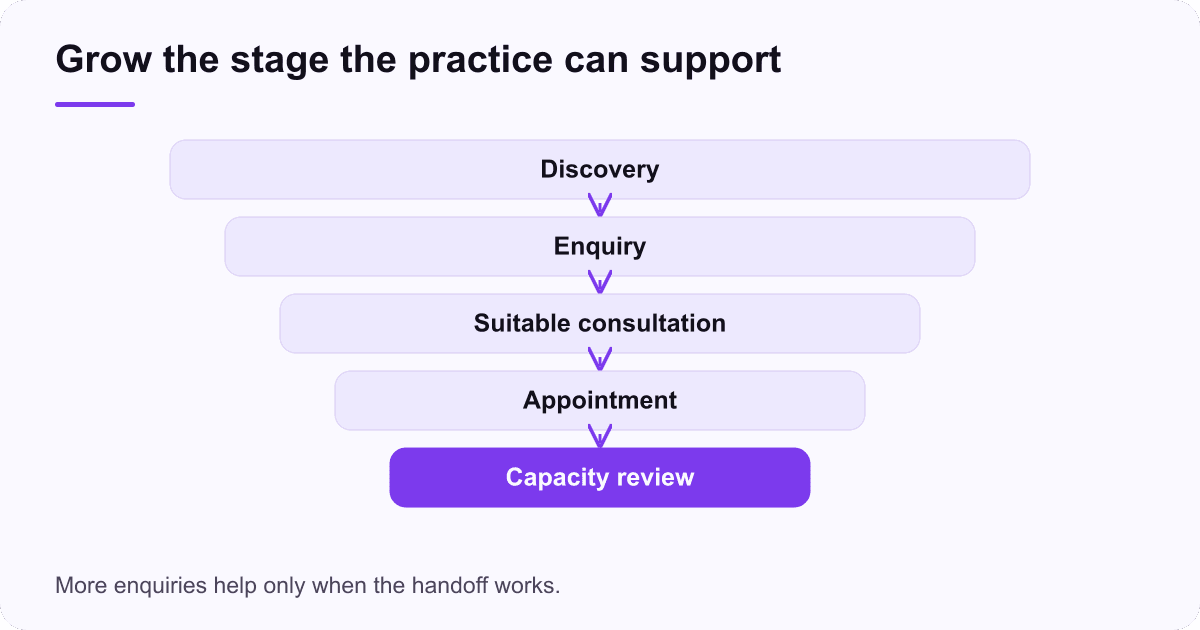
Choose a channel that reaches the defined audience and that you can maintain. That might be referrals, a useful local event, project-focused content or a carefully scoped promotion. Give the test a time and spending boundary, then define the outcome before it begins.
For eligible local businesses, Google Business Profile guidance explains the profile and its eligibility. An online-only service should not assume it qualifies in the same way as a storefront or service-area business. Keep business information accurate and choose channels appropriate to your operating model.
Consider a hypothetical month: 20 enquiries arrive, eight fit the practice's service and territory, five consultations occur and two projects are appointed. Suitable enquiries are 8/20, or 40% of enquiries. Appointments are 2/5, or 40% of completed consultations. The identical percentages describe different stages.
If each consultation requires two hours of preparation, meeting and notes, those five consultations consume ten hours. Add proposal work and delivery commitments before deciding the practice should double the enquiry volume. These invented inputs illustrate capacity planning, not expected conversion rates.
Use the small-business budget guide to connect cash and time. The channel with the cheapest enquiry is not necessarily the one producing the most suitable work per hour of owner effort.
7. Improve the stage that is preventing appointments
Review the pipeline with actual examples. If many enquiries are outside your scope, clarify the service and project pages. If suitable people hesitate before consultation, explain the first appointment better. If consultations do not lead to proposals, investigate whether the brief, budget expectations or timing are mismatched.
Keep pending decisions separate from lost work. A client waiting for a lease or another approval may need a later check-in rather than another sales sequence. Record the reason and the next date so the practice can follow up with context.
Choose one improvement at a time where possible. Rewrite a confusing service description, simplify the booking step or build a project page that answers a repeated question. Keep the definitions stable enough to see whether the change helped.
The campaign measurement guide can support reporting when email is part of the process. Across all channels, distinguish attention, enquiries, suitable conversations and appointed work.
Start by reviewing the last ten enquiries and identifying where each became clear or stalled. That small exercise often produces a better next action than launching another channel. A sustainable client pipeline grows from a recognizable service, credible work and a response process the practice can deliver consistently.