
How to Verify an Electrician Before Business Work Begins
Before hiring an electrician for a business property, verify the professional and contracting business against the rules for the project's location. Then confirm that the proposed work falls within their scope and that the agreement covers the job you actually need. A license is an important check, but it does not replace references, insurance review or a clear work order.
This article is a credential and appointment guide for owners and facilities managers. It does not provide instructions for performing electrical work.
Start with the location and the work being proposed
Write down the property's address and a plain-language description of the work. “Electrical services” is too broad to evaluate. Replacing equipment, investigating recurring faults, adding capacity and fitting out a new space may involve different responsibilities and approvals.
Ask the local licensing authority which credentials apply to the particular work and which body handles permits or inspections. Rules differ across jurisdictions and can include exemptions. A statement that a contractor is licensed somewhere is not the same as confirmation that the business can perform this job here.
Texas provides a useful example, not a nationwide rule. TDLR's electrical program explains that non-exempt electrical work generally must be performed by licensed people through a licensed electrical contractor. Its frequently asked questions address categories and exceptions. Use the equivalent authority in your location.
Keep the distinction between investigating a problem and carrying out a proposed repair. You may first need a defined diagnostic visit, with findings and options, before approving further work. Ask what that visit includes and how additional work will be authorized.
If electrical work is part of a wider alteration, discuss it with the project lead. The construction-partner selection guide explains why instructions and responsibility should stay consistent across trades.
Match the license record to the people and business
Collect the legal name of the business, its relevant license number and the identity of the person responsible for the work. Use the regulator's own search or contact channel to check the record. A screenshot supplied by the candidate can be helpful, but the current official entry is the stronger reference.
Compare names carefully. A trading name on a van may differ from the legal entity on a contract. That can be legitimate, but ask the business to explain the relationship. Do not accept a license number belonging to an unrelated person or firm as a substitute for confirmation.
Check status, category and any publicly shown restrictions. If the record uses language you do not understand, ask the authority what it means for the proposed assignment. Keep a dated note of the check and the source. Repeat it if there is a long delay before appointment or a change in the contracting party.
Ask who will attend the site and who supervises the work. A business may employ people at different stages of qualification under arrangements permitted locally. The useful question is how the actual team satisfies the applicable rules, rather than assuming everyone must hold the same credential.
Do not infer technical competence from a license alone. It provides evidence about regulatory status. You still need relevant project experience, a sensible assessment of the work and a clear route for resolving problems.
Treat five checks as separate decisions
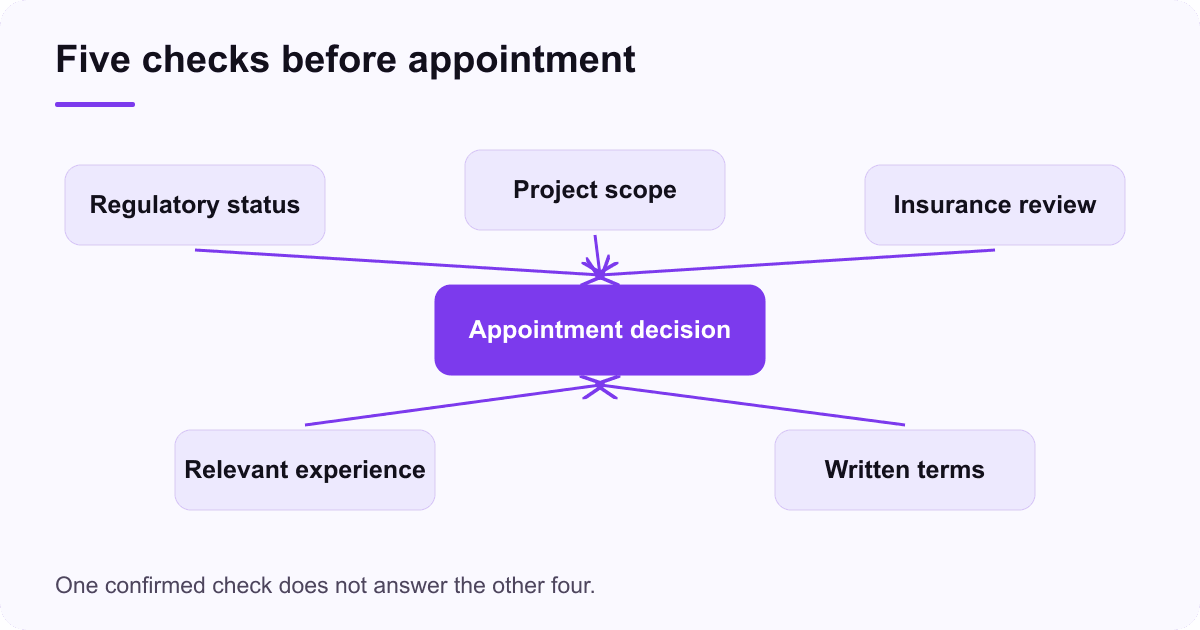
A common purchasing mistake is to let one reassuring fact answer every question. A licensed business may have the wrong availability; an insured business may propose an incomplete scope; a highly recommended individual may not be the contracting party. Keep the checks separate so gaps remain visible.
Check | Evidence to request | What still needs a separate decision |
|---|---|---|
Regulatory status | Current record from the applicable authority | Fit for the particular project |
Work scope | Written description and exclusions | Cost of excluded work |
Insurance | Current information for review by your adviser | Whether relevant losses fall within coverage |
Experience | Comparable references and assigned team | Availability during your work window |
Appointment | Named entity, price basis and change process | Ongoing owner approvals |
Use a simple status for each item: confirmed, needs clarification or unacceptable. Avoid averaging these into a single score when a missing item could prevent the appointment. An attractive price does not compensate for an unresolved question about who is authorized to do the work.
For an illustrative shortlist of three firms, suppose two have verified credentials, but only one can explain how it will work around your operating hours. The third firm's identity remains unresolved. You have one candidate ready for final clarification, one with a scheduling problem and one requiring a basic verification step. Calling all three “qualified quotes” would overstate the evidence.
Ask questions that reveal relevant experience
Describe the operating environment during the interview. An occupied shop, a production area and an empty renovation site create different access and coordination demands. Ask for examples with similar constraints and whether the proposed site lead participated in those projects.
Useful questions include how the contractor handles incomplete drawings, unexpected conditions and owner-requested changes. Ask who answers technical questions and who can approve a revised price. The answers should describe an ordinary working process, not depend entirely on the owner reaching the founder's mobile phone.
Contact references with a short, consistent set of questions. Was the work clearly described? Were interruptions communicated? How were changes handled? What documents arrived at handover? If a problem arose afterward, did the customer know how to get it assessed?
Be cautious with claims that every job finishes without complications. Existing buildings contain uncertainty. A good process makes that uncertainty visible and assigns decisions promptly. Ask the candidate to explain what it cannot confirm until the site has been assessed.
The electrical-contractor project guide goes deeper into bid comparison, shutdown planning and completion records. Use it once the credential checks have established who can reasonably be considered for appointment.
Put the agreed work and changes in writing
The work order should identify the property, the contracting entity, the scope, the price basis and the intended schedule. Include assumptions about access, existing conditions and supplied equipment. If the contractor needs information from a manufacturer or another designer, name the person responsible for obtaining it.
Distinguish a fixed price from an estimate, an allowance or time-based work. Ask what records will support charges and what requires approval before proceeding. The words should match the arrangement rather than relying on a total at the bottom of a page.
A worked comparison can help. Imagine Firm A quotes $4,800 for a defined installation but excludes a $600 access item. Firm B quotes $5,200 including that item. On those hypothetical inputs, comparable totals are $5,400 and $5,200. That arithmetic says nothing about workmanship; it simply prevents an incomplete price comparison.
Agree who can approve changes. For a small business, that may be the owner; for a larger property, it may be a facilities manager with a spending limit. Tell staff that requests made during a site visit should go through that person. A convenient suggestion can otherwise become unplanned scope.
Keep clarifications with the signed agreement. If the final decision depends on an email confirming after-hours work or an excluded item, preserve that message in the project record rather than trusting that both sides will remember it.
Arrange access, inspection and handover
Give the contractor accurate information about occupancy, equipment and access restrictions. Coordinate with the building manager and affected users before the work window. The qualified team should establish the technical work method; the business should establish who receives operational notices and who is available for decisions.
Ask which permits or inspections apply and who arranges them. Avoid a blanket assumption that a small job needs none, or that the owner must personally obtain everything. The answer comes from the applicable rules and the agreed scope.
Specify the completion evidence you expect. Depending on the job, that may include inspection documentation, relevant test results, updated information about the installation, equipment instructions and warranty terms. Ask the contractor to identify the appropriate records rather than requesting a generic certificate without understanding its purpose.
For work that interacts with heating, cooling or controls, coordinate the handover with the HVAC provider. A facilities person needs to know which contractor owns a later question. An unresolved interface can otherwise be passed between businesses while the owner waits.
Record outstanding items and the planned follow-up. Keep the final records accessible to whoever maintains the property. That preparation is useful even for a modest alteration because future staff may have no memory of why it was made.
Use directories to discover candidates, then verify them
An electrician business directory, a referral or a search result can help build a shortlist. Each is a discovery route. None substitutes for the regulator's record, the contractor's proposal or a conversation about the specific property.
Check the business website and contact details, then send a short enquiry with the location, problem, required timing and available information. Ask whether the firm handles that type of commercial work before requesting a detailed proposal. This avoids spending time comparing candidates whose normal service is a different fit.
Keep the first conversation focused on assessment and next steps. Do not send a vague request for a price and assume the cheapest response includes every requirement. If the business needs a site visit, clarify its purpose, cost and deliverable.
If a material question remains unresolved, resolve it before appointment. Verification is most valuable while you can still choose the provider and define the work. Once those decisions are clear, the project can move into scheduling with a shared understanding of responsibility.