
Hiring an HVAC Company for a Commercial Property
Choose a commercial HVAC company by matching its experience and service scope to your building, equipment and operating hours. Ask for an assessment before accepting a replacement recommendation, and define what maintenance, callouts and completion records are included. A low monthly fee tells you little if the contract leaves essential work or response expectations unclear.
This guide helps owners and facilities managers prepare that appointment. Technical design, refrigerant work and system adjustments belong with appropriately qualified professionals.
Describe the building and the problem you need solved
Start with a short equipment and operating summary. Record the building's use, normal occupancy pattern, operating hours and areas affected by complaints. Gather equipment details, service history and available drawings. If the information is incomplete, mark the gaps so the provider can plan an appropriate assessment.
Describe observations precisely. “Meeting room becomes uncomfortable during afternoon sessions” is more useful than “the system is bad.” Note when the problem occurs, which spaces are affected and what has changed, such as occupancy, opening hours or a new fit-out. Avoid diagnosing a technical cause from those observations alone.
Separate the assignment into investigation, routine maintenance, repair or replacement. You may need the first before deciding on the others. Ask what the investigation will produce: findings, measurements relevant to the issue, recommended options and unresolved questions.
For a leased property, confirm which equipment and decisions belong to the landlord. The business using the space may not have authority to alter a shared system. Establish the communication route before inviting providers to propose work that another party controls.
If the problem arose during a renovation, bring the construction project lead into the discussion. A building-service issue may involve the design, installation or operation of several systems, so keep the relevant parties informed.
Choose experience that matches the equipment and use
Ask candidates which kinds of commercial buildings and systems they regularly service. Experience with a small standalone unit does not automatically establish capability for a more complex installation. Request examples that resemble the equipment, access constraints and business schedule involved.
Identify the proposed service team and escalation route. Who attends routine visits? Who handles a fault outside normal hours? Is specialist support available when needed, and what does the contract actually promise? A sales statement about round-the-clock service should be translated into a defined contact and response arrangement.
Verify applicable trade credentials through the relevant authority. For refrigerant work, EPA's Section 608 certification guidance describes certification requirements for technicians performing covered activities. That credential addresses a particular regulatory scope; it is not a substitute for every local contractor requirement or evidence of competence with every system.
Ask about manufacturer familiarity and access to appropriate parts or technical information. If a provider recommends replacing equipment, request the reasons and alternatives. An older unit may warrant investigation, but age alone does not tell the owner the full condition or economics.
Use an HVAC-business directory to locate candidates, then confirm the current service offering directly. A business listing is a starting point for research, not a verified assessment of technical capability.
Compare service scope instead of contract labels
Terms such as “full service,” “preventive maintenance” and “priority response” need definitions. Ask for a task schedule, visit frequency, equipment list and exclusions. The schedule should be appropriate to the system and operating conditions, not copied from an unrelated property.
Clarify which consumables, labor and parts are included. Ask how callouts are charged, whether travel or after-hours premiums apply and what happens when a fault requires a specialist. Confirm whether the agreement covers investigation only or also certain repairs.
The Pacific Northwest National Laboratory guidance on service contracts examines operations and maintenance contracting for federal facilities. A commercial owner can adapt its contract-planning questions, while recognizing that federal procurement arrangements may differ. It is not current market-price research. Use it to identify which outcomes and risks your own agreement actually covers.
Contract question | Useful answer |
|---|---|
What equipment is covered? | A named asset list with locations |
What happens on a planned visit? | Defined tasks and reporting |
What counts as an emergency? | Agreed criteria and contact route |
What does response mean? | A stated action, timeframe and exceptions |
Who approves extra work? | Named owner contact and approval process |
What records are returned? | Service findings, actions and outstanding issues |
Ask the provider to walk through a realistic fault scenario. The explanation often reveals whether “priority” means a returned call, a scheduled visit or a specific attendance commitment.
Build a maintenance and fault-response plan
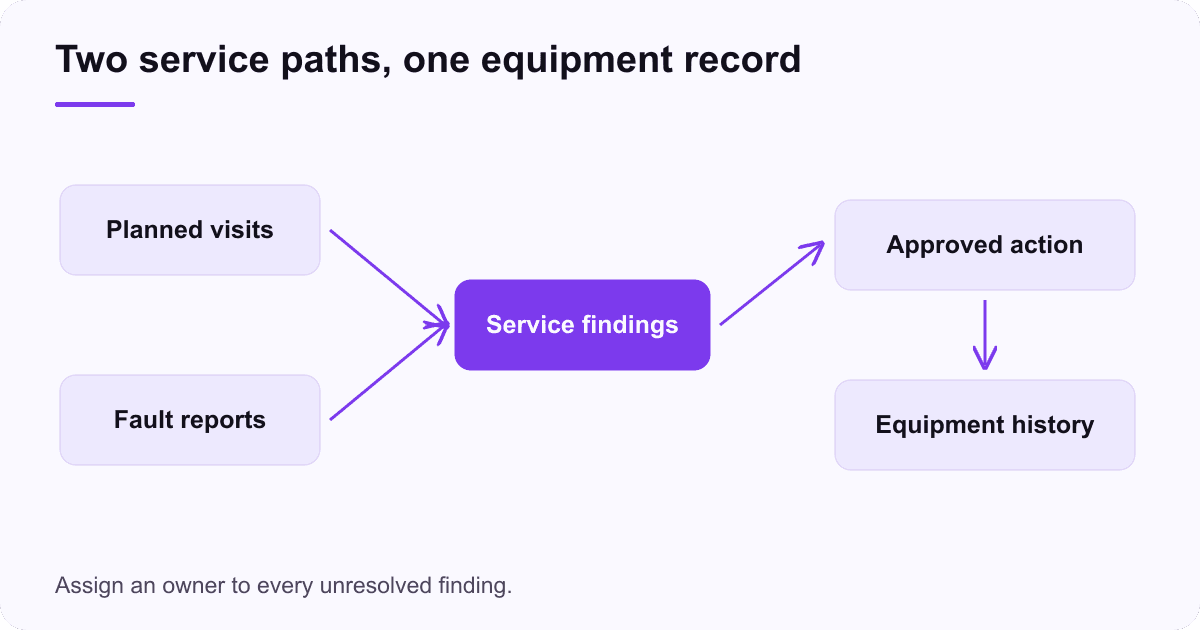
Routine maintenance and reactive service serve different purposes. Keep both in the plan. A calendar of visits does not describe how the business reports a sudden problem, and a callout number does not replace scheduled attention to the equipment.
For each planned visit, agree access requirements, affected areas and the information the provider returns. Someone on the owner side should read the report and assign decisions. Repeated recommendations can sit unresolved if reports are filed without an accountable reviewer.
Create a fault-report template with location, observed symptoms, time, operating conditions and contact person. Staff should report observations and follow the site's established procedures rather than attempting technical repairs. Give the provider enough context to decide the appropriate response.
Keep an asset history. Link service reports, repair approvals, warranty information and recurring issues to the equipment concerned. This makes later repair-versus-replacement discussions more informed than a recollection that “it has been troublesome.”
Coordinate interruptions with the business and other trades. If work involves electrical interfaces, use the electrical-contractor planning guide to establish who owns those decisions. Avoid asking one contractor to assume responsibility for another discipline without an explicit agreement.
Test the cost comparison with a realistic scenario
Compare annual planned costs and the likely charging structure for work outside the base agreement. Keep uncertain future repairs separate from guaranteed charges. A simple scenario can reveal how two proposals behave without pretending to predict the year.
Suppose Provider A proposes an illustrative annual maintenance fee of $2,400, with each of four assumed callouts charged at $250. The scenario total is $3,400 before parts and other exclusions. Provider B proposes $3,000 with those defined callouts included. B is $400 lower in that scenario, but may not be lower if the callouts never occur or if its exclusions differ.
These amounts are invented for comparison. Ask both providers to explain the included scope and what changes the charge. Do not present the scenario as an estimate of equipment reliability or an industry maintenance price.
Include owner time and operational effects when they matter. A cheap contract that requires repeated follow-up or poorly timed access may cost the business attention and disruption. Describe those effects rather than assigning an unsupported dollar value to every inconvenience.
For proposed replacement, request a separate comparison of capital cost, scope, warranty, operating assumptions and unresolved design work. Any projected savings should identify the baseline and assumptions. A higher efficiency rating alone does not establish the savings your specific building will achieve.
Evaluate comfort and air quality claims carefully
HVAC affects the indoor environment, but no service contract can promise that every comfort or air-quality concern has one mechanical cause. Occupancy, moisture, outdoor conditions, pollutant sources and building use can matter. Ask what the provider will assess and when another specialist is appropriate.
Define the problem in terms the business can observe and the professionals can investigate. If one room is consistently different from adjacent rooms, record the pattern. If complaints began after a change, include that timing. Avoid accepting a generic “cleaner air” promise as a complete diagnosis.
Ask for the basis of recommendations. What finding supports the proposed action? Which issue is it intended to address? How will the result be assessed afterward? A useful explanation connects the work to evidence rather than simply listing products.
Do not turn an equipment service into medical advice. Health concerns require the appropriate professional response, while the building team investigates conditions within its remit. Keep communications to staff factual and avoid claiming that a service visit proves the absence of every indoor-environment risk.
The licensed-electrician verification guide illustrates the broader purchasing principle: verify the credential, define the assignment and evaluate the evidence separately. None of those steps alone answers all the others.
Agree the handover and the next review
Before appointment, confirm the covered equipment, service tasks, response definitions, pricing rules and reporting format. Identify the owner contact who can approve work and the backup person available during absences. These details make a contract usable when a problem occurs.
For installation or major repair, ask what completion checks, operating information and training will be provided. Confirm who records settings and who holds warranty documents. The facilities team should know how to obtain support and what information to supply.
Schedule a review of the service relationship after enough work has occurred to assess it. Look at completed visits, unresolved findings, response performance and clarity of invoices. Ask whether the equipment list or building operation has changed and whether the agreement needs updating.
Start with the building summary and a shortlist of providers able to assess it. A well-defined HVAC appointment gives your business a practical maintenance routine and a clear response path. It also creates the records needed to decide on future repairs or replacement without relying on urgency alone.