
Hiring an Electrical Contractor for a Commercial Project
Hire an electrical contractor to organize and deliver a defined package of electrical work, with the people, planning and documentation the project needs. For a business, the decision often involves more than finding someone to install equipment. You also need to protect operating hours, coordinate other trades and understand what is included in the price.
This guide covers selecting the contracting business for a commercial project. For checking an individual license and its relationship to the contractor, use the companion electrician credential checklist.
Write the scope around the business operation
Describe the change you want to make before requesting a price. A new machine, office refurbishment and recurring fault investigation are different assignments. Include the equipment involved, its intended location, the business hours and any existing drawings. Let the qualified contractor determine technical requirements after reviewing the site and relevant specifications.
Avoid prescribing a solution based only on an equipment brochure. The building's existing supply, distribution, routes and other loads may affect what is feasible. Ask candidates which information they need to assess the work, and whether their initial proposal includes investigation or assumes that someone else has already completed it.
A useful brief describes the operational result. For an illustrative print shop, the requirement might be to accommodate a replacement press while preserving access to the adjacent production area. The brief should say when the press arrives, who provides manufacturer information and which work periods the shop can accommodate. It should not tell staff to make electrical changes themselves.
List interfaces with other parties. The equipment installer, landlord, building manager and general contractor may all have decisions to make. Identify who can authorize access, interruptions and changes. A contractor can price a clear responsibility more reliably than a collection of unconfirmed assumptions.
Add known documentation gaps to the brief. Missing circuit schedules or uncertain previous alterations are reasons to request an assessment, not to hide the uncertainty until installation day.
Understand what the contractor is taking responsibility for
An electrician is a person performing a trade role; an electrical contractor is the business engaged to provide a service. The legal relationship between individual and business credentials varies by jurisdiction. In Texas, for example, TDLR states that non-exempt electrical work generally requires licensed individuals working through a licensed electrical contractor. Check the rules where the project is located.
Ask which entity will sign the contract, which professional will oversee the work and who will attend the site. If subcontractors will be involved, identify their work and the party coordinating them. A sales representative's experience is not necessarily the experience of the crew assigned to your project.
Confirm the boundary between design and installation. Some packages use drawings supplied by an independent designer; others include a design responsibility. Ask how changes to the design are authorized and documented. Do not assume that “complete installation” includes every calculation, application and specialist service.
The construction-company hiring guide is relevant when electrical work sits inside a larger fit-out. Decide whether you will contract directly with the electrical business or whether the main contractor will appoint it. Either arrangement needs a clear route for instructions and payment.
Keep responsibility aligned with the contract. If the business accepts instructions from several people on site, cost and scope can change without the owner realizing it. Name the person authorized to request additional work and give the site team that information.
Compare proposals using the same scope
Ask each candidate to list included work, exclusions, assumptions and provisional items. A one-line price may conceal differences in access equipment, making good, testing, disposal or work outside normal hours. Those differences matter even if the proposed equipment looks identical.
Use a comparison sheet with the same headings for every contractor. Mark an unanswered question as unresolved rather than giving the lowest price the benefit of every doubt. A clarification can change the evaluation substantially.
Proposal item | What to ask |
|---|---|
Investigation | Is the existing installation being assessed, and what report is included? |
Equipment | What is specified, and who approves substitutions? |
Access and shutdown | Which hours, access arrangements and interruptions are assumed? |
Associated work | Who repairs finishes or coordinates other trades? |
Completion | Which tests, inspection records and handover documents are included? |
Changes | How are additional costs and schedule effects approved? |
Consider an illustrative comparison: Proposal A is $18,000 but excludes $2,500 of stated access work and a $1,000 after-hours allowance. Its comparable planned total is $21,500. Proposal B includes those items at $21,000. These invented amounts demonstrate scope normalization, not market pricing. You still need to evaluate competence and unresolved risks.
Ask what triggers a revised price. An unexpected condition is easier to manage when the agreement explains how it will be reported, assessed and approved. Preserve the written clarification with the final proposal so it remains part of the purchasing decision.
Plan interruptions before the crew arrives
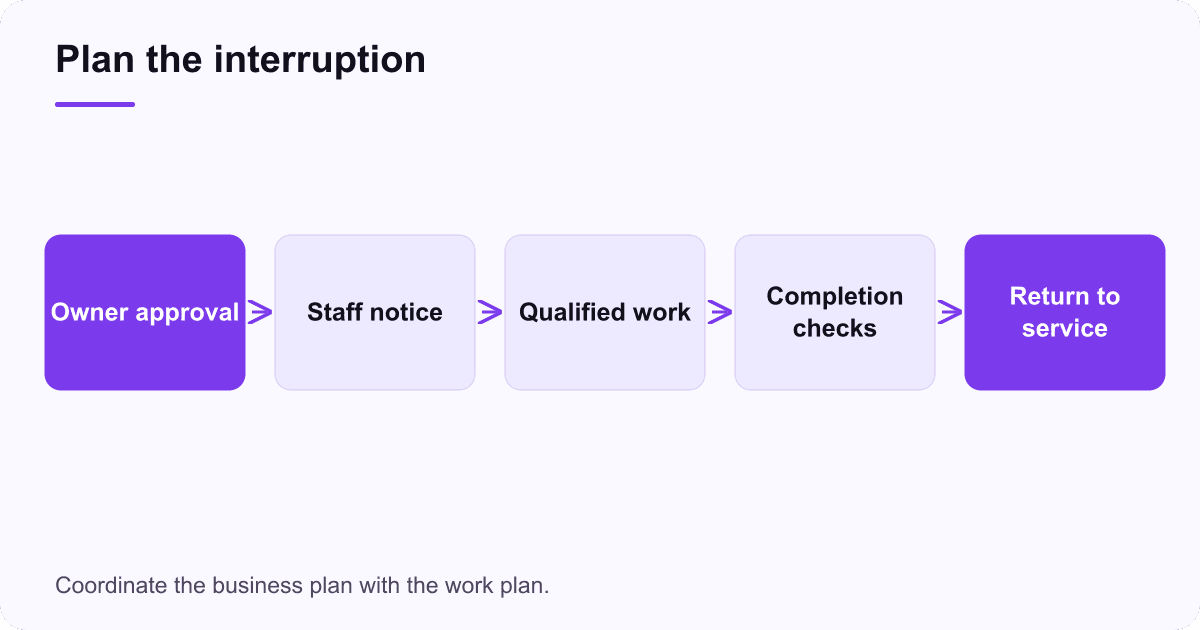
The contractor's work plan and your operating plan need to meet before any interruption. Identify activities that rely on the affected area: customer service, production, access systems, refrigeration, communications or tenant operations. Have qualified professionals assess the technical dependencies; your role is to explain the business consequences.
Choose a shutdown coordinator on the owner side. That person should know who approves the interruption, who receives notice and who decides whether the agreed operating conditions have been restored. A calendar invitation alone rarely captures all of those responsibilities.
For a shop that can pause production on a Sunday, establish what must be ready beforehand. Equipment delivery, access permissions and other trades may determine whether the work can proceed. Ask for a readiness review before the scheduled window rather than discovering a missing dependency after staff have gone home.
Agree how the team will respond if work cannot finish in the planned period. The answer may involve rescheduling, a qualified assessment of a temporary arrangement or a revised operating plan. It should not rely on untrained staff improvising a workaround.
Coordinate with HVAC and other building-service specialists where systems interact. The commercial HVAC contractor guide helps identify questions about controls, access and operating hours. Keep each contractor's technical responsibility explicit while sharing the information needed for coordination.
Check credentials, insurance and relevant experience
Look up the contracting business through the applicable regulator and verify that the record matches the entity on the proposal. Check the status and scope, not just the existence of a number. Ask the authority about anything you cannot interpret, including whether a particular category covers the proposed work.
Request insurance information appropriate to the project and confirm it through the relevant insurer or adviser. Licensing, insurance and bonding address different questions. A license does not establish that a particular loss will be covered, and a bond is not an unlimited warranty of workmanship.
Use references that resemble your project. For an occupied workplace, ask how the contractor handled access, notices, changes and handover. For equipment work, ask about coordination with the manufacturer or installer. The most useful reference is often about a problem and how it was resolved.
Review who will lead the site work and how that person's availability fits the schedule. A business may have relevant experience but be unable to allocate its suitable team during your required window. Ask for that constraint early enough to consider another date or candidate.
You can use an electrical-business directory to discover candidates, but validate the current information directly. Directory presence is a research starting point, not a licensing determination or an endorsement.
Specify completion evidence in the agreement
Decide what “finished” means before the job starts. The agreement should identify the physical work, the inspections or approvals required by the authority, and the documents needed by the owner. Ask the contractor to explain which records it provides and which come from another professional or agency.
Useful handover material may include updated schedules or drawings, equipment information, test records relevant to the work, warranty terms and a list of outstanding items. The exact package depends on the installation and jurisdiction. Avoid accepting a generic folder that does not identify the actual equipment and changes.
Arrange an owner walkthrough with the appropriate facilities person. They should understand the information needed to operate and maintain the completed work, and know whom to contact about a problem. Technical training should come from the qualified provider rather than being improvised from a label on a cabinet.
Record outstanding work with an owner and expected date. Separate an unfinished item from a later change requested by the business. That distinction helps prevent arguments over whether something belongs to the original price.
Keep the final records where the next facilities team can find them. Losing the documentation can make a later repair or expansion harder to assess.
Choose the contractor you can work with through a change
Price and availability matter, but the quality of clarification is revealing. A candidate who identifies a missing equipment specification and explains its effect is helping you make a better decision. A promise to handle everything without defining the work can leave the owner with more uncertainty.
Before appointment, resolve the questions that materially affect scope, cost or downtime. Agree the payment basis, change process, schedule assumptions and communications route. Have the appropriate adviser review the agreement when the project warrants it, particularly if several parties control the site.
For a smaller job, the paperwork can be brief and still be precise. A page identifying the work, exclusions, authorized contact and completion records is more useful than a long brochure. For a complex installation, expect a more developed package and time for technical coordination.
Start your shortlist with the operational brief, then evaluate candidates against it. The benefit of hiring a suitable electrical contractor is an organized, accountable process for delivering that work. The owner still has decisions to make, but those decisions become clearer and arrive before they disrupt the business.