
Email Marketing for Architects: Projects, Referrals and Follow-up
An architecture practice can use email to explain how it works and stay relevant to people who may commission or refer a project. Organize the program around relationships and project stages: a past client, an interested owner and a professional referrer need different messages. A portfolio becomes more useful when it explains a decision the reader recognizes.
This guide is for architects marketing their own practice. Agencies selling services to architects have a different task, covered in the architecture-firm prospecting guide.
Map relationships before choosing a campaign
Start with people who have a clear connection to the practice: subscribers, past clients, existing professional contacts and enquiries that remain active. Record the relationship, stated interests and any agreed follow-up. Keep newsletter preferences separate from a personal conversation about a specific project.
Group people only as far as the information supports. You may know that a subscriber is interested in small commercial spaces, but not whether they own a property or have a budget. Avoid writing as if an observed interest proves a purchasing intention.
For a small practice, a few groups are enough: prospective owners, past clients and referral partners. Add project-stage information only when it is known and useful. A long taxonomy that no one maintains can create less relevant messages than three clear categories.
Decide who owns replies. An email about an upcoming consultation should reach someone who can answer scope and availability questions. A principal's name in the signature does not help if the reply lands in an unattended marketing inbox.
For a public newsletter, explain the topic and frequency at signup and retain the preference. The opt-in communication guide helps establish that expectation. Keep the practice's professional and local requirements in view when deciding how to communicate.
Turn a project into an explanation of one decision
A finished photograph can attract attention, but the reader also needs to understand why the work matters. Choose one decision from the project: a constrained entrance, a phased occupation plan or a layout that supports several uses. Explain the brief, the options considered and the reason for the selected approach.
Use material the practice is authorized to publish. Confirm the permitted use of photographs, drawings, client names and project details. A portfolio should not reveal confidential information or imply sole responsibility for work delivered by a wider team. Credit collaborators appropriately within the publication arrangement.
An illustrative portfolio email might begin: “This small office needed quiet client meetings without losing a shared working area. The design separated the arrival route from the desks and kept the meeting room close to reception.” That tells the reader about a recognizable problem without inventing a performance statistic.
Link to a project page with enough context to evaluate fit. Include the project type, the practice's role and the relevant constraints. Avoid promising that the same design will work for every property. The first conversation should establish the reader's actual circumstances.
The owner's architect-selection guide is useful content to share with early-stage prospects. It explains the appointment in terms of decisions and responsibilities, which can improve the quality of the enquiry.
Give referrers a specific situation to recognize
Referral partners need to know when to think of the practice. “We welcome any project” is difficult to act on. A description such as “We help small commercial owners assess a space before committing to a fit-out” gives a professional contact a clearer reason to make an introduction, provided it reflects the practice's real work.
Write a short referral note with the project type, territory, typical starting stage and a suitable introduction route. Mention an actual capacity constraint if relevant, such as the earliest period for an initial assessment. Do not manufacture scarcity to encourage a hurried decision.
Offer something useful to the referrer's client. That could be a plain-language checklist of information to gather before a first meeting. It should help the owner prepare, rather than act as a disguised demand for a large amount of data before any conversation.
Keep the referral relationship professional. Do not assume a contact has permission to share another person's private details. Ask for an introduction through an agreed route, allowing the prospective client to participate in the next step.
If the practice collaborates with interior designers, the interior-design email guide shows how the adjacent profession can explain its own services. Use that distinction to make the referral handoff clearer rather than presenting both roles as interchangeable.
Match the email to the next project decision
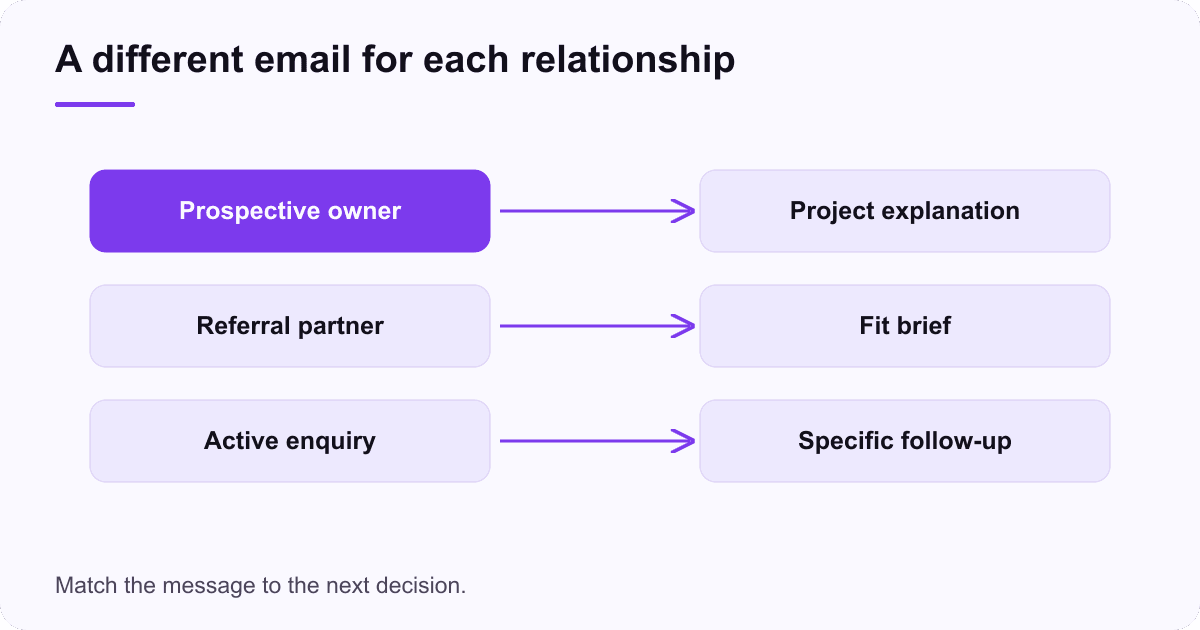
A prospective owner who has not chosen a property may need a feasibility conversation. Someone with a brief and a site may need to understand the appointment. A past client considering another phase may need a review of what has changed. Give each a next step appropriate to that stage.
Relationship | Useful message | Appropriate action |
|---|---|---|
Early-stage owner | How the practice assesses a brief and site | Request an initial scope discussion |
Professional referrer | Project situations the practice can help with | Make a relevant introduction |
Active enquiry | Clarification of the unresolved project question | Supply information or choose a meeting time |
Past client | A relevant update or invitation to discuss a new phase | Reply with current plans |
For an active enquiry, reference the real conversation. “You mentioned that the lease decision is expected in October; would it help to review the information needed for a feasibility appointment?” is more useful than a generic “just checking in.” Use only facts the person actually shared.
If the project is no longer active, record that and stop treating every silence as a request for another reminder. Ask whether the person wants future general updates through the appropriate subscription process. A personal follow-up and a newsletter are different relationships.
Create a small publishing routine the practice can sustain
Select a cadence around available material and review capacity. A quarterly project explanation with a clear purpose may be more useful than weekly messages assembled from stock claims. The practice needs time to check the content, rights, current service details and reply handling.
Keep a content list drawn from real work: questions owners ask, decisions that often delay a brief, useful explanations of appointment stages and project stories approved for publication. Record who can review each topic and which supporting material is available.
Write the email after deciding its destination. If the action is to read a project explanation, make that page current first. If it is to request a consultation, ensure the form asks for enough context without demanding a full project dossier. Test the complete route on a phone.
Use clear source, medium and campaign labels where website measurement is appropriate. Google's campaign-URL guidance explains how tagged links identify campaign visits. Those visits remain separate from conversations, appointments and commissions.
Before sending, read the message aloud. Remove sentences that merely say architecture is important or design is transformative. Replace them with the specific decision, constraint or action the email is meant to explain.
Measure suitable conversations and capacity
Define a useful enquiry for the practice. It might require a relevant project type, a location the team serves and a plausible next step. Keep that definition separate from the fact that someone clicked a photograph or asked a general question.
Suppose a hypothetical newsletter reaches 240 subscribers. Nine people reply, four describe projects that meet the practice's initial criteria and two arrange scope meetings. The reply rate is 9/240, or 3.75%. The suitable-enquiry rate is 4/240, about 1.7%. The meeting rate is 2/240, about 0.8%.
These invented results demonstrate the reporting stages. A meeting is not a commission, and a commission's value depends on the agreed service and delivery effort. Track the later outcome without rewriting the earlier campaign report to claim revenue that has not occurred.
Use the campaign-metrics guide to keep definitions consistent. Review the substance of replies as well as counts. If owners repeatedly ask whether the practice handles their project type, the service explanation may need improvement.
Check capacity before increasing reach. A campaign that creates good enquiries still needs someone to respond, qualify the brief and arrange the next meeting. If replies wait a week without ownership, expanding the list may worsen the experience.
Send the first campaign as a complete client journey
Choose one audience and one project story or question. Draft an opening that makes the relevance clear, use a suitable image with context and offer one next action. Have the project lead check factual accuracy and the responsible person confirm publication permissions.
For U.S. commercial email, FTC guidance addresses sender identification and opt-outs. Use an appropriate sending platform and follow its audience rules as well as the requirements applicable to the practice.
Test the email, destination page and reply route. Give the person handling responses a short briefing on the content and intended audience. After the send, record questions and next steps in the practice's normal relationship system.
Review the campaign once there has been enough time for the planned response. Keep the strongest explanation, correct confusing language and choose the next topic from what readers actually needed. Email then becomes a useful extension of the practice's project conversations rather than a separate stream of promotional noise.