
Types of Accountants: Choose the Right Business Support
Choose an accountant by the decision or obligation you need help with. Maintaining records, preparing tax returns, reviewing financial statements and investigating a discrepancy are different assignments. Professional titles and credentials matter, but the engagement should also identify the work, output, deadlines and responsibilities on both sides.
This guide helps a business owner describe the need before comparing providers. It is a selection framework, not advice on a particular tax position, investment or financial transaction.
Start with the work rather than the title
List the questions your business cannot answer reliably today. You might need to know whether invoices are recorded correctly, why cash is tight despite reported profit, what information a lender requires or how to respond to a tax notice. Each points toward a different service.
Distinguish recurring work from a one-off assignment. Monthly recordkeeping needs an agreed workflow and handoff. A transaction or investigation may need specialist experience and a defined deliverable. Combining everything into a vague request for “an accountant” makes proposals difficult to compare.
Gather the basic context: business structure, locations, accounting system, reporting periods, transaction volume and upcoming deadlines. Describe known gaps honestly. A provider can estimate cleanup work more sensibly when it knows which months are incomplete and what records exist.
Write a short outcome statement. For example: “Close the books monthly and give the owner a report explaining cash movement and overdue receivables.” That is more actionable than “improve finances.” A separate tax engagement might use the same records but have its own review and filing responsibilities.
Keep legal and financing questions connected to the right advisers. The guides to business legal-service selection and choosing a mortgage broker explain adjacent roles that an accounting appointment does not automatically cover.
Bookkeeping and financial reporting support
Bookkeeping work concerns recording and organizing transactions, reconciling accounts and maintaining the underlying records. Depending on the engagement, a provider may help with invoices, bills, payroll information or month-end routines. Establish which tasks it performs and which your staff retain.
Accounting support can build on those records to produce financial reports and explain them. Ask who reviews unusual transactions, how corrections are approved and what the owner receives each period. A report delivered without context may leave you with the same unanswered business question.
Define a close calendar. It might include a date for staff to submit documents, a review of missing items and a meeting to discuss the completed period. The exact timing depends on your operations. What matters is that the provider and owner share the same expectations.
For an illustrative small agency, the owner might submit expense information by the fifth working day, review open questions in the following week and then receive the monthly pack. That is a suggested workflow, not a statutory deadline. If information arrives late, the process should show the effect on reporting.
Ask about access and ownership. Use individual accounts where supported, clarify who controls the accounting subscription and retain access to your records. Decide how files and documentation will be handed over if the engagement ends.
Tax preparers, CPAs and enrolled agents
Tax work is a service area, while CPA and enrolled-agent status are credentials with different governing frameworks. A credential does not tell you every service the person offers. Ask about experience with your business type, jurisdictions and the particular issue involved.
The IRS overview of tax-preparer qualifications distinguishes credentials and representation rights. In broad terms, CPAs are licensed through state boards, while enrolled agents are licensed by the IRS. Verify the relevant credential and current status through the appropriate source.
The IRS guidance on choosing a tax professional provides a starting point for finding and checking preparers. Its directory includes specified credentials and qualifications; it is not a complete ranking of every competent provider.
Describe the requested tax work precisely. Return preparation, planning, notice response and representation are not interchangeable. Ask who signs the return, who reviews it with you and what support is included after filing. Confirm deadlines and required information in the engagement.
Avoid choosing on a promised refund or guaranteed reduction before the professional understands the facts. A sound proposal explains the process, fee basis and information needed. The owner remains involved in reviewing the return and supplying complete records.
Management accounting and finance leadership
Management accounting focuses on information used to run the business: costs, margins, budgets and performance. A provider may help design reports, compare actual results with plans or understand the economics of a service line. The assignment should connect to a decision you can act on.
For example, imagine a business reports $80,000 of monthly sales and $50,000 of variable delivery costs. The illustrative contribution is $30,000 before fixed and other remaining costs. If one service line consumes much more staff time than expected, a useful analysis investigates that pattern rather than simply repeating the total revenue figure.
A controller or fractional finance leader may coordinate reporting, processes and planning at a broader level. Titles vary, so ask for responsibilities rather than relying on the label. Who prepares forecasts? Who challenges assumptions? Who supervises the close? Who communicates with the lender or board?
Discuss the quality of the underlying records before buying a sophisticated dashboard. Missing expenses or inconsistent classifications can make a polished forecast misleading. The first phase may need to repair the input process before producing more detailed analysis.
Agree how recommendations will be tested. A budget is a model with assumptions; it should be revisited against actual results. Ask for an explanation that lets the owner see which variables changed and what decision follows.
Assurance, audit and investigation are distinct assignments
An external audit or another assurance service has a particular purpose and professional framework. Ask the intended recipient—such as a lender or investor—what level of work it requires before commissioning a report. Do not assume that ordinary bookkeeping or tax preparation satisfies that request.
Internal audit work examines processes and controls within an organization. It can address a different question from an external financial-statement audit. Define the area under review, reporting route and expected output so the assignment has a useful boundary.
Forensic accounting may be appropriate when there is a disputed transaction, suspected irregularity or need to analyze records for a legal matter. Involve legal counsel where appropriate and agree how evidence will be preserved. Avoid asking staff to alter or tidy the underlying records before a specialist has advised on the process.
If a lender asks for financial information, obtain its exact requirements. A business can waste time purchasing the wrong report because “certified accounts” was interpreted differently by the owner, provider and recipient. Have the accounting professional explain the proposed service and its limitations in terms the recipient accepts.
Independence and professional requirements can affect who may perform particular work. Ask the provider to assess those questions before appointment. A firm that maintains your records may not be suitable for every separate assurance role you later need.
Compare proposals with an engagement map
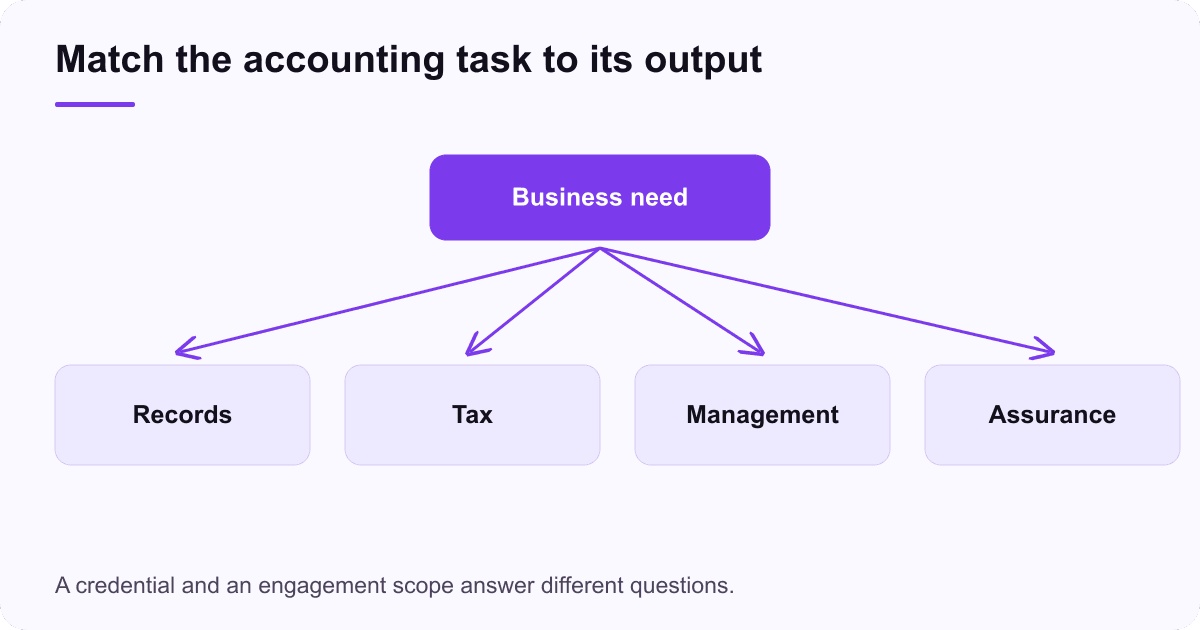
Create a one-page map of the work, output and owner. This helps you compare a small firm, an individual specialist and a broader service provider without pretending that they offer identical packages.
Business need | Output to define | Selection question |
|---|---|---|
Reliable monthly records | Reconciled accounts and a close process | Who resolves missing information? |
Tax compliance | Specified returns and review responsibilities | Does the provider handle this entity and jurisdiction? |
Better operating decisions | Cost, margin or cash analysis | Which decision will the report support? |
Lender assurance requirement | The exact requested professional report | Is the proposed service acceptable to the recipient? |
Disputed or unusual activity | A defined investigative analysis | What specialist experience and evidence process apply? |
Compare the fee basis, included meetings, cleanup assumptions and charges for additional work. A monthly price may cover routine processing but exclude historical corrections, tax work or special reports. Ask for examples of what would trigger a separate proposal.
Use an accounting-business directory to develop a shortlist, then verify services and credentials. If your immediate question is how much to spend on customer acquisition, the small-business marketing budget guide provides a worked cash-and-time model you can discuss with your accounting adviser. It remains a planning example, not a substitute for your own records.
Set up the relationship so the work can be completed
Choose an internal contact responsible for supplying information and answering questions. Agree a secure route for documents and avoid sharing credentials casually. Ask how the provider handles access, backups, retention and the return of records at the end of the engagement.
Start with a clear first deliverable. It might be an assessment of incomplete records, a monthly close plan or a defined tax assignment. Confirm what the professional needs from you, what remains outside scope and when the next decision will occur.
Schedule a review of the relationship after the initial work. Are reports understandable? Are questions answered in time? Does the owner know which tasks remain with the business? A good engagement makes responsibilities clearer rather than creating a dependency no one can explain.
The right accountant is the provider whose qualifications and process fit the task. Begin by naming that task, verify the relevant credentials and agree the output. You can then expand the relationship as the business's needs become clearer, without assuming one title covers every financial question.