
Choosing a Mortgage Broker for a Business Property
Choose a mortgage broker by the type of property and borrowing your business needs, then compare the proposed process, lender access and fees. Ask the broker to explain which lenders it can approach and what it requires from you. A broker can help organize a financing search, but cannot guarantee approval or the lowest possible cost across the entire market.
This guide is for researching a professional appointment. A specific loan decision should be reviewed with advisers who understand your finances, property and jurisdiction.
Establish what kind of borrowing you are considering
Describe the property, intended use, borrower and purpose of the funds before seeking proposals. Buying premises for your own operation, financing an investment property and borrowing personally against a home can create different requirements. A broker specializing in one area may not be the right person for another.
Prepare a short funding brief. Include the purchase or project stage, expected timing, available financial records and the amount of capital you intend to contribute. If the property has tenants or requires work, say so. Do not hide an uncertainty because you think the initial enquiry needs to look complete.
Separate a desired loan amount from the amount a lender may offer. The lender will assess the application under its own criteria. Ask the broker which information is needed for an initial discussion and which questions remain subject to underwriting, valuation or legal review.
Consumer mortgage procedures do not automatically apply to business-purpose borrowing. The CFPB's Regulation Z exemption provision excludes specified business, commercial and organizational credit. Classification depends on the transaction, so ask qualified advisers which rules and disclosures apply rather than assuming a familiar home-loan process.
The accounting-service guide can help you identify support for preparing reliable financial information. Clean records make the application easier to evaluate, but they do not predetermine the lending decision.
Understand the broker's role and lender coverage
A broker generally helps connect borrowers with lenders and organize applications; the lender provides the loan. The CFPB's explanation of brokers and lenders gives a useful consumer-market distinction. For a business property, ask how the specific broker's role and compensation work in the proposed engagement.
Request a description of the lenders or financing sources the broker can approach for your type of transaction. Do not assume that “many lenders” means the entire market. Ask whether relevant sources are excluded and whether you may also compare a direct lender.
Clarify whether the broker will provide a preliminary view, prepare a full application, coordinate questions or remain involved through closing. Those services require different levels of work. The agreement should identify what you are purchasing and when fees become payable.
Ask how the broker chooses which lenders to approach. A useful answer connects your brief to lender criteria and identifies what still needs confirmation. A vague claim that approval will be easy is less useful than an explanation of the documents and issues the lender is likely to examine.
Keep communication ownership clear. You should know who provides updates, who requests documents and which statements are preliminary. An initial indication from a broker is not the same as a final lender commitment.
Verify experience and the relevant regulatory position
Look for experience with similar property use, borrower structure and transaction complexity. Ask for examples the broker can discuss without disclosing another client's confidential information. A residential purchase history may not establish experience with a commercial lease structure or a property requiring substantial work.
Check the broker's business identity and applicable licensing or registration with the relevant regulator. Requirements vary by location and type of activity. Ask which authority governs the proposed service and verify the answer independently. A directory listing or a professional-sounding title does not resolve that question.
Meet the person handling the transaction. Discuss current workload and coverage if that person is unavailable. A time-sensitive purchase can suffer when the owner assumes someone is monitoring a deadline that the broker has not agreed to manage.
Request references where appropriate and ask about process: were fees explained, document requests organized and changes communicated promptly? Avoid asking a former client to disclose private loan terms just to validate a marketing claim.
A mortgage-broker business directory can help identify candidates. Treat it as a research pool, then confirm the service offering and regulatory position directly. Your shortlist should narrow around the transaction rather than the volume of available contacts.
Compare fees and terms on a common basis
Ask who pays the broker, how compensation is calculated and when it is due. Establish whether an application, valuation, legal review or other work creates separate charges. Ask what happens if the application is declined, the purchase falls through or you decide not to proceed.
Compare the financing terms as a package. Interest, repayment structure, fees, security, guarantees, conditions and exit provisions can all matter. Have your advisers explain unfamiliar terms and their practical consequences. A lower initial payment can coexist with a different repayment obligation later.
Use a written comparison, keeping quoted terms separate from assumptions. Record the date and status of each indication. If terms are subject to further review, make that visible rather than ranking them as firm offers.
Comparison field | Question to resolve |
|---|---|
Broker compensation | Who pays, how much and at which milestone? |
Lender and third-party charges | Which costs apply even if the transaction does not close? |
Repayment structure | What is paid during the term and at its end? |
Security and guarantees | What obligations are proposed, and who must review them? |
Conditions | Which approvals or documents remain outstanding? |
Exit provisions | What happens on early repayment or another planned change? |
Avoid a fee-only decision. The usefulness of the broker's process and the suitability of the financing still need to be assessed alongside the stated costs.
Use a transparent worked comparison
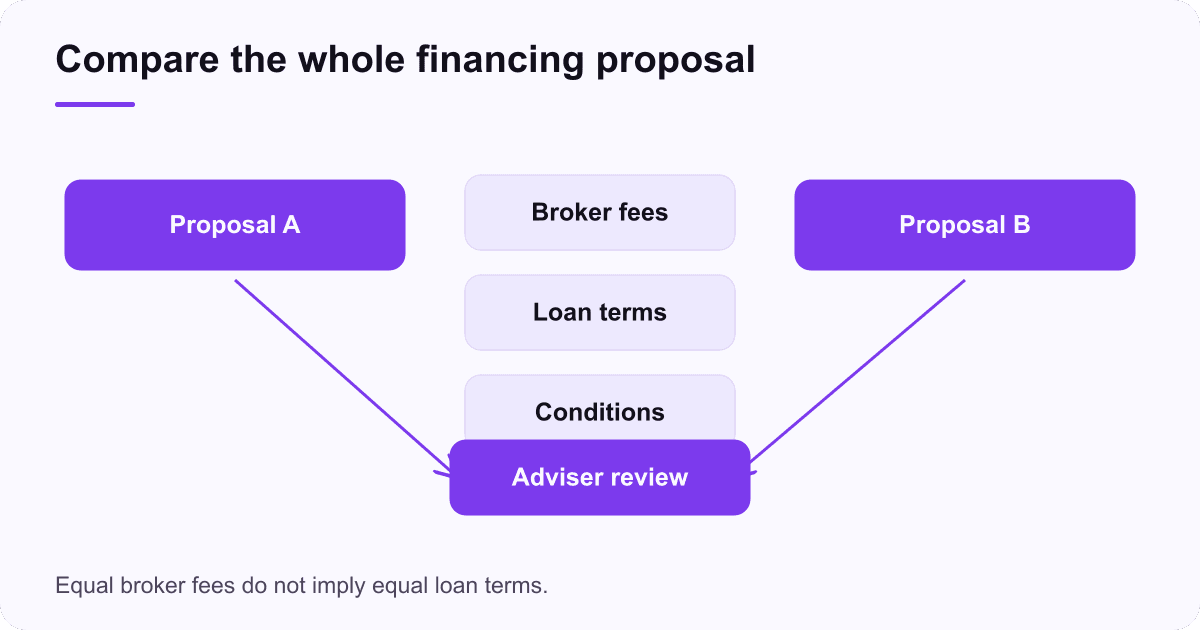
Suppose two hypothetical proposals concern the same $600,000 loan amount. Broker A charges 1% of that amount, or $6,000, plus a stated $1,000 administration charge. Broker B proposes a $7,000 fixed broker fee. On those inputs, both broker-fee totals are $7,000.
That arithmetic does not make the financing equivalent. The proposals may involve different lender charges, repayment terms or conditions. Keep those in separate rows and compare the complete written information. The example amounts are invented to explain the calculation, not current pricing guidance.
If one proposal says the broker is paid by the lender, ask how that arrangement is disclosed and whether any borrower charges remain. “No direct broker fee” answers one cost question; it does not establish the total cost or suitability of the loan.
Give uncertain items their own status. A valuation charge not yet quoted should remain an open item, not become zero in the spreadsheet. Ask the provider for a range or a written explanation of when the amount will be known.
Before selecting an option, have the relevant advisers examine the terms that affect your business. The legal-service selection guide can help you identify appropriate property or transaction counsel. A comparison sheet supports that discussion; it does not replace professional interpretation.
Organize the application without losing control of the records
Ask for a document list and a secure submission method. Identify which financial statements, property information and ownership records are required at the current stage. Supply consistent versions and keep a record of what was sent, to whom and when.
Nominate one person in the business to coordinate responses. If the accountant updates a financial report, make sure the broker knows which version supersedes the earlier one. Conflicting figures can create avoidable questions and delay.
Keep a milestone tracker: initial assessment, application submission, lender questions, valuation, legal review and proposed closing. The actual stages vary, but the tracker should show the current status, next action and responsible party. Do not treat a target date as confirmation that every condition has been met.
Ask before signing an exclusivity arrangement. Understand its scope, duration, termination terms and effect on other financing discussions. The right arrangement depends on the engagement; the important point is that you understand the commitment before making it.
Preserve copies of the engagement, disclosures, application information and final documents. Access to your own records should not depend entirely on the broker's inbox. That file also helps future advisers understand the transaction.
Make the appointment around a clear next step
Send shortlisted brokers the same brief and ask for a response covering relevant experience, proposed process, lender coverage, fee basis and information gaps. Compare how clearly they explain the transaction, not just how confidently they predict an outcome.
Use a concise decision sheet covering property fit, regulatory checks, compensation, the assigned contact and unresolved questions. If financing includes building work, the construction proposal comparison guide helps distinguish a defined work scope from uncertain allowances before those costs enter the funding brief. Keep material gaps visible until they are answered.
Your first commitment may be a defined assessment rather than a full application. Ask what that phase produces and whether it creates any later obligation. Once the scope is clear, agree the communication schedule and the first document deadline.
The best broker for your business is the one whose relevant capability, process and terms fit the transaction you actually have. Start with that transaction, verify the professional and compare the complete proposal. This gives you a more reliable decision than a claim of universal lender access or a promise of guaranteed approval.