
How Restaurants Contribute to Local Economies
Restaurants contribute to a local economy through employment, purchases from suppliers, use of commercial space and the activity they bring to surrounding businesses. The size of that contribution depends on where money goes, who benefits and what would happen otherwise. A restaurant's sales are therefore a useful starting measure, but they are not the same as the net economic benefit to a neighborhood.
For a community group, supplier or local researcher, the practical task is to identify those flows and use evidence at the right geographic level.
Start with a clear local boundary and question
Decide what “local” means before collecting figures. It could mean a commercial district, municipality, county or state. A supplier located across a city boundary may be local to the wider region but outside a neighborhood study. Neither definition is inherently wrong; switching between them without explanation creates misleading totals.
Define the question as well. Are you studying employment, the viability of a main street, opportunities for local suppliers or the effect of a particular development? Each requires different evidence. A count of restaurants can help describe a district, but it does not show how much workers earn or how much purchasing stays nearby.
Use consistent units. One company may operate several restaurants, while one venue may house several food businesses. A directory record, a licensed establishment and a tax-reporting business may not match one for one. Keep a method note explaining what is included and how you treated branches, temporary vendors and closed locations.
The business-category coverage study demonstrates why a commercial directory count should not be presented as an industry census. A business list can support discovery and interviews, but economic claims need data designed for the question being asked.
Follow the money through distinct channels
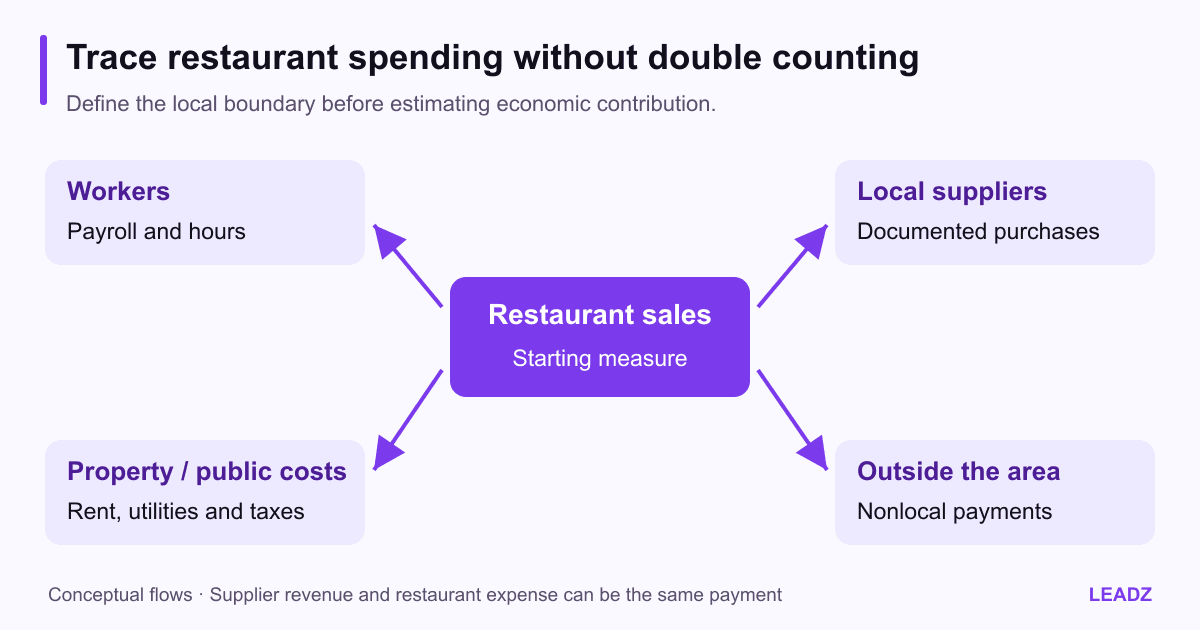
Begin with direct activity: restaurant employment, payroll, purchases and occupancy. Then consider relationships with other businesses, such as food distribution, equipment maintenance, laundry, cleaning and professional services. Finally, examine how workers and owners spend income. These are related flows, not independent piles of money that can simply be added together.
A restaurant's payment to a local supplier is an expense for the restaurant and revenue for the supplier. Counting both as separate new local spending without a defined economic model can double-count the same transaction. A multiplier estimate requires a specified method, geography and assumptions; a national multiplier should not be applied casually to one street.
Ownership alone does not tell you where all spending goes. An independent restaurant can buy ingredients from outside the region, while a chain location can employ residents and purchase local services. Investigate the actual purchasing and employment relationships rather than treating business format as proof of local benefit.
Ask operators which purchases could realistically be sourced nearby. Availability, reliability, quality, delivery schedules and price all matter. A recommendation to “buy local” is more useful when it names a feasible supplier category and the conditions required for the arrangement to work.
Examine jobs alongside wages and working patterns
Employment is an important part of the picture, but a job count alone is incomplete. Consider wages, hours, seasonality and access to training where reliable evidence is available. Avoid assuming that every position is full-time or that growth in restaurant jobs automatically represents an equal reduction in local unemployment.
The BLS Quarterly Census of Employment and Wages overview describes establishment, employment and wage data available by industry and geography, subject to disclosure limits. Use a consistent industry definition and period when making comparisons. A quarterly payroll measure should not be combined with an annual sales estimate as though they cover the same window.
For a local study, record both the release date and the period measured. A report published in 2026 may describe 2025 or an earlier quarter. If detailed local data are suppressed, say so. Do not fill the gap with a commercial contact count and label it official employment evidence.
Interviews can add useful context about recruitment, training and scheduling, but identify them as qualitative evidence. Five operators describing staffing difficulty do not establish a citywide rate. Explain how interviewees were selected and include different restaurant formats if the question concerns the whole district.
Use national trends as context, not a local forecast
The National Restaurant Association's February 2026 outlook projected nationwide restaurant and foodservice sales of $1.55 trillion for 2026 and inflation-adjusted growth of 1.3%. These are forecasts for a broad national industry, not observed full-year results or a prediction for a particular town. See the 2026 industry outlook.
A local operator can experience falling traffic while national sales increase. Prices, population, tourism, business openings and the mix of restaurant formats can all affect the relationship between national totals and local conditions. Use national reports to frame questions, then investigate the actual area.
The restaurant trends guide translates current industry themes into operating decisions. For an economic study, keep those decisions separate from the claim that a trend benefits the entire community. A labor-saving change might improve one business's viability while altering staffing requirements; both effects deserve attention.
Compare local observations over a consistent period. If you count occupied storefronts in September, compare with the same season where possible. A summer resort district and an office-centered lunch district may have very different patterns. Context is part of the explanation, not an inconvenient exception to remove from the analysis.
Work through a transparent spending example
Imagine a fictional neighborhood restaurant with $100,000 in monthly sales. For illustration, it spends $32,000 on payroll, $28,000 on ingredients and supplies, $12,000 on rent and utilities, and $18,000 on other operating costs. The remaining $10,000 is not automatically profit available for local spending; financing, taxes, owner compensation or other obligations may still apply depending on the accounting structure.
Now suppose the researcher can document that $9,000 of the ingredient-and-supply spending goes to businesses inside the defined study area. That is a known local purchasing flow. It does not mean the entire $28,000 is local, nor that the supplier's full $9,000 revenue remains in the area after its own costs.
If workers live in several municipalities, the payroll total also cannot be treated as spending entirely inside the restaurant's neighborhood. The study could report direct payroll without estimating where it is spent, or collect appropriate aggregate information for a more detailed analysis. It should not assume the missing distribution.
This example uses invented figures to show the accounting questions, not typical restaurant margins. The useful output is a table of known flows, unknown flows and sources. A cautious, reproducible estimate is more informative than a large economic-impact number built from overlapping categories.
Assess community benefits and costs beyond sales
Restaurants can provide meeting places, contribute to a district's identity and support events. Describe these contributions with concrete evidence: opening hours that serve a neighborhood need, documented participation in community programs or observations about how the space is used. Avoid claiming that a venue creates social cohesion simply because people gather there.
Consider costs and constraints too. Deliveries, waste handling, noise, transport access and use of public space can affect neighbors. The aim is not to undermine the economic contribution, but to understand what makes it sustainable. A district strategy should account for residents, workers and nearby businesses as well as restaurant owners.
Tourism claims need similar care. A restaurant may serve visitors who were already in the area rather than cause their trip. If you want to estimate additional visitor spending, ask what evidence distinguishes those situations. Reviews and social posts can identify interest; they do not by themselves establish incremental economic impact.
For suppliers considering a local initiative, the guide to selling services to restaurant owners explains how to connect an offer to an operator's actual needs. A community narrative is not enough to establish that an individual restaurant can afford or use a service.
Build a short evidence brief the community can use
Organize the findings around the question you set at the start. Include the study boundary, time period, restaurant definition, data sources and limitations. Present employment, payroll, purchasing and occupancy as separate measures. Explain any model used to estimate indirect effects rather than hiding the calculation behind a single headline.
Use a simple evidence table with four columns: claim, measure, source and limitation. For example, “restaurants occupy 18 of 70 commercial units” could be supported by a dated street survey, with a note about vacant units and mixed-use premises. That evidence can support a discussion about the district's business mix without claiming to quantify every restaurant's economic contribution.
End with a feasible next action: interview a broader set of operators, test a shared delivery arrangement, review access issues or investigate a supplier gap. Assign responsibility and decide what evidence would show whether the action helped. Avoid proposing an expensive campaign merely because restaurants are important in general.
If you need to identify businesses for research, restaurant business records can be one discovery input. Verify the locations and use an appropriate business-inquiry process. A contact database is for finding potential participants, not for choosing dinner or certifying an establishment's economic impact.
The strongest local case for restaurants is specific: which jobs, which suppliers, which places and which period. That evidence gives communities a firmer basis for supporting viable businesses and addressing the practical conditions that allow them to contribute.