
Email Marketing for Landscaping Companies: Seasonal Planning
A landscaping company's emails should help the right property owner understand a service and choose a practical next step. Organize messages by service area, property type and relationship, then send information that fits the local season and your capacity. A maintenance client, a design prospect and a commercial property manager should not receive identical offers by default.
This guide focuses on marketing the landscaping business's own services, with examples you can adapt to your real territory and operating calendar.
Define the service and the properties it suits
Begin with what you can deliver well. Recurring maintenance, landscape design, installation and specialist work involve different buying decisions. Describe the service, property types and geographic area clearly before building the campaign.
Consider travel and scheduling. A customer inside a broad city boundary may still be difficult to serve on an existing route. Ask the operations team which areas and work types fit current capacity. Marketing should use that information rather than sending an offer to every address in the database.
Keep household customers and commercial contacts separate where their needs differ. A homeowner may want to understand a design consultation; a property manager may need a site scope, service schedule and approval process. The same photograph can support both, but the message and action should reflect the reader's job.
A landscaping-business directory describes landscaping companies. It is not a list of homeowners requesting work. Such data may suit a supplier researching landscapers, but it does not provide the customer audience for the campaign described here.
The service-business lead-generation guide helps define the broader customer journey. Use it to connect the email with the enquiry, site assessment and proposal your team can actually handle.
Build the list through clear relationships
Offer a straightforward subscription at relevant points: a website guide, an event or a customer conversation where the person chooses to receive updates. Explain the topic and expected frequency. Keep a record of that choice and provide an easy way to stop the messages.
Separate general marketing preferences from active service communication. An existing maintenance customer still needs a dependable route for schedule changes and project questions. A newsletter should not become the only place where important service information appears.
Ask for a property area or service interest only when it helps send more relevant content. Avoid making the signup so detailed that it resembles a quotation request. You can gather project-specific information when the person wants an assessment.
The opt-in email guide explains how to keep the subscription understandable. Respect the sending platform's audience rules, and avoid treating an old enquiry as permission for unlimited promotional messages.
Keep the list current through ordinary customer handling. If someone moves outside the service area, changes their interest or asks to stop receiving a campaign, update the relevant record. A small, maintained list is easier to serve than a larger one full of assumptions about property and intent.
Tie seasonal content to local decisions
A seasonal email should address a decision that actually belongs in your region and service. Do not copy a national gardening calendar and imply that the same timing suits every climate, plant or property. Have the responsible practitioner review technical advice and point readers toward local guidance where needed.
Useful topics can focus on planning: how far ahead to request a design consultation, what information helps scope a maintenance service or how access affects an installation visit. These explain your process without making unsupported horticultural promises.
If you share plant-care or treatment guidance, identify the conditions and limits clearly and use appropriate local authoritative sources. Avoid including chemical or pesticide instructions casually in a general promotional email. A marketing message should not replace the assessment and professional requirements applicable to that work.
An illustrative subject could be “Planning a courtyard refresh before your busy period?” The body can explain the consultation, the information to prepare and the current process for discussing timing. It should not guarantee completion before a date that depends on scope, weather and supply.
Prepare a response note for the person handling enquiries. It can record the requested service, property area, access question and preferred callback time. Review the note after a few conversations: if every caller asks the same unanswered question, add that answer to the service page rather than making staff repeat it indefinitely.
Keep the destination page current. If the email invites a service that is no longer available, a good subject line only creates avoidable enquiries. Assign an owner to check the offer, territory and next step before sending.
Show the work through a specific property problem
Choose a project story that helps the audience recognize fit. Explain the original problem, the agreed scope and the practical considerations. For a commercial property, that might be maintaining access while improving a shared outdoor area. For a homeowner, it could be organizing a small space around its intended use.
Use photographs and client details with appropriate permission. Identify conceptual designs as concepts and completed work as completed work. Avoid implying that an image proves water savings, property-value growth or another measured outcome unless you have suitable evidence for that claim.
A short before-and-after explanation can be useful without exaggerated results. Describe what changed: a route was clarified, a planting area was reorganized or a maintenance access point was retained. Let the visual support the explanation rather than replacing it with a vague claim that the project was transformed.
Link to a page with the relevant service and enquiry process. If the reader needs an assessment, explain what it covers and whether there is a fee. A button should make the next step predictable.
The small-business acquisition budget guide can help decide how much time to spend producing case material. A simple, accurate project story may be more useful than an elaborate campaign the business cannot maintain.
Connect campaign timing to route and crew capacity
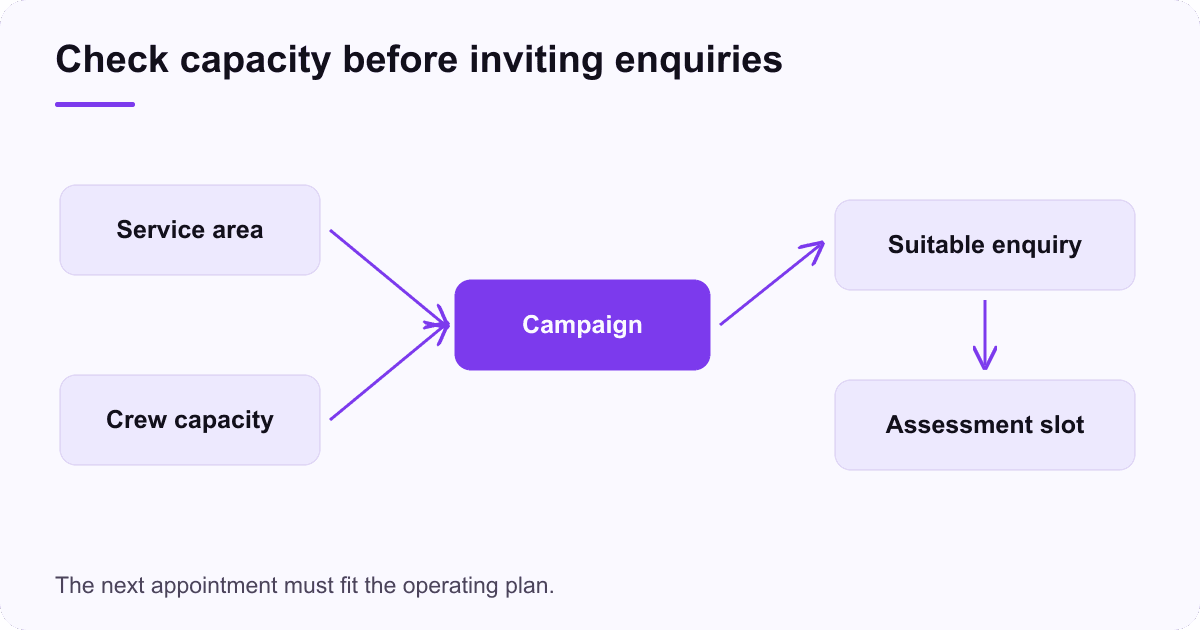
Ask operations what the company can accept before promoting availability. Consider site assessments, proposal preparation and delivery work separately. A crew may have installation capacity while the owner has no time to visit new prospects, or the reverse.
Use a simple planning table for the campaign. It can show the service, area, available assessment windows, person handling enquiries and conditions that would pause promotion. This makes marketing responsive to the actual business schedule.
Planning question | Example decision |
|---|---|
Which service? | Courtyard design consultations |
Which area? | A defined local service zone |
What capacity? | A stated number of assessment appointments |
Who responds? | The person who can discuss scope and timing |
When to pause? | When the assessment queue cannot be handled promptly |
For illustration, suppose the team can handle four assessments next week and expects each to take two hours including travel and notes. That is eight hours of assessment capacity. If six suitable enquiries arrive, arrange later appointments honestly rather than pretending all can be served immediately.
Weather or project changes may alter the plan. Keep the email's promise focused on the booking or assessment process, and communicate a revised arrangement directly when needed. Manufactured urgency is unnecessary when the real constraint can be explained clearly.
Track enquiries through assessment and proposal
Define a suitable enquiry using service, location and basic scope. Record questions that remain open, rather than rejecting every incomplete form. A short follow-up may establish whether the property fits the work you offer.
Suppose a hypothetical email reaches 200 subscribers and creates ten enquiries. Six fit the service and area; four assessments take place; two proposals are accepted during the reporting period. The initial enquiry rate is 5%, while accepted proposals represent 1% of the subscriber count. Those stages should remain separate.
Do not label all ten enquiries as customers. Also avoid judging the campaign only by the two acceptances if some proposals remain open at the cutoff. Give each active opportunity a next step and expected review date.
The campaign-metrics guide explains how to keep denominators consistent. For this business, the quality of the property brief and the cost of assessment may matter more than a high image-click rate.
Track staff time as well as spending. If a campaign produces many unsuitable enquiries, inspect the service-area wording and example project. If suitable enquiries do not progress, review response time, assessment availability and the clarity of the proposal before rewriting the entire campaign.
Make the first send easy to repeat responsibly
Choose one audience, one service and one useful explanation. Write the opening around the property decision, then include a clear action and the information needed to take it. Test the email and booking route on a phone before sending.
For U.S. commercial messages, FTC guidance addresses sender identification and opt-outs. Apply the relevant requirements and platform rules, and keep preferences synchronized with future campaigns.
Tell the response owner what was sent and whom it targeted. Prepare a short qualification checklist so callers and email respondents receive consistent information. If the team needs photographs or a site address for assessment, explain the purpose and approved submission route.
After the campaign, review the enquiry reasons, assessment workload and accepted work. Save the message and the changes you would make next time. A landscaping email program becomes useful when it respects local conditions, serves the right properties and creates work the business can deliver well.