
Build a B2B Marketing Strategy Around a Real Buying Decision
A B2B marketing strategy explains which businesses you want to serve, why they would choose your offer, and how your team will help them reach a decision. Start with those choices before preparing a content calendar or buying another tool. Activities become easier to prioritize when they serve the same commercial problem.
This planning guide uses an illustrative facilities-service company. Adapt the reasoning to your market rather than copying the example's audience or budget. Official resources were checked on September 23, 2026.
Choose a market you can serve well
Begin with the work your business can deliver consistently. A facilities company might offer scheduled maintenance to small commercial properties in a defined area. “All local businesses” would include prospects with incompatible buildings, centralized national contracts and service requirements the team cannot meet. Narrowing the market prevents marketing from creating the wrong kind of demand.
Review recent work if you have it. Compare the projects that were profitable and manageable with those that required repeated exceptions. Look for patterns in service scope, decision process and delivery effort. A difficult project is not necessarily a poor market, but it may reveal a capability or pricing issue that advertising cannot solve.
If the offer is new, gather evidence through conversations and small tests. Ask prospective buyers how they handle the task today, what triggers a review and what makes a supplier unsuitable. Questions about past behavior are often more concrete than asking whether someone likes an imagined product. Record uncertainty instead of converting polite interest into a demand forecast.
The SBA's market-research framework covers demand, alternatives and competition. Use that structure to distinguish the size of a market from the part you can realistically serve. A large category count does not establish that a small team can reach or support every business in it.
Write a market statement with explicit exclusions. For example: independent commercial property operators within the service territory, with scheduled maintenance needs that fit the team's skills; exclude emergency-only work and contracts requiring nationwide coverage. That statement can guide research, content, sales questions and resource allocation.
Understand the people involved in choosing
The person who first enquires may not be the person who approves spending. A site manager could explain the maintenance problem, an operations lead compare suppliers and an owner authorize the agreement. Treat these as roles in a decision, not fixed job titles that every company must have.
For each role, list the question your material should answer. The site manager may care about disruption and reporting. Operations may need service coverage and escalation arrangements. The approver may want contractual scope and a clear cost. One brochure can contain all three, but a first conversation should follow the question the reader actually has.
Use evidence to establish involvement. A reported role associated with an email address is a lead for research. A person explaining that they manage the supplier review is stronger evidence. Record both the source and date, and leave unknowns visible. The qualification scorecard helps prevent a job title from becoming an unsupported claim of buying authority.
Also identify constraints on the decision. There may be an incumbent contract, an annual budget window, a procurement portal or a requirement to obtain several quotations. Asking about the process can explain a delay more accurately than assuming the buyer needs another promotional message.
State the offer and the evidence behind it
Describe the outcome you support in terms the buyer can evaluate. “Reliable facilities support” is broad. A defined maintenance schedule, named escalation route and report after each visit tell the prospect what would happen. Promise only the service levels your business can operate and include the conditions that affect them.
Compare your offer with the real alternative. The competitor may be another supplier, an in-house employee, a patchwork of trades or continued delay. Each alternative has different costs and friction. Explain when your approach is a good fit and when the buyer may need something else. This saves both sides time during qualification.
Collect the proof needed for the most important claims. That could include a sample report with fictional details clearly labeled, a service-area map, relevant certifications or an authorized project example. Avoid presenting a mock report as a customer deliverable. If you have no measured outcome yet, explain the process rather than inventing a percentage improvement.
Make the next action specific. A scope discussion may require location, building type and the tasks currently covered. Explain that in the invitation. A vague “learn more” link can hide the effort expected from the prospect; a clear request helps them decide whether to proceed.
Turn the strategy into a connected customer journey
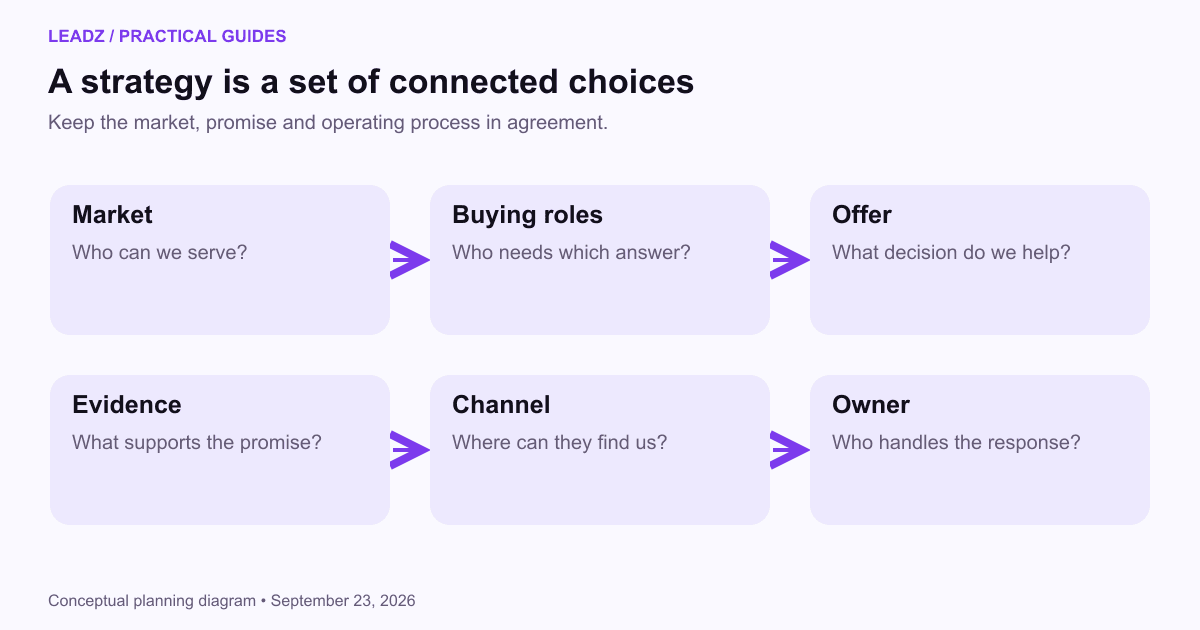
Plan the sequence from first discovery through a decision. The facilities buyer might find a service page, read the scope, request a conversation, receive a site assessment and compare a proposal. Each transition needs a reason to continue and an owner. A marketing plan that ends at form submission misses much of the work.
Buyer question | Material or interaction | Team responsibility |
|---|---|---|
Do you handle properties like ours? | Specific service page and coverage details | Marketing keeps scope accurate |
How would the work happen? | Example schedule and scope conversation | Operations confirms feasibility |
What would the agreement include? | Tailored proposal with exclusions | Sales checks requirements |
Who helps after we agree? | Handoff and contact instructions | Account owner accepts responsibility |
Choose channels that can reach the selected market. Search content can answer active questions. Researched introductions can approach a defined group of accounts. Partnerships can connect you with complementary providers. The B2B lead generation guide explains how to compare those routes without pretending one channel wins in every market.
Keep the promise consistent across the journey. If an ad offers a maintenance assessment, the landing page should describe that assessment and the confirmation should explain preparation. Sending the prospect to an unrelated newsletter signup changes the task halfway through. Review the complete journey as a prospective buyer would experience it.
Allocate money and time to the limiting step
List the work required to operate the plan: research, writing, account review, response handling, site visits and proposals. Assign people before assigning a large media budget. If the service manager can attend only a few assessments, marketing needs to respect that capacity or arrange additional coverage.
Use an illustrative monthly budget to see the tradeoffs. Suppose a team can spend $1,200 in cash and allocate 20 hours. It might reserve $400 for improving a service page, $500 for a tightly scoped campaign and $300 for a workshop with a relevant partner. The hours must cover preparation and every expected response, not just campaign setup.
Those amounts are planning inputs, not recommended market prices. Obtain actual quotes and estimate your team's workload. Record one-time setup separately from recurring expense. A page improvement may serve later campaigns, while media cost repeats. The budget guide shows how to keep these distinctions visible.
Set a spending boundary for the test. State the learning goal and the condition for stopping or changing direction. If the campaign repeatedly attracts properties outside the service area, correct targeting and copy before adding budget. A low enquiry cost is not useful if operations must reject almost every enquiry.
Define evidence before the campaign starts
Agree what counts as a suitable enquiry, an accepted sales opportunity and a completed sale. A form submission might be a supplier message or an existing customer's support request. Sales should review the request before it becomes an opportunity. Keep the original enquiry so the classification can be checked later.
Capture campaign identifiers consistently. Google's campaign URL documentation explains how tagged links identify referred traffic. Use a small naming convention and keep it stable. The traffic record should connect to your enquiry log where possible, without treating a visit as a sale.
Suppose an illustrative test generates 30 enquiries, 18 suitable accounts, nine assessments and three signed agreements. Suitability is 18 divided by 30, or 60%. Agreements are 10% of enquiries and one third of assessments. These are different views of the same process, and each points to a different question.
A low suitability share suggests investigating audience or message fit. Many assessments with few agreements call for a review of scope, pricing and the buying process. Do not jump to a conclusion from one small test. Read the reasons and check whether some decisions are still pending at the reporting cutoff.
Write a one-page plan that can be revised
Your working plan should state the audience, exclusion rules, offer, evidence, channel, capacity, budget and review date. Keep it brief enough that the people carrying out the work can use it. Supporting research can live elsewhere; the plan should make the next decisions easy to locate.
Add a short assumptions section. “Site managers influence the shortlist” is an assumption until your research confirms it. “The team can handle four assessments a week” is an operational commitment that needs agreement. Distinguishing them makes the plan easier to update when new evidence arrives.
At the review, compare what happened with what you expected. Ask sales and operations about the quality of the conversations, not just the number. Review unanswered questions and rejected prospects. Those observations can become clearer service pages, better qualification questions or a narrower market definition.
Choose the next change and record its purpose. You might simplify the request form, clarify an excluded service or provide a sample maintenance report earlier. Keep the other major variables steady where practical so you can interpret the result. A strategy remains useful when it guides these decisions as the market and the business change.