
How Agencies Build a Prospect List of Architecture Firms
An agency prospecting to architecture firms needs to connect its offer to a practice's projects, working area and buying process. A list of businesses labeled “architect” is a starting point. The useful output is a smaller set of accounts with a documented reason for fit and a sensible route to the person responsible.
This workflow is for agencies selling services to architecture practices. Architects promoting their own practice should use the separate email marketing guide for architects.
Translate your service into an account definition
Start with the work you can deliver well. A project-photography agency needs different prospects from a recruitment specialist or a website studio. Photography may require travel, completed projects and permission to access a site. Recruitment might depend on current hiring and the types of roles the firm needs. A broad architectural category cannot express all those conditions.
Write an account definition in one sentence, followed by exclusions. A hypothetical photography agency might seek practices with completed residential projects within a two-hour travel area. Its exclusions could include projects outside that radius, businesses that only sell design products and firms whose relevant images are already supplied under an exclusive arrangement. The last point requires confirmation; it cannot be inferred from a polished portfolio.
Separate hard constraints from preferences. Delivery territory can be a hard constraint. A particular visual style might be a preference. If you treat every preference as mandatory, you may reject worthwhile accounts. If you treat practical constraints as optional, you create a shortlist your team cannot serve.
Define what evidence qualifies a record for research and what evidence qualifies it for contact. A relevant project page may justify further research. A named marketing contact and an appropriate inquiry route may support an introduction. Neither establishes that the firm has a budget or intends to appoint an agency.
Research projects before assigning a score
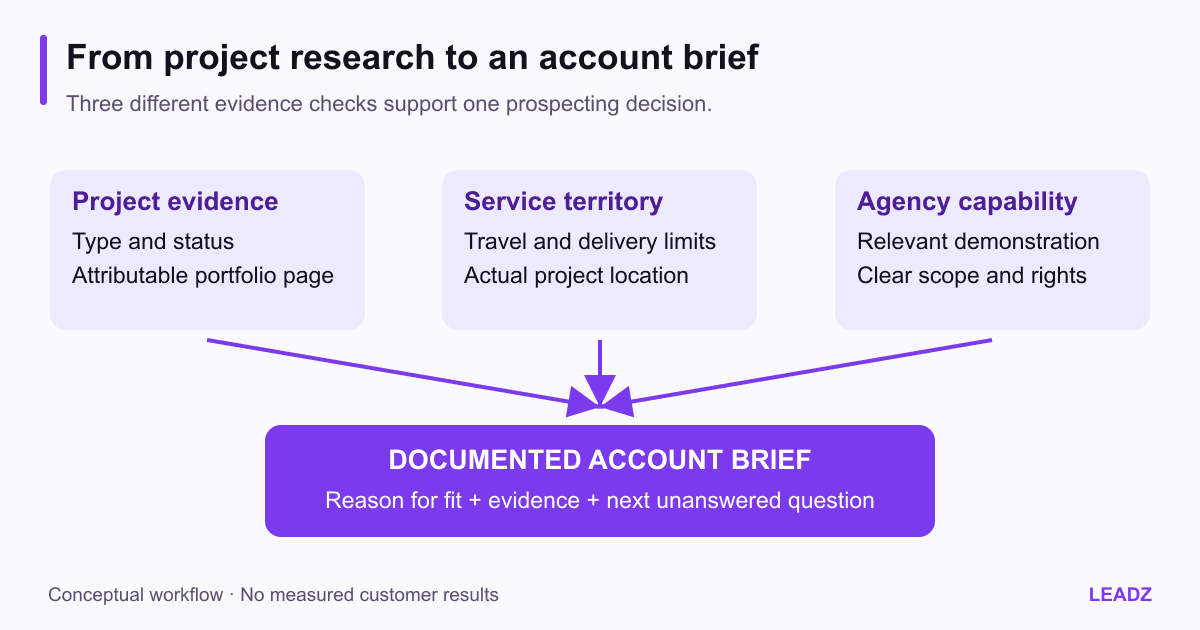
Read the firm's own project and services pages. Note the sectors it describes, the locations of relevant work and any public information about how it presents projects. Record specific page links rather than a general impression that the firm “looks like a good fit.” Another researcher should be able to retrace the decision.
Dates need care. A project uploaded recently may have been completed years earlier. A press article can describe work by a former employee. A rendering may show a proposed development rather than a completed building. If your offer depends on a completed project, keep its status unresolved until you have adequate evidence.
Use professional licensing sources only for the question they answer. NCARB's architect lookup links to jurisdictional rosters. It can help direct an identity check, but a license does not establish a firm's purchasing needs or permission to photograph a project. Keep credentials, project fit and commercial interest in separate fields.
Avoid speculative criticism in your research notes. “Only three project pages include location information” is observable. “The firm has poor marketing and needs us” is a sales assumption. A useful brief can explain why a conversation might be relevant without insulting the practice or pretending to know its internal priorities.
Keep the firm, office and project as separate records
Architecture practices may have several offices and work beyond the city shown in a directory. A central website can represent all offices, while individual projects have different locations and project teams. Decide which entity your service is sold to before deduplicating anything.
For a firm-wide website engagement, multiple office records may belong under one account. For a local event or office photography assignment, location records may remain distinct. For project photography, the project itself might be the unit of opportunity. A shared domain is a clue to investigate, not an automatic instruction to delete every matching row.
Entity | Useful identifier | Question it answers |
|---|---|---|
Practice | Confirmed organization name and domain | Who could contract with the agency? |
Office | Address and office contact page | Where does a local relationship belong? |
Project | Project page and confirmed location | What work might the service support? |
Person | Attributable role and contact evidence | Who can route or assess the inquiry? |
The business-contact deduplication guide covers the mechanics of preserving these relationships during import. Keep a reason for each merge, a surviving account identifier and the original rows. Without that history, a later teammate may recreate the duplicates or lose a legitimate office relationship.
Start a business search at architecture firm records, then apply the territory relevant to your offer. The displayed business location should not be treated as a complete map of where a practice accepts projects. Confirm the actual service relationship during research.
Find a responsible role without inventing authority
A principal, studio manager, marketing director and project architect can have very different responsibilities. Use the firm's own team pages and inquiry instructions to decide where your subject belongs. Record the role as published and the date you checked it. Do not upgrade “architect” to “decision-maker” because the name is available.
When responsibility is unclear, ask a short routing question. For photography: “Who coordinates commissioned photography for completed residential projects?” For website work: “Is responsibility for the practice website held centrally or within each office?” These questions are easy to answer and make your intent apparent.
Leadz business exports can contain available contact names, roles and professional-profile information associated with saved email profiles. Coverage varies; an empty field means more research may be needed. A populated role still needs to fit the subject and account. Review the export field guide before mapping those values into CRM contact and company properties.
Respect the firm's stated route. If it has a supplier or business inquiry form, use that process rather than sending the same introduction to every published employee address. Assign an internal account owner so multiple agency staff do not independently approach different offices with inconsistent proposals.
Offer a useful first conversation
An effective introduction connects one observation to one relevant service and asks for a modest next step. It does not need to diagnose the firm's entire business. A fictional example: “Your residential portfolio includes several completed coastal projects within our working area. We produce architectural photography for project submissions and practice portfolios. Who would be best placed to discuss whether any upcoming shoots need an external photographer?”
That message distinguishes visible evidence from an unknown need. It avoids claiming that the agency knows the firm's schedule or that existing photographs are inadequate. Adapt the language to what you actually observed and to the recipient's role; do not paste a project reference into an otherwise unrelated offer.
Prepare a small proof package. Show relevant work you are entitled to share, explain deliverables and usage rights, state travel constraints and describe the approval process. If you have no architecture-specific client work, be honest about adjacent experience and use a clearly labeled demonstration. Invented case studies create a problem the moment the buyer asks for detail.
The personalization guide is useful when turning research notes into messages. Personalization should explain relevance. Repeating a person's name, complimenting an award without understanding it or referencing private personal information adds little to the buying decision.
Work a pilot backward from delivery capacity
Suppose a fictional two-person agency can prepare twelve careful account briefs in a week. It begins with 30 business records. Six are unrelated design retailers, four repeat offices already represented and eight have insufficient project evidence. Twelve remain for deeper research. This example illustrates screening arithmetic, not a predicted yield from any provider.
If the initial review takes three hours and the twelve briefs take another four hours, research totals seven hours. At an internal planning cost of $45 per hour, that is $315, or $26.25 per completed brief. Add data access and proposal time separately. The hourly value is a hypothetical assumption; replace it with your own working cost.
Set a review point after those twelve accounts rather than automatically increasing volume. If most appropriate contacts say the service is handled internally, investigate whether the segment or the offer needs to change. If the right people ask about usage rights, improve that part of the proof package. Different replies imply different next actions.
Measure account progression: researched, appropriate route found, relevant conversation, scoped request and accepted engagement. Keep a record of reasons for exclusion and no-fit responses. The qualification framework helps prevent a reply from being mistaken for a qualified opportunity.
Hand over evidence with the shortlist
The final shortlist should contain enough context for a colleague to continue without repeating your research. Include firm and office identity, the relevant project evidence, source dates, contact role, account owner, previous outreach and the unresolved question. Keep the source row identifier so corrections can be traced back to the import.
Write a concise account note rather than a numerical score with no explanation. “Residential projects within travel area; photography responsibility unknown; central inquiry route confirmed” tells a salesperson what to do. “Score 84” does not explain whether the remaining problem is geography, role research or timing.
Schedule a refresh based on how the list is used. Project status, team responsibilities and office details can change. Recheck the facts that support a proposal before relying on them in a meeting. Preserve earlier research dates instead of presenting every record as newly verified whenever you open the spreadsheet.
Your first practical deliverable is a set of twelve or another manageable number of account briefs, each with a reason for inclusion and a next question. That is a stronger foundation for agency prospecting than a large export whose records nobody can connect to the service you sell.