
Build a Dental Referral Network with Clear Handoffs
A useful dental referral network helps a practice identify an appropriate professional contact, explain the next administrative step to the patient and confirm that the handoff was received. Build it around patient needs, professional judgment and reliable communication. The objective is not an agreement to exchange equal numbers of patients.
This guide covers the administrative design of a professional network. Clinical decisions, treatment recommendations and the choice of an appropriate referral remain with the qualified professionals involved and the patient.
Define the gaps your network should help address
Start by asking the clinical team which referral relationships are needed, then translate those needs into an administrative directory. The list may need to distinguish practice locations, professional scope, accepted referral routes, accessibility information and the person who can answer scheduling questions. Do not let an available email address determine clinical suitability.
Review where handoffs become difficult today. Perhaps the receiving office's details are out of date, the patient does not know whom to call or staff cannot tell whether a referral was received. These are specific process problems. “Increase referrals” is too broad to reveal which part of the experience needs attention.
The ADA's guidance on consultation and referral places patient welfare at the center of professional referral decisions. Use that principle to separate clinical selection from administrative convenience. A directory can support the process; it cannot substitute for the clinician's assessment.
Write a short purpose statement for the network. For example: “Maintain current professional contacts and agreed administrative handoff steps for referrals our clinicians consider appropriate.” This leaves room for patient choice and avoids framing the network as a closed sales channel or a promise that every patient will receive the same destination.
Build a professional directory without creating a patient list
Maintain professional contact information separately from patient-specific records. The directory can contain practice name, address, public phone, administrative contact, website, relevant professional information confirmed by the practice and the date last checked. Patient histories, clinical documents and appointment details belong in the practice's approved systems and workflows.
A business directory such as dental practice records can help discover nearby offices. It does not certify clinical quality, confirm a specialist's current credentials or establish an agreement to accept referrals. Follow discovery with direct confirmation and the professional checks appropriate to the proposed relationship.
Ask each receiving practice who should maintain its directory entry. Confirm how it wants administrative questions routed, which locations are relevant and how your team should check current acceptance or scheduling availability. Avoid promising a patient that an office accepts their coverage or can offer a particular appointment unless that has been confirmed for the situation.
The medical practice versus physician contact guide explains a related identity problem: a business location and an individual professional are different records. Preserve both where useful. A practitioner may work at more than one location, and a location may have several professionals with different responsibilities.
Agree on the handoff before the first referral
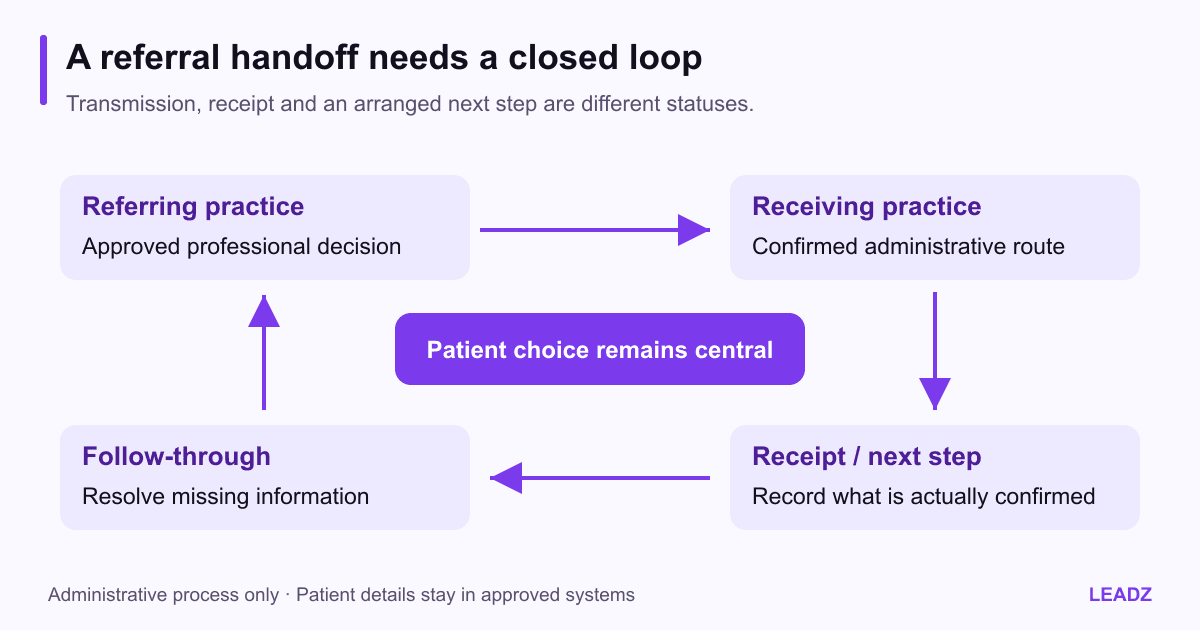
Discuss the administrative process with the receiving office. Identify the accepted referral route, how receipt is acknowledged, who handles missing information and how your team should follow up when the patient reports a problem. Clinical teams should define the clinical content and urgency procedures through their established professional process.
Document the distinction between “sent,” “received” and “appointment arranged.” Sending a referral does not establish that anyone has reviewed it. Receipt does not prove the patient has booked. A simple status vocabulary helps staff avoid making reassuring statements that the record does not support.
For patient information, use the practice's approved secure communication route and applicable privacy procedures. Do not add patient details to a general marketing CRM, a prospecting spreadsheet or a supplier email campaign. Staff should know where to ask questions when a proposed transfer does not fit the established workflow.
Create an exception route as well as the ordinary route. What happens if the office cannot accept the referral, contact information is wrong or the patient prefers another professional? An administrative network is useful when it handles these cases clearly. It should not trap the patient in a fixed sequence designed around the convenience of participating practices.
Preserve patient choice and avoid referral incentives
A professional relationship can make communication easier without turning the referral into a reciprocal obligation. Do not promise another practice a fixed volume of patients or agree to route referrals solely to balance business between members. The appropriate destination depends on the individual circumstances and professional judgment.
The ADA's ethics guidance on referral services addresses payments for patient referrals. Treat this as professional ethics guidance, not a substitute for applicable law. Have qualified advisers review any proposed financial arrangement, membership fee or marketing structure before it is implemented; do not assume calling a payment an administrative fee settles the issue.
Patient-facing explanations should be factual. Describe who the receiving professional is, the location and the administrative next step that has actually been agreed. Do not imply guaranteed outcomes, claim credentials you have not checked or present the network as an independent quality certification.
Keep commercial promotion separate from care coordination. If the practice also runs patient communications, the medical email communication guide can help organize the audience and purpose. A referral directory should not become a source of patient addresses for unrelated advertising.
Walk through a fictional administrative example
Imagine a general dental practice whose clinical team decides that a patient should be referred to another professional. The administrative coordinator checks the approved directory, confirms the chosen office's current referral route and explains the next step to the patient. This example deliberately does not specify a condition or recommend a treatment.
The coordinator records that the referral was sent through the approved channel on Monday. The receiving office acknowledges receipt on Tuesday but asks for an administrative clarification. The coordinator routes the request to the appropriate team member and updates the status. The record remains “received, clarification pending,” rather than inaccurately becoming “completed.”
On Wednesday, the receiving office confirms that the next administrative step has been arranged. The referring practice records the confirmation in its approved system. If the patient chooses a different office instead, staff update the routing information and follow the established process for the change. They do not count that decision as a failure to support a partner practice.
The useful lesson is the visibility of responsibility. At each stage, someone knows what is pending and who can resolve it. The network's value comes from a dependable process, not from claims that membership alone improves clinical outcomes.
Measure administrative reliability without ranking clinical care
Choose measures that match the process you control. Examples include the share of directory entries checked within your chosen review period, the number of returned messages caused by incorrect contact details and the time between sending a referral and receiving an administrative acknowledgment. Define the start and end event for any time measure.
For a hypothetical monthly review of 20 administrative handoffs, suppose 16 have documented acknowledgment within the practice's chosen review window, three remain pending and one was redirected after the patient's choice changed. The acknowledgment share is 16 divided by 20, or 80%. This is illustrative arithmetic, not a recommended clinical standard or a measured result.
Keep the reasons behind the other four cases. A missing acknowledgment, a patient-led change and an incorrect address suggest different improvements. Combining them into one failure category would hide the operational issue and could unfairly judge the receiving practice.
Do not turn administrative metrics into public clinical rankings. Response time can be affected by the channel, completeness of information, staffing and the particular circumstances. Clinical quality assessment requires its own appropriate methods. A network dashboard should help staff repair the handoff process, not support unsupported superiority claims.
Assign maintenance and review the network together
Give one role responsibility for maintaining the directory and another appropriate role responsibility for approving substantive professional changes. A staff member can correct a phone number; decisions about clinical referral relationships should remain with the qualified people responsible for them.
Set a review schedule that fits how often the directory is used, then add event-driven updates. A returned message, a closed location or a notice of changed acceptance should trigger a check immediately. Preserve the prior verification date and the source of the correction rather than making every entry appear freshly reviewed at once.
Invite receiving offices to report administrative problems through a clear contact route. A short discussion about missing information or unclear instructions can improve the next handoff. Keep that conversation focused on process and handle patient-specific details through approved channels.
For broader practice communications, use the personalization guide to distinguish relevant professional messages from generic promotion. A useful introduction explains why you are reaching out, what administrative relationship you hope to establish and who should respond.
Begin with a small set of relationships the clinical team actually needs. Confirm the contacts, document the handoff and test the administrative steps with the participating offices. Expand once the process is dependable. A modest, maintained network is more useful to staff and patients than a large directory nobody has checked.