
B2B Cold Calling: Prepare the Conversation and Record the Outcome
A useful business call establishes whether there is a relevant reason to speak and leaves an accurate next step. Prepare the account, identify yourself plainly, and give the recipient room to decline. The goal of an opening call may be finding the appropriate contact rather than selling anything immediately.
The scripts below are illustrative language for an equipment supplier approaching plumbing businesses. They are not tested conversion claims. Official guidance was reviewed on September 23, 2026.
Decide which accounts deserve a call
Review the business before opening the dialer. Confirm that it advertises the services your offer supports, operates in your territory and appears to be trading. A broad category match is a starting point. A supplier of commercial pipe-inspection equipment should distinguish commercial specialists from businesses that only undertake small domestic repairs.
A plumbing business directory can help identify companies to research. Check their own websites and the contact route they publish. Record the relevant service and the source you used so another colleague can understand the selection. Avoid copying a personal detail simply because it is available; the note should explain business fit.
Choose the unit of contact. A multi-location company may buy equipment centrally, while an independent branch may select its own suppliers. Calling every location without checking that relationship can create duplicate conversations. If your records are unclear, make the first call about where purchasing enquiries belong.
Check your existing relationships and exclusions before calling. Another salesperson may be discussing a proposal, the company may already be a customer, or someone may have asked your team to stop. Those facts can live in different systems, so decide which record governs the campaign. The lead-qualification workflow helps separate suitable accounts from accounts ready for outreach.
Check the calling method and context
Business phone availability does not establish which rules apply. A published number may reach an office, a mobile phone or a sole proprietor. Calling manually is different from using prerecorded messages or automated calling technology. Check the applicable federal, state and destination-country requirements before choosing the method, and assign that review to a responsible person.
The FTC's March 2024 rule announcement extended prohibitions on misrepresentations to B2B telemarketing. An older summary of B2B exemptions should not be read as permission to mislead a business. Be accurate about your identity, offer, existing relationship and the reason for calling.
Consult the FTC's telemarketing resources for the wider framework. If your process includes recording calls, obtain advice on the recording requirements that apply. Do not assume an internal training purpose removes those obligations. Staff need an operational instruction they can follow, including when recording must stay off.
Set sensible local calling windows based on the business and your compliance review. A contractor may be supervising a job when you call. If someone says it is inconvenient, ask whether they want a later call and record the answer. A requested appointment is different from treating every interruption as permission to try again tomorrow.
Open with a reason the business can evaluate
An opening needs your name, organization and a relevant reason for calling. Keep it short enough that the recipient can decide whether to continue. Avoid pretending to follow up on a conversation that never happened, implying an existing supplier relationship or disguising a sales approach as an administrative issue.
For reception or a general line, the example could be: “I'm Alex from Northline Equipment. We supply inspection equipment to plumbing contractors. Your website lists commercial drain work. Who handles enquiries about that equipment, or is there a supplier process we should use?” Replace the invented company and service with truthful details.
The question gives reception a routing task rather than asking them to evaluate the whole offer. If they provide a general supplier inbox, use it according to their instructions. Do not press for a personal mobile number when the organization has explained its preferred route. Record whether a named person or department was actually confirmed.
If you reach someone responsible, ask whether there is time for a brief explanation. Then connect the offer to one operational question: “Do your teams own their inspection units, or hire them for particular projects?” Their answer may reveal that the offer is irrelevant. That is useful information and a reasonable place to end the call.
Use questions to establish fit, not force a pitch
Let the answer determine the next question. If the company hires equipment only occasionally, a purchasing presentation may be premature. If it owns equipment but has no replacement plans, a service or compatibility question might be appropriate only if it relates to your actual offer. Listen for the conditions under which the business would consider a change.
An illustrative discovery question is: “When a unit is unavailable, does that delay the job, or do you already have a backup arrangement?” It invites a description of the work. It does not presume that the current supplier is unreliable. If the recipient describes a satisfactory arrangement, acknowledge that instead of manufacturing a problem.
Ask only for information needed to decide whether a further conversation makes sense. Detailed budgets, customer names or internal project documents can wait until there is a legitimate reason and an agreed process. A cold call is a poor setting for collecting information the recipient cannot comfortably share.
Summarize what you heard before proposing a next step. “You hire for larger jobs and would only compare options before the next tender” is more useful than marking the contact “interested.” If they correct the summary, update the record. The account database guide explains how to keep those observations separate from assumptions.
Handle the answer without turning every response into an objection
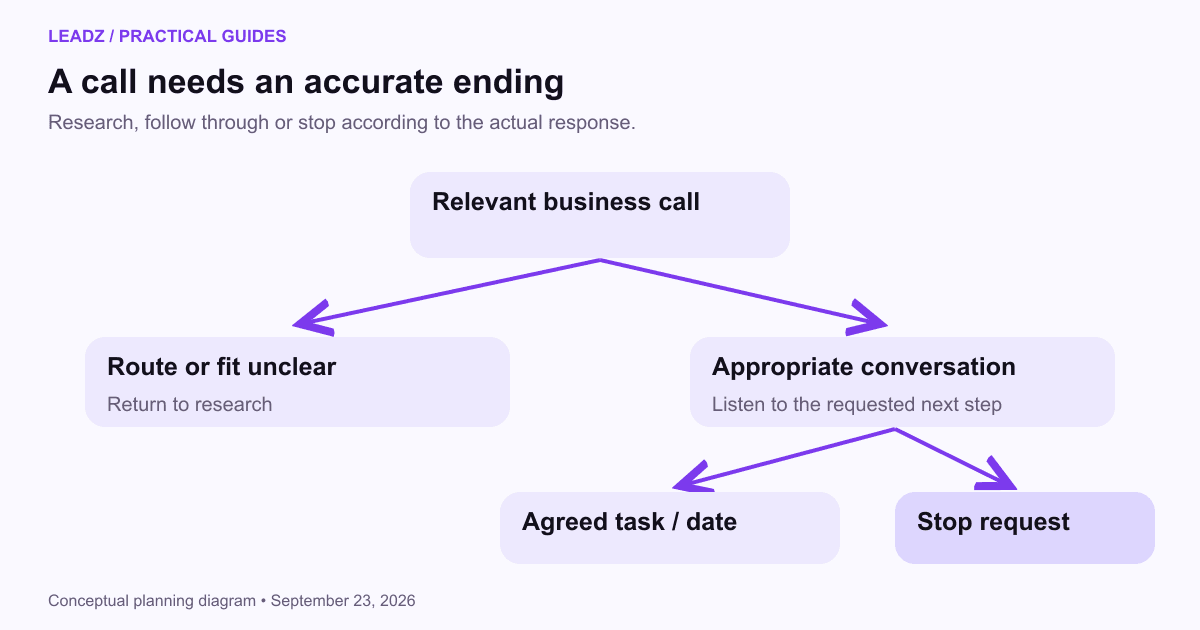
“Not interested,” “wrong person,” “send information” and “call in November” are different instructions. Treat them that way. A request to stop ends the campaign for that contact according to your suppression process. A wrong-person response sends the record back to research unless the recipient chooses to provide a route.
When someone asks for information, clarify the topic and destination. “Would the compatibility sheet answer your question, and is the supplier inbox the right place?” creates a specific task. Sending a full sales sequence after a request for one document changes the agreement and makes later follow-up difficult to justify.
For an agreed follow-up, use the context: “We spoke on Tuesday about units compatible with your existing camera heads. You asked for the specification sheet. Was there a detail you needed clarified?” This is an illustrative script, not a claim that the earlier conversation occurred. Only use it when the record supports it.
If the person says the timing is wrong, ask whether they want any further contact. Record the stated timing, purpose and channel if they do. Avoid assigning an arbitrary future date to every declined call. The outreach sequence guide can help coordinate follow-up without different channels repeating the same unwanted approach.
Keep an outcome log that another person can use
Store the company, number used, person or department reached, date, outcome and next action. Include the source of role information and whether the person confirmed it. A profile label from a database should not silently become “purchasing manager confirmed by phone” when no such conversation happened.
Outcome | Record | Next action |
|---|---|---|
No answer | Attempt time and number | Apply the planned attempt limit |
Wrong route | What the recipient explained | Research or use the offered route |
Information requested | Exact document and destination | Send the agreed material |
Future discussion requested | Date, purpose and owner | Create a dated task |
Stop requested | Suppression instruction | Stop and synchronize exclusions |
Keep notes factual and concise. “Uses hired units; no purchase planned; requested hire-specification sheet” is enough for the next colleague. Avoid subjective descriptions of the person's attitude. Do not include unrelated personal information or a transcript when a short decision record serves the purpose.
An illustrative weekly log could contain 40 attempted calls, 12 conversations, four requests for information and two agreed technical discussions. Conversation rate is 12 divided by 40, or 30%. The two discussions represent 5% of attempts. Neither number describes sales revenue, and repeat attempts to the same business should remain identifiable.
Review the process before increasing volume
Look at why calls ended. Repeated wrong departments suggest a research or routing problem. Repeated questions about a missing specification suggest the opening or supporting material needs work. Many relevant conversations with no agreed next step may indicate weak offer fit, but review the notes before deciding that the script alone is responsible.
Check whether promised actions were completed. A supplier that fails to send requested information has a follow-through problem that more calls will amplify. Audit a few records from first research through the latest task. Confirm that exclusions, branch relationships and contact changes survive transfers between people and systems.
Use small, comparable batches when changing the approach. Keep the account criteria stable while testing a different opening question. Record the change and the observation period. If the next batch uses a different trade or region, describe that difference rather than presenting the results as a clean script experiment.
Give new callers examples of accurate endings as well as confident openings. Ending an unsuitable conversation respectfully, recording a stop request and asking a useful routing question are successful execution of the process. The campaign should produce better account knowledge and appropriate next conversations, with enough detail that the team can decide what to do next.