
Email Ideas for Interior Designers That Help Clients Decide
Interior-design emails are most useful when they answer a question a client already has: what the service includes, how a project starts, what a design decision involves or whether the practice fits a new brief. Build messages around those decisions. A gallery of attractive rooms can support the explanation, but it should not be the entire campaign.
This guide is for designers communicating with their own prospects, subscribers and past clients. The examples are illustrative and should be adapted to the services you actually provide.
Begin with the relationship and the project stage
Separate people who subscribed for general ideas from clients in an active project. An approval request belongs in the agreed project workflow; a newsletter is a broader communication with its own preferences. Keeping those routes distinct reduces the chance that a client mistakes inspiration for an instruction to purchase.
Use a few useful audience groups. A new subscriber may need to understand how the practice works. An enquiry may need an explanation of the first consultation. A past client may want to hear about services relevant to a new phase or property. Record what you know instead of inferring a budget or purchase intention from one click.
Ask for interests when they genuinely change the content. Residential and commercial projects, for example, may need different explanations. Avoid creating many segments that the team cannot keep current. A small practice can start with one public newsletter and personal follow-up for active conversations.
Set expectations at signup. Describe the topics and likely frequency, and provide a clear way to stop the messages. The opt-in email guide covers that foundation. An active client relationship should not silently become permission for every future promotion.
Explain one choice from a completed project
Choose a decision the reader can understand: making a small reception area easier to use, selecting a durable material for a busy space or coordinating furniture with an existing feature. Explain the constraint, the options and the reason for the choice.
Use images and project details you are authorized to publish. Confirm permissions and credits for photographs and other collaborators' work. Avoid revealing a client's private information or implying that your practice delivered services provided by someone else.
An illustrative email might show a reception desk and say: “The client needed storage for daily supplies without adding visible clutter. We compared a separate cabinet with integrated storage and selected the latter to keep the arrival route clear.” That gives the image a purpose without inventing a claim about increased sales or productivity.
Link to a project page that identifies your role and the relevant scope. If the image is a concept rather than a completed installation, label it clearly. Readers should be able to distinguish a proposal, an inspiration reference and actual finished work.
The guide to hiring an interior designer is useful supporting reading for early-stage prospects. It explains the questions they should ask about services, purchasing and approvals, which can make the first conversation more productive.
Show the process before asking for a large commitment
Many prospective clients do not know what happens after an enquiry. Explain the first meeting, the information needed and the output of the initial phase. If the practice offers a paid consultation, state its real scope and booking terms rather than presenting it as a generic discovery call.
A process email can walk through three practical moments: agreeing the brief, reviewing options and approving a defined next stage. Describe the decisions the client makes at each point. This helps the reader judge whether they have the information and time to begin.
Keep pricing communication appropriate to the service. If fees depend on scope, explain what determines the proposal. Do not imply a fixed project price from an unrelated example or use a small consultation fee to suggest the whole design service costs the same amount.
For an illustrative office refresh, the initial brief might cover staff needs, available furniture, the decision-maker and the target installation period. The email can link to a short preparation checklist. It should not ask the prospect to select every product before the designer has understood the space.
The architecture-practice email guide offers a related approach to explaining professional services through decisions. Use it as a communication principle, while keeping the designer's actual responsibilities distinct.
Connect each idea to one useful action
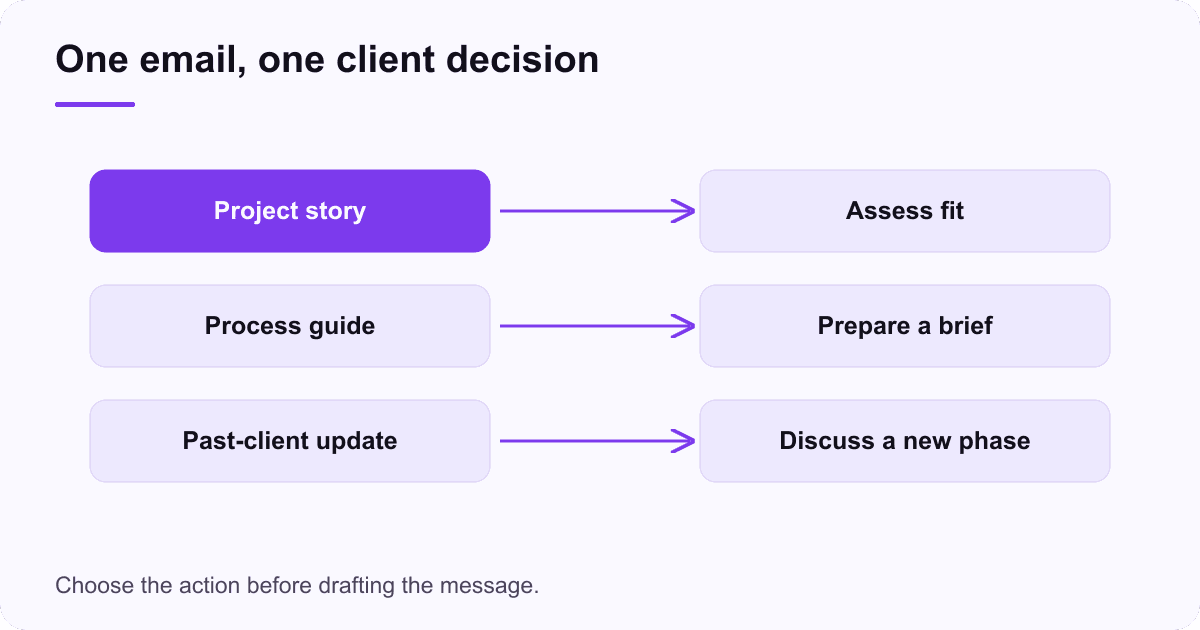
Choose the action before writing the campaign. If the goal is to help a reader assess fit, link to a relevant project or service page. If the goal is a consultation, explain what will happen and what information the form requests. If the goal is feedback from past clients, ask a specific question they can answer easily.
Email idea | What it helps the reader decide | Main action |
|---|---|---|
Project decision story | Does this approach resemble what I need? | View the full project explanation |
Service-scope guide | Which appointment might suit my project? | Read the service details |
Consultation preparation | Am I ready for the first meeting? | Use the preparation checklist |
Material-selection explanation | What should I consider when comparing options? | Read the practical guide |
Past-client update | Is there a relevant next phase to discuss? | Reply with a current brief |
Do not add a competing button for every possible service. A reader who wants to understand one project should not have to choose among a download, a sale, a consultation and a social follow at once. Secondary navigation can exist, but the main reason for the message should remain clear.
Use past-client communication with real context
A past client may have a new need, but the prior project does not prove that another purchase is imminent. Contact them with a relevant update or a thoughtful question based on the relationship. Avoid claiming that their space must be outdated or that a product needs replacing without evidence.
For example, an illustrative note could say: “You mentioned that the meeting area might be reviewed after the first year of use. Has that become a priority, or would you prefer that we leave it for now?” Use that wording only when the client actually discussed the future phase.
A broader past-client newsletter can share a useful maintenance or process topic within the practice's competence, or explain a new service that genuinely exists. Keep the message optional and respect preferences. If a reader asks not to receive it, update the system that controls future sends.
The new-client development guide covers the wider pipeline, including referrals and qualification. Email supports that work; it cannot compensate for an unclear service or a follow-up process that leaves enquiries unanswered.
Record the outcome of a personal reply in the normal client system. Otherwise the next campaign may ignore a conversation the designer already had, creating a repetitive or impersonal experience.
Evaluate enquiries rather than image clicks alone
Image clicks can show interest in a particular example, but the business needs to know whether the campaign created suitable conversations. Define fit before looking at the results: project type, location, scope and timing may all matter. Keep uncertain information as a question rather than a rejection by default.
Suppose an illustrative campaign goes to 180 subscribers. Twelve visit the project page, six enquire and three enquiries match the practice's initial criteria. The visit rate is 12/180, about 6.7%; the enquiry rate is 6/180, about 3.3%; the suitable-enquiry rate is 3/180, about 1.7%.
These are invented numbers for explaining the stages. A page visit is not evidence of a budget, and a suitable enquiry is not a signed project. Track consultations, proposals and appointments separately with a clear reporting period.
Use consistent campaign metrics and retain the actual counts. When a small list moves from one enquiry to two, the percentage increase looks large but the underlying evidence remains small. Review the content of those enquiries before deciding the campaign is reliably better.
If the right people enquire but do not book, inspect the handoff. The booking page may be unclear, the response may be slow or the offered appointment may not answer the question the email raised.
Build a repeatable editorial routine
Keep a small bank of approved project stories, process explanations and client questions. Record image permissions, the person checking accuracy and the date the destination page was reviewed. This reduces last-minute dependence on whatever photograph is easiest to find.
Set a cadence the practice can sustain. Each message needs preparation, approval and reply capacity. A useful monthly or quarterly email is preferable to a schedule that repeatedly sends thin material. Treat those intervals as planning options, not universal performance rules.
For U.S. commercial messages, FTC guidance addresses identification and opt-out requirements. Follow the sending platform's audience rules and the requirements relevant to the actual recipients.
Before the first send, test the complete route on a phone: email, image, destination, form and confirmation. Check that the person handling replies knows what was promised. Afterward, record the questions and outcomes, then choose the next topic from that evidence.
The strongest program helps readers understand the practice before asking them to commit. Make one decision clearer in each message, show relevant work honestly and give the reader an appropriate next step. That creates a useful conversation around design rather than a stream of interchangeable promotional images.